// SORT RESEARCH • LEVEL-0 STRUCTURAL ASSESSMENT FRAMEWORK • sort-research.org

Introducing SORT Research: A Level-0 Structural Assessment Framework

A tour of the public research surface behind the SORT-AI domain — the Supra-Omega Resonance Theory, its public core, four domain modules, the whitepaper series, and a reproducible validation run.

The analyses on this site apply SORT-AI to advanced AI systems. This article steps back to introduce the broader research framework those analyses rest on. SORT — Supra-Omega Resonance Theory — is a Level-0 structural assessment framework published openly at sort-research.org, with whitepapers, reproducible code, DOIs, and a frozen validation package.

Visit SORT Research Public Source Repository Whitepapers & DOIs
SORT Research — A Level-0 Structural Assessment Framework

SORT Research: a Level-0 structural assessment framework for structural consistency, projection behavior, scale coupling, and cross-domain coherence.

22-OPERATOR PUBLIC CORE 4 DOMAIN MODULES 107 APPLICATIONS WHITEPAPER v4–v7 v7 VALIDATION RUN

The Limits of Local Diagnostics

Readers of this site already know the core problem from the AI domain: modern complex systems are increasingly too coupled for component-local diagnostics. Local metrics can remain perfectly healthy while global structure drifts. A system's components each report green, while the composition becomes incoherent.
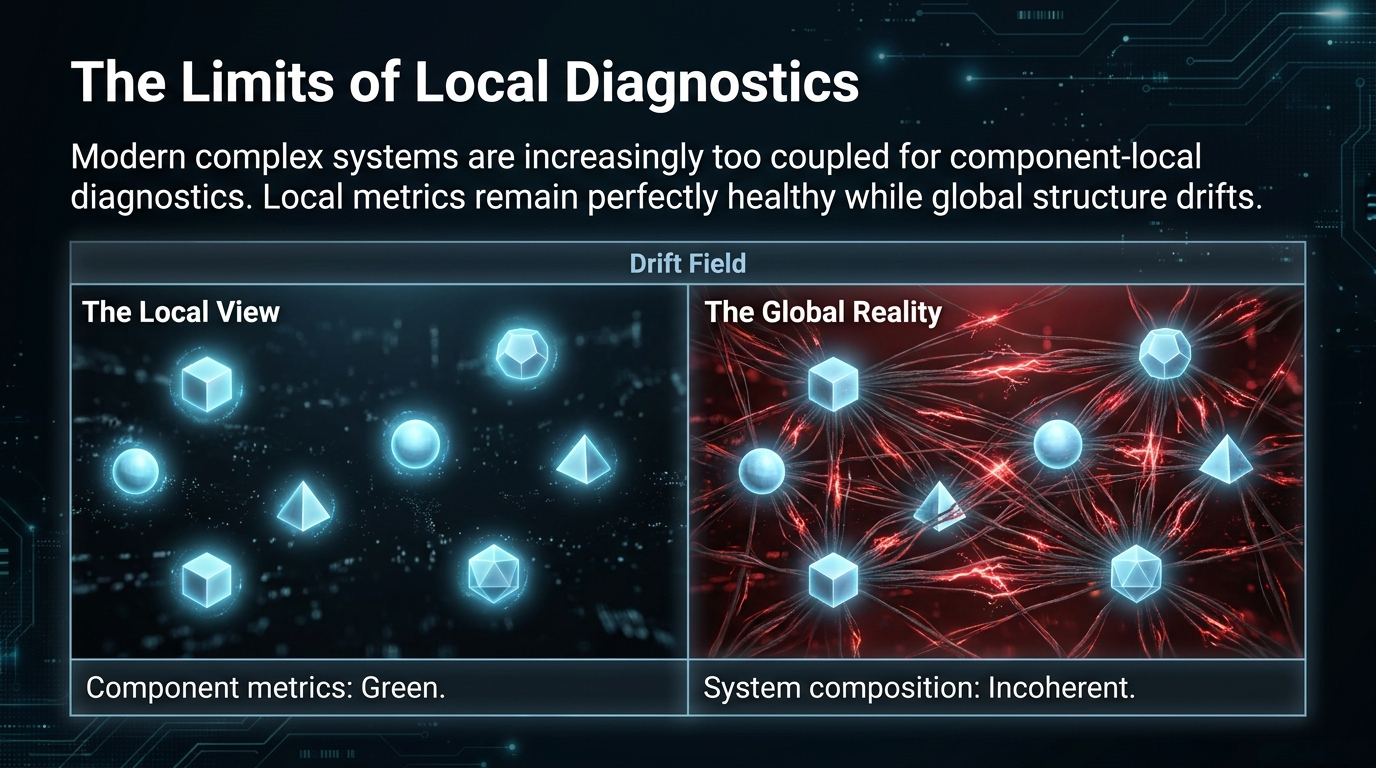
The limits of local diagnostics: component metrics green, system composition incoherent

The local view versus the global reality: component metrics stay green while the composed system drifts into incoherence.

This is not unique to AI. The same structural pattern appears in complex systems, quantum error-correction spaces, and cosmological inference. SORT Research exists to address that shared pattern directly — not by replacing the dynamical models that describe each domain, but by adding a layer that asks whether the resulting structure stays coherent.
The Missing Layer: What "Level-0" Means

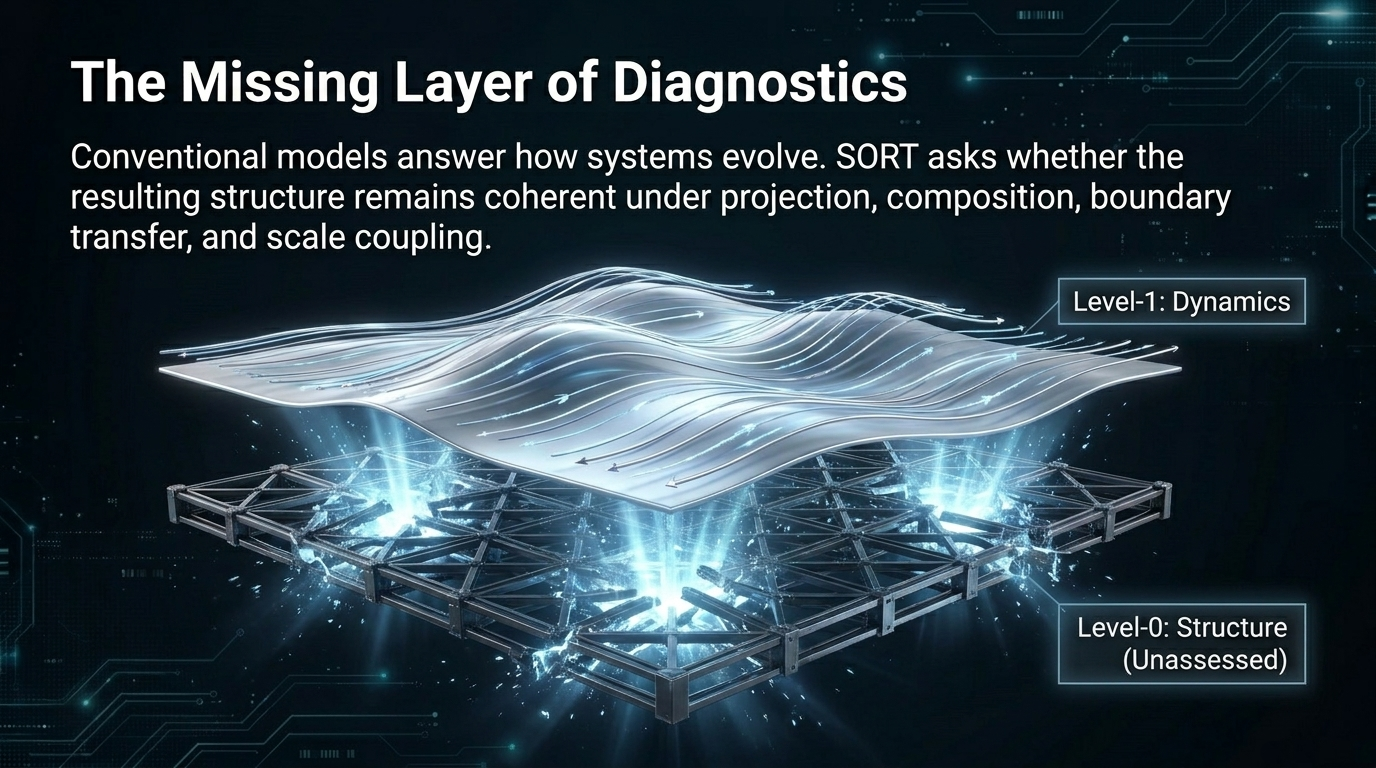
The central idea of SORT is the distinction between two layers of analysis. Conventional models — field equations, benchmarks, simulations, telemetry — answer how a system evolves. SORT asks a different question: whether the resulting structure remains coherent under projection, composition, boundary transfer, and scale coupling.

The missing layer of diagnostics: Level-1 dynamics over Level-0 structure

Level-1 (Dynamics) describes how systems evolve. Level-0 (Structure) asks whether the composition underneath stays coherent — the layer SORT addresses.

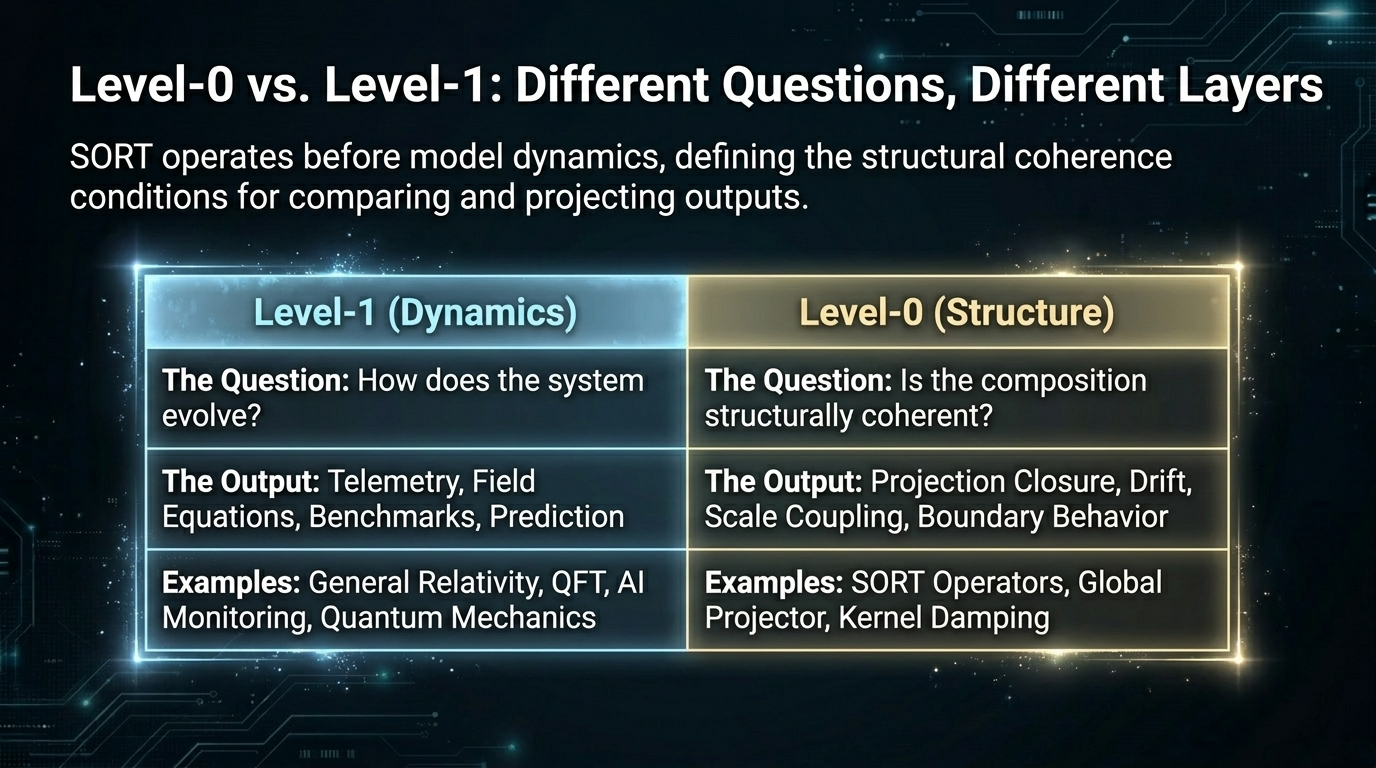
Level-1 (Dynamics) Level-0 (Structure)
Question: How does the system evolve? Question: Is the composition structurally coherent?
Output: Telemetry, field equations, benchmarks, prediction Output: Projection closure, drift, scale coupling, boundary behavior
Examples: General Relativity, QFT, AI monitoring, quantum mechanics Examples: SORT operators, global projector, kernel damping
Level-0 vs Level-1: different questions, different layers

SORT operates before model dynamics, defining the structural coherence conditions for comparing and projecting outputs.

SORT does not predict how a system evolves. It defines whether the structure that evolution produces remains coherent under projection, composition, and scale.

The SORT Public Core

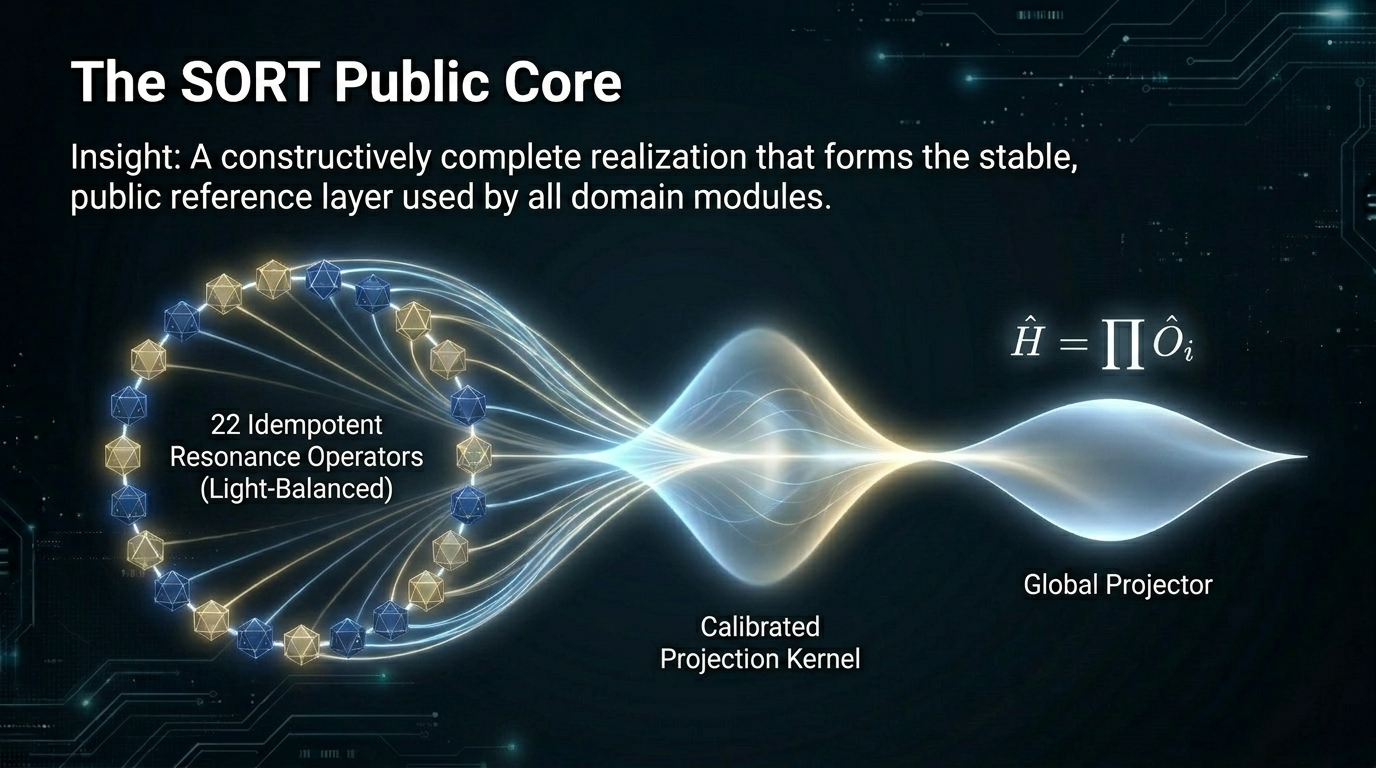
At the center of the framework is a constructively complete public core — the stable reference layer used by every domain module. It consists of 22 idempotent resonance operators (light-balanced), a calibrated projection kernel, and a global projector.

The SORT Public Core: 22 idempotent resonance operators, calibrated projection kernel, global projector

The SORT Public Core: 22 idempotent resonance operators feed a calibrated projection kernel into a global projector — the constructively complete reference layer used by all domain modules.

Three public core objects anchor the mathematics. The 22-operator algebra satisfies a light-balance neutrality condition. The projection kernel κ(k) defines how structural states project across scales. The global projector Ĥ composes these into a single coherence operator:

Ĥ = ∏ Ôi

Σi ci = 0  (light-balance condition)

This core is deliberately public. It forms the frozen reference layer that all domain modules read from. The terminology deliberately replaces particle-, string-, and brane-based metaphors with operatoric and resonant terms — resonance carriers, order contributions, structural equilibrium — expressed through operator closure rather than geometric or field-theoretic language.

Shared Core, Domain-Specific Interpretation

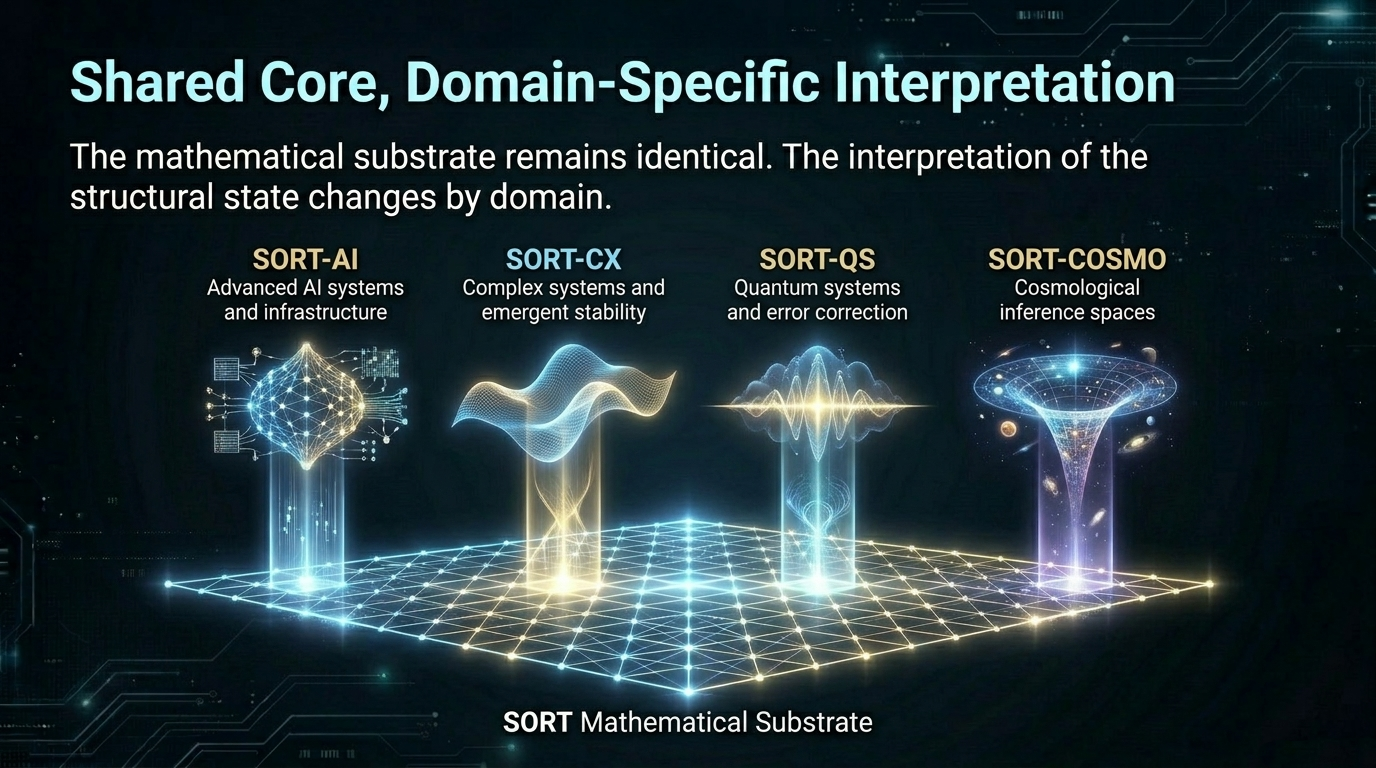
The same mathematical substrate applies across four research domains. What changes between modules is not the mathematics, but the interpretation of the structural state, the coupling surface, the evidence layer, and the domain-specific diagnostic question. The modules are research domains, not collections of use cases.

Shared core, domain-specific interpretation across SORT-AI, SORT-CX, SORT-QS, SORT-COSMO

The mathematical substrate remains identical. The interpretation of the structural state changes by domain: AI systems, complex systems, quantum systems, and cosmological inference spaces.

SORT-AI: The Canonical Domain

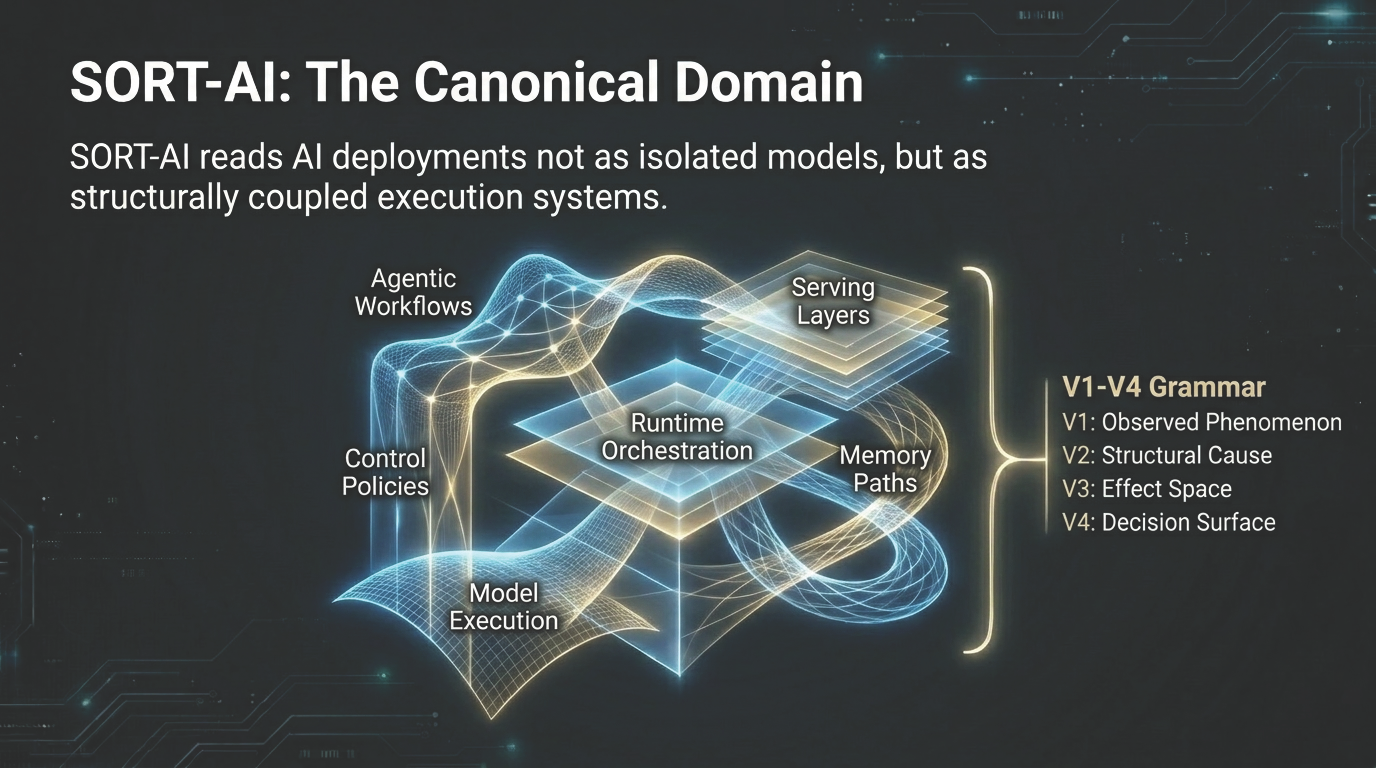
For readers of this site, SORT-AI is the familiar entry point. It reads AI deployments not as isolated models, but as structurally coupled execution systems — model execution, runtime orchestration, control policies, memory paths, serving layers, and agentic workflows — all read through the same V1–V4 grammar.

SORT-AI: the canonical domain reading AI deployments as structurally coupled execution systems

SORT-AI reads AI deployments as structurally coupled execution systems, organized through the V1–V4 grammar: observed phenomenon, structural cause, effect space, decision surface.

The SORT-AI domain currently comprises 52 applications across five clusters. Runtime Control Coherence (AI.04) serves as the canonical example of locally correct mechanisms producing globally incoherent behavior under scale. The companion articles on this site — from The Hidden Structure of Advanced AI Systems to From AI-Fabric Signals to Structural Evidence — develop this domain in depth. The full application catalog is available here.

Why Hyperscale Systems Require Structural Diagnostics

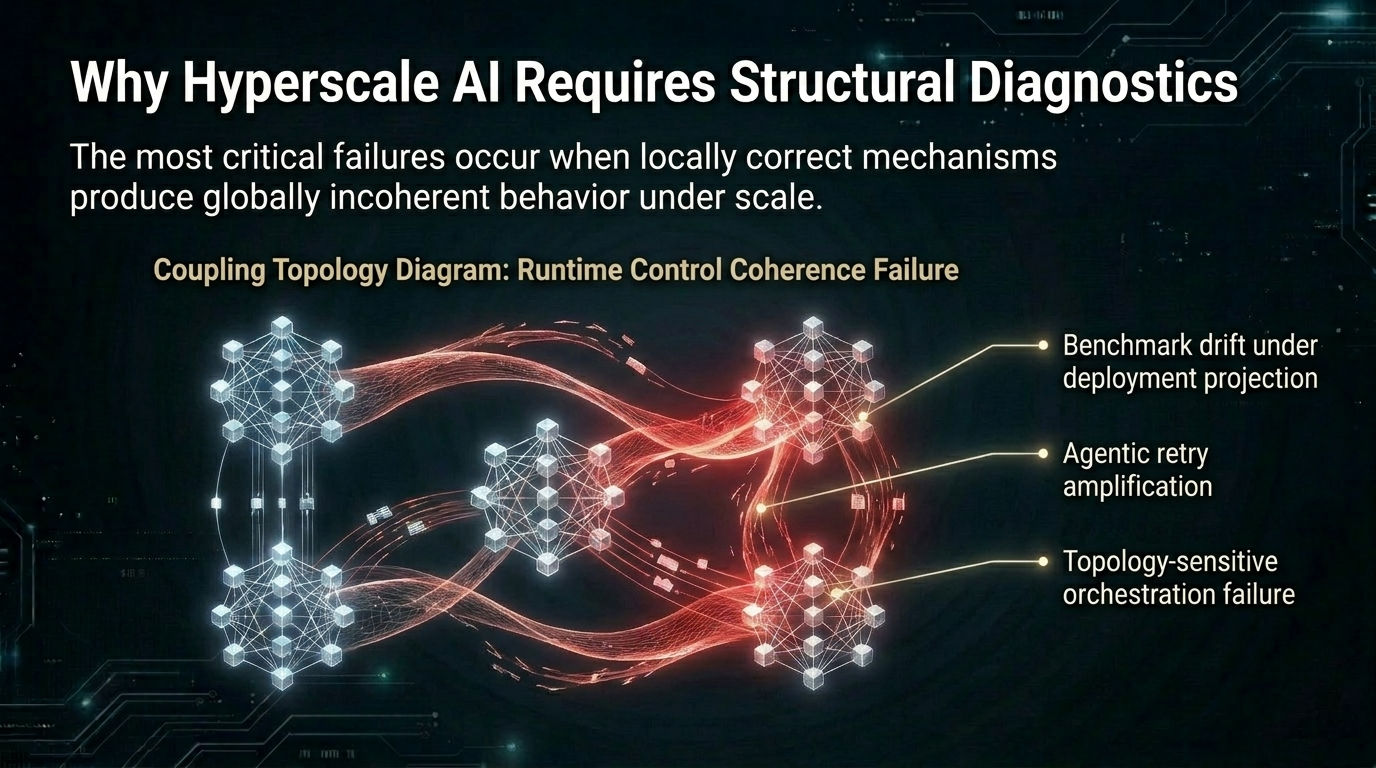
The most critical failures occur when locally correct mechanisms produce globally incoherent behavior under scale. SORT-AI captures three recurrent coupling signatures: benchmark drift under deployment projection, agentic retry amplification, and topology-sensitive orchestration failure.

Why hyperscale AI requires structural diagnostics: coupling topology of runtime control coherence failure

Coupling topology of a runtime control coherence failure: benchmark drift under deployment projection, agentic retry amplification, and topology-sensitive orchestration failure.

These signatures are not bugs in individual components. They are structural conditions that emerge between components, where no single layer's metrics reveal the composed-system behavior. That is exactly the gap the structural assessment layer is built to read.

The Public Research Surface

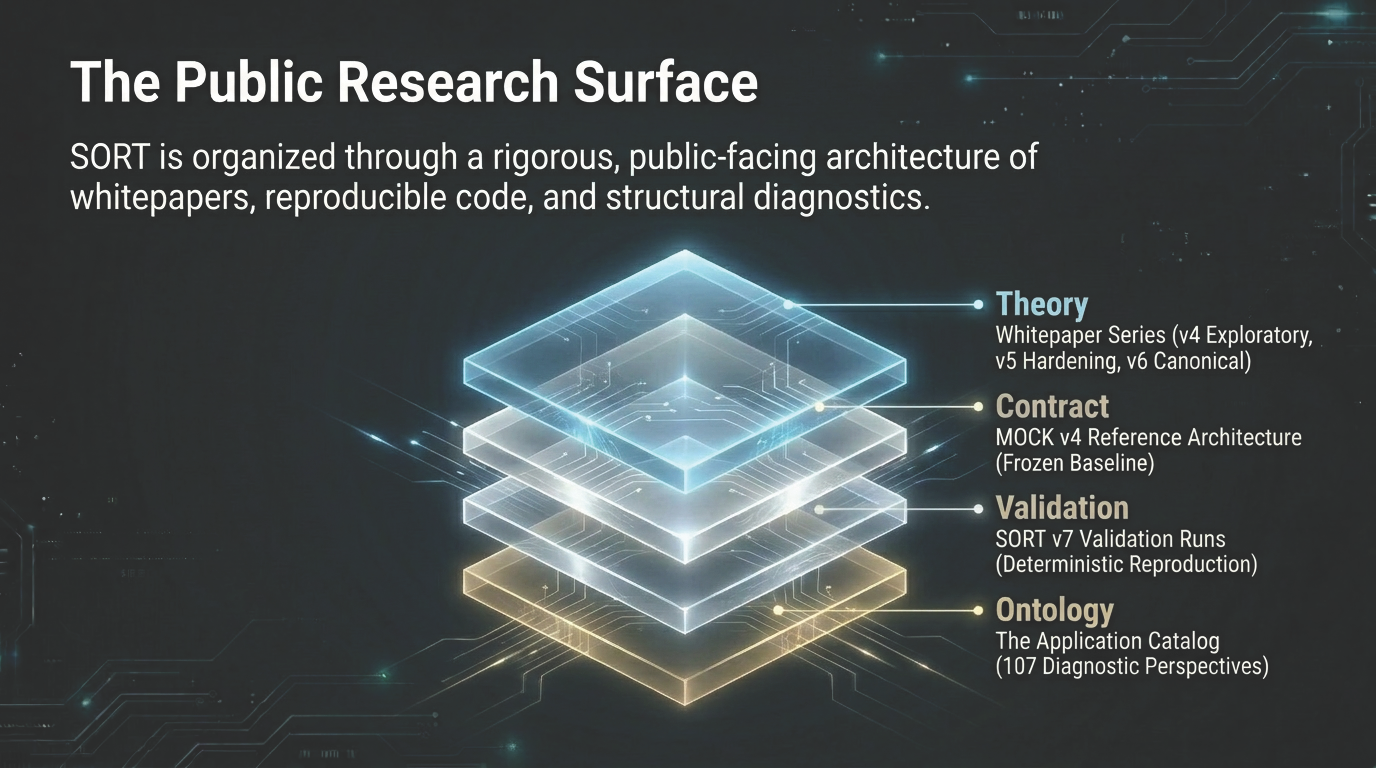
SORT is organized through a rigorous, public-facing architecture of whitepapers, reproducible code, and structural diagnostics. The research surface is layered: a theory layer, a contract layer, a validation layer, and an ontology layer.

The public research surface: theory, contract, validation, ontology layers

The layered public research surface: Whitepaper Series (Theory), MOCK v4 Reference Architecture (Contract), SORT v7 Validation Runs (Validation), and the Application Catalog (Ontology).

Structural Assessment, Not Replacement Theory

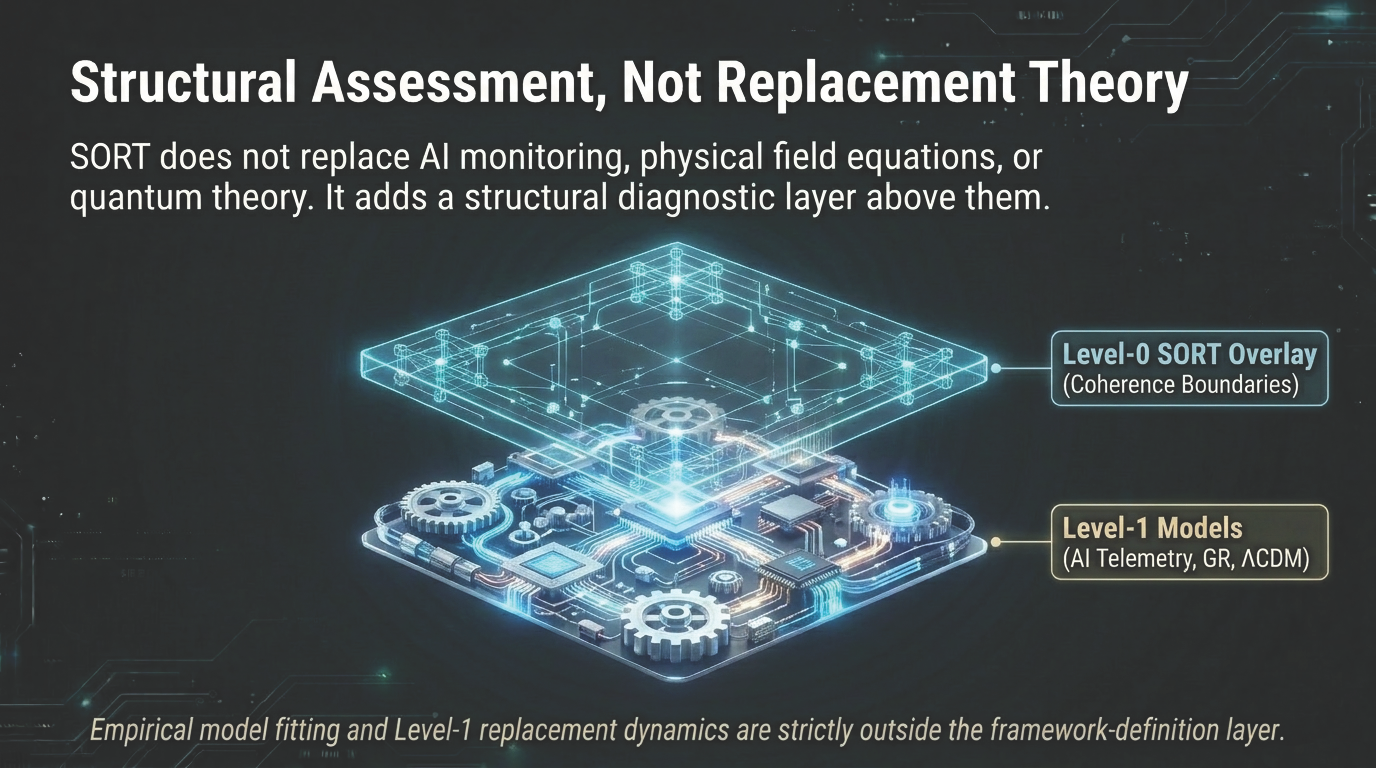
An important boundary: SORT does not replace AI monitoring, physical field equations, or quantum theory. It adds a structural diagnostic layer above them. Empirical model fitting and Level-1 replacement dynamics are strictly outside the framework-definition layer.

Structural assessment, not replacement theory: Level-0 SORT overlay above Level-1 models

The Level-0 SORT overlay defines coherence boundaries above Level-1 models — AI telemetry, General Relativity, ΛCDM — without replacing them.

SORT is not a competing theory of AI, physics, or complex systems. It is a structural diagnostic overlay that becomes informative whenever local models remain valid but cannot account for composition, scale coupling, or systemic coherence by themselves.

This positioning matters for how the work should be read. SORT makes no claim to be a theory of everything, and its public materials are explicit about what it does and does not assert. The Orientation Note exists precisely to define those claim boundaries for reviewers and expert readers.

The SORT Version 7 Workstation Validation Run

The most recent addition to the public surface is the SORT Version 7 Workstation Validation Run — a deterministic Level-0 structural validation sequence for the declared SORT Version 7 operator, projection, kernel, fixed-point, drift, stability, workstation execution, and artifact-freeze chain. It is the empirical groundwork for the upcoming Whitepaper Version 7.

The v7 validation runs are deterministic numerical re-executions of the established SORT core under controlled single-node conditions. They demonstrate numerical stability, reproducibility, convergence under grid refinement, and robustness under perturbation. Importantly, they operate on top of MOCK v4, the final MOCK architecture — they are not a new MOCK version, not a production runtime, and not an HPC execution environment.

Status

Frozen Artifact Package

The first frozen package is documented and archived, prepared for SORT Whitepaper Version 7. It includes the full operator, projection, kernel, fixed-point, drift, stability, and artifact-freeze chain under deterministic reproduction.

Suggested citation: Wegener, G. H. (2026). gregorwegener/SORT: SORT Version 7 Workstation Validation Run — Frozen Artifact Package (sort-v7-workstation-validation-v1.0.0). Zenodo. https://doi.org/10.5281/zenodo.20634212

Reproducibility, MOCK Archives & Validation Evidence

A core commitment of SORT Research is reproducibility. The public source repository, the MOCK archives, and the validation evidence are all openly accessible, with archived DOIs for citation.

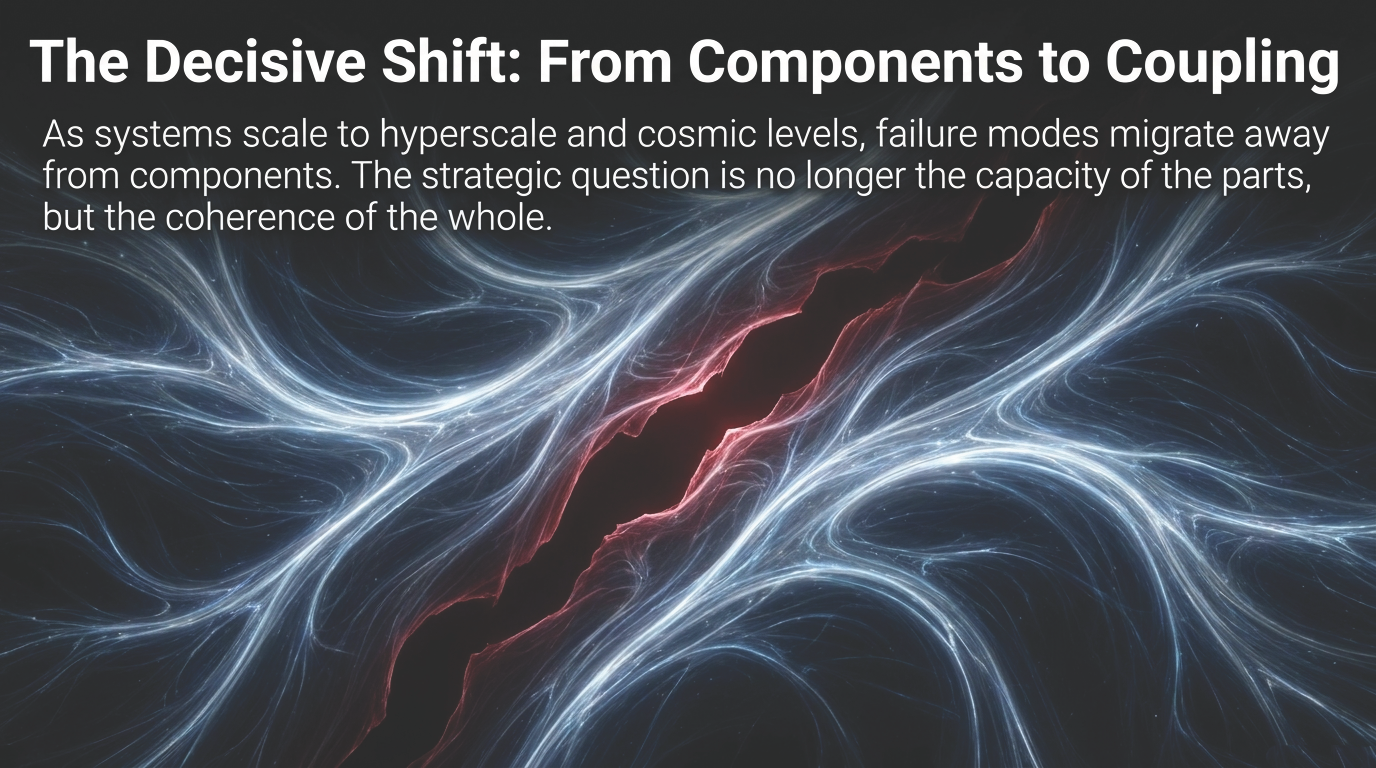
The Decisive Shift: From Components to Coupling

As systems scale to hyperscale and cosmic levels, failure modes migrate away from components. The strategic question is no longer the capacity of the parts, but the coherence of the whole.

The decisive shift: from components to coupling

As systems scale, failure modes migrate away from components. The strategic question becomes the coherence of the whole, not the capacity of the parts.

This is the unifying thread across all four SORT domains. Whether the object is an AI fabric, a complex system, a quantum error-correction space, or a cosmological inference space, the structural question is the same: does the composition remain coherent under projection, composition, boundary transfer, and scale coupling?

The Next Frontier Is Structural Coherence

SORT Research is an open, non-commercial scientific reference layer. It is published transparently, with whitepapers, reproducible code, archived DOIs, and a frozen validation package — so that the framework can be read, inspected, reproduced, and critiqued on its own terms.

The next frontier is not only more compute. It is structural coherence.

The next frontier is not only more compute. It is structural coherence.

The next frontier is not only more compute. It is structural coherence.

If the analyses on this site have shown why AI fabrics need structural diagnostics, SORT Research shows the framework those diagnostics are built on — and how the same Level-0 structural assessment logic extends across AI, complex systems, quantum systems, and cosmology.

Explore SORT Research

Visit the full research surface at sort-research.org — whitepapers, the public core, four domain modules, reproducible archives, and the SORT Version 7 validation run.

Visit SORT Research Public Source Repository v7 Validation Run SORT-AI Catalog