// SORT-AI STRUCTURAL ASSESSMENT • V1–V4 DIAGNOSTIC PROTOCOL • CORE-3 EVIDENCE LINE

From AI-Fabric Signals to Structural Evidence

How SORT-AI Turns Observability Outputs into Assessable Structural Conditions

Modern AI systems do not lack signals. They produce metrics, traces, logs, latency distributions, utilization curves, retry counters, cost surfaces, benchmark results, audit records, and governance artefacts. The harder question is: which of these signals can become structural evidence?

← Read Previous Article Explore Methodology Download Technical Notes
From Signals to Structural Evidence — advanced AI systems lack structural classification, not observability

Advanced AI systems do not lack observability. They lack structural classification. Translating raw hyperscale telemetry into reproducible structural evidence.

SORT-AI STRUCTURAL ASSESSMENT V1–V4 DIAGNOSTIC PROTOCOL CORE-3 EVIDENCE LINE AI FABRICS STRUCTURAL EVIDENCE

AI Systems Do Not Lack Signals

Modern AI infrastructure teams already work with a wide range of diagnostic inputs: throughput, latency, tail behavior, accelerator utilization, memory pressure, queueing effects, scheduler behavior, retry counts, failure rates, routing patterns, cost per output, benchmark results, safety evaluations, audit traces, and deployment records. These signals are necessary. Without them, no serious operational or scientific assessment of an AI system is possible. But they are not sufficient by themselves.
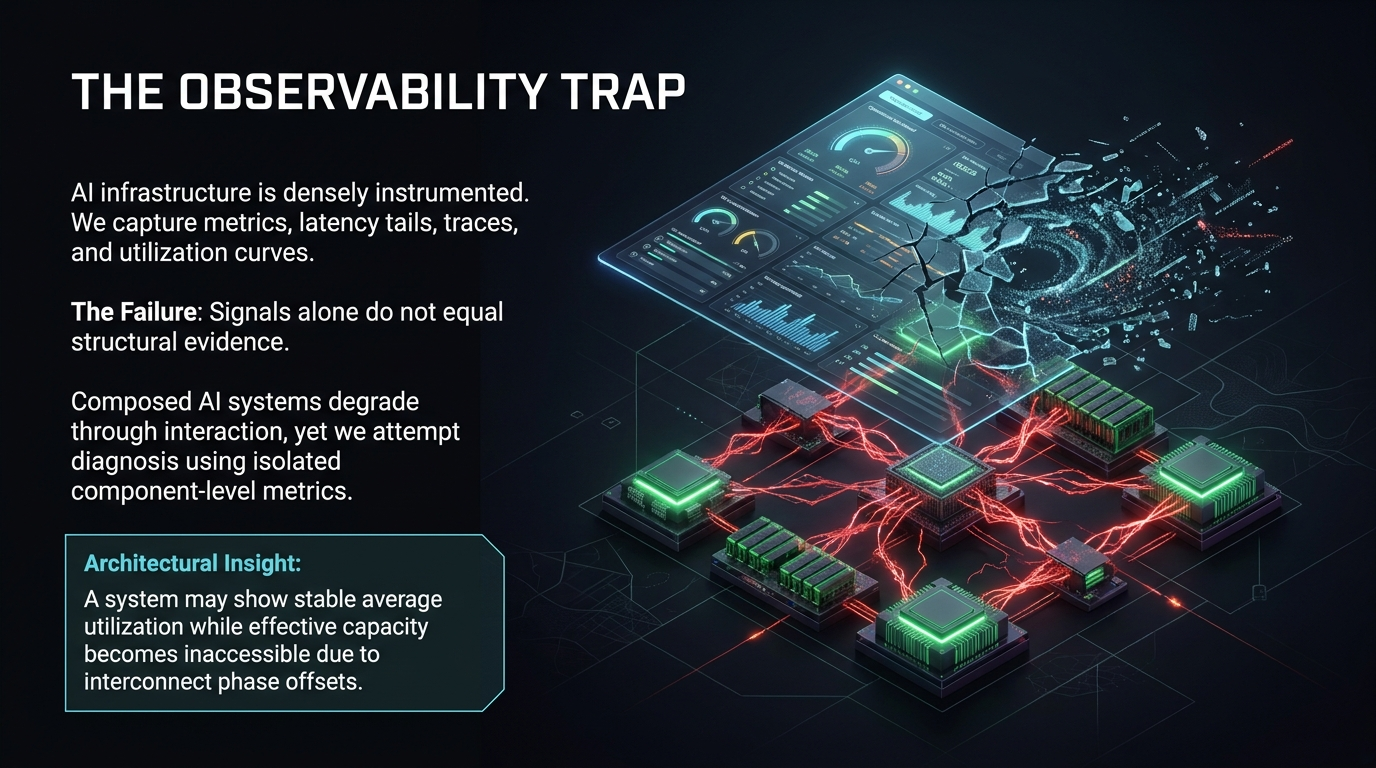
The observability trap: dense instrumentation does not produce structural classification

The observability trap: AI fabrics are densely instrumented, yet dense instrumentation does not automatically produce structural classification.

The reason is structural. Advanced AI systems are no longer isolated model instances. They are composed execution fabrics. Model execution, serving layers, schedulers, orchestrators, memory paths, runtime engines, policy mechanisms, tool chains, agentic workflows, and evidence surfaces interact across multiple layers. Each layer can remain locally functional while the composed system develops behavior that is difficult to explain from any one signal alone.
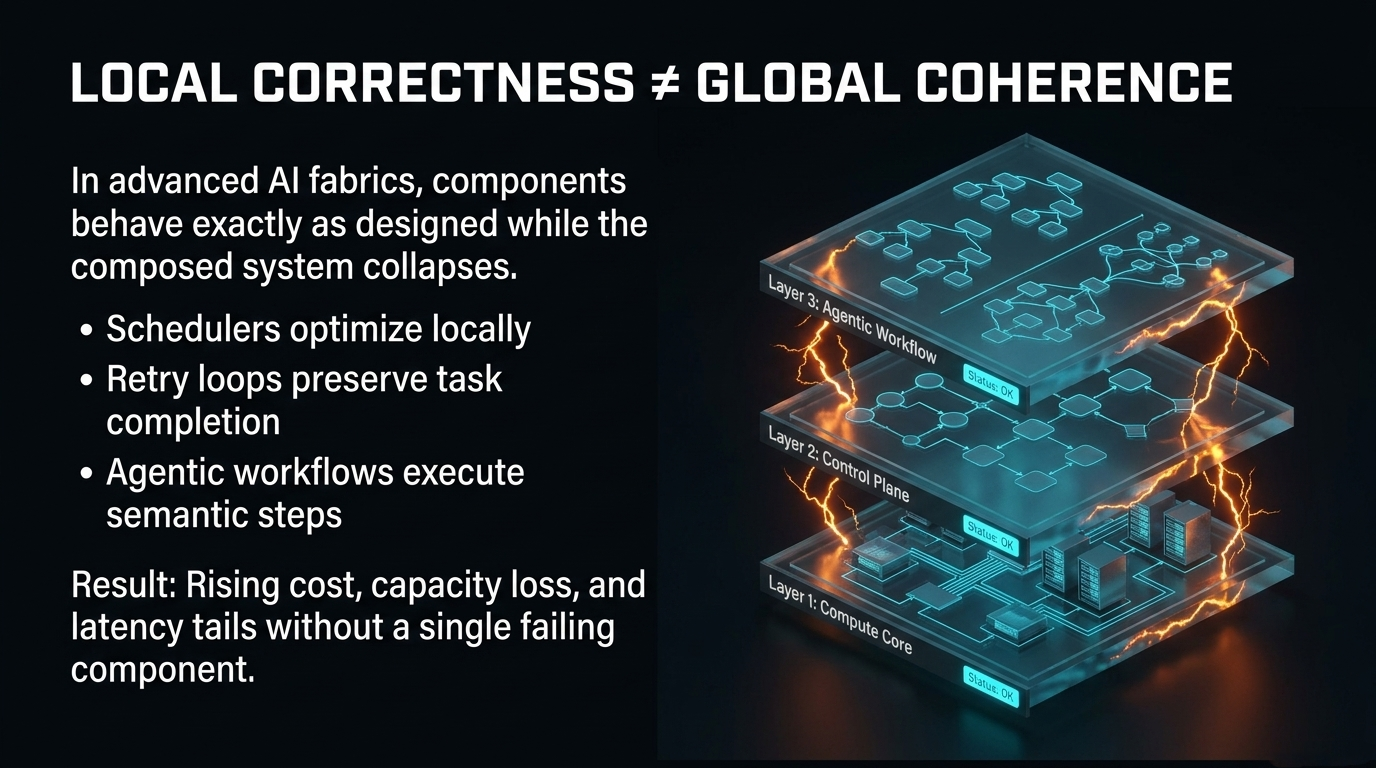
Local correctness does not guarantee global coherence in composed AI systems

Local correctness does not guarantee global coherence. A component can behave as designed while the composed system becomes less predictable.

None of the following patterns necessarily means a component is broken — they indicate that the relevant object of analysis is no longer only the component, but the composed system condition:

Signal vs Structure

Stable utilization, declining effective capacity

A system may show stable average utilization while effective capacity becomes inaccessible. The utilization curve is valid; what it instantiates structurally is not yet classified.

Signal vs Structure

Successful retries, growing effective load

A runtime may complete more requests while consuming a disproportionate retry budget. The retry counter indicates resilience, but it may also conceal cost amplification.

Signal vs Structure

Valid agentic outputs, expanding tool calls

An agentic workflow may produce valid outputs while expanding the number of intermediate tool calls or verification loops. Task completion remains acceptable; the structural class is ambiguous.

Signal vs Structure

Strong benchmark, deployment drift

A benchmark may remain valid within its evaluation boundary while deployment behavior shifts under real runtime, orchestration, memory, policy, or tool-use pressure.

The problem is not missing data. The problem is that signals do not automatically become structural evidence.
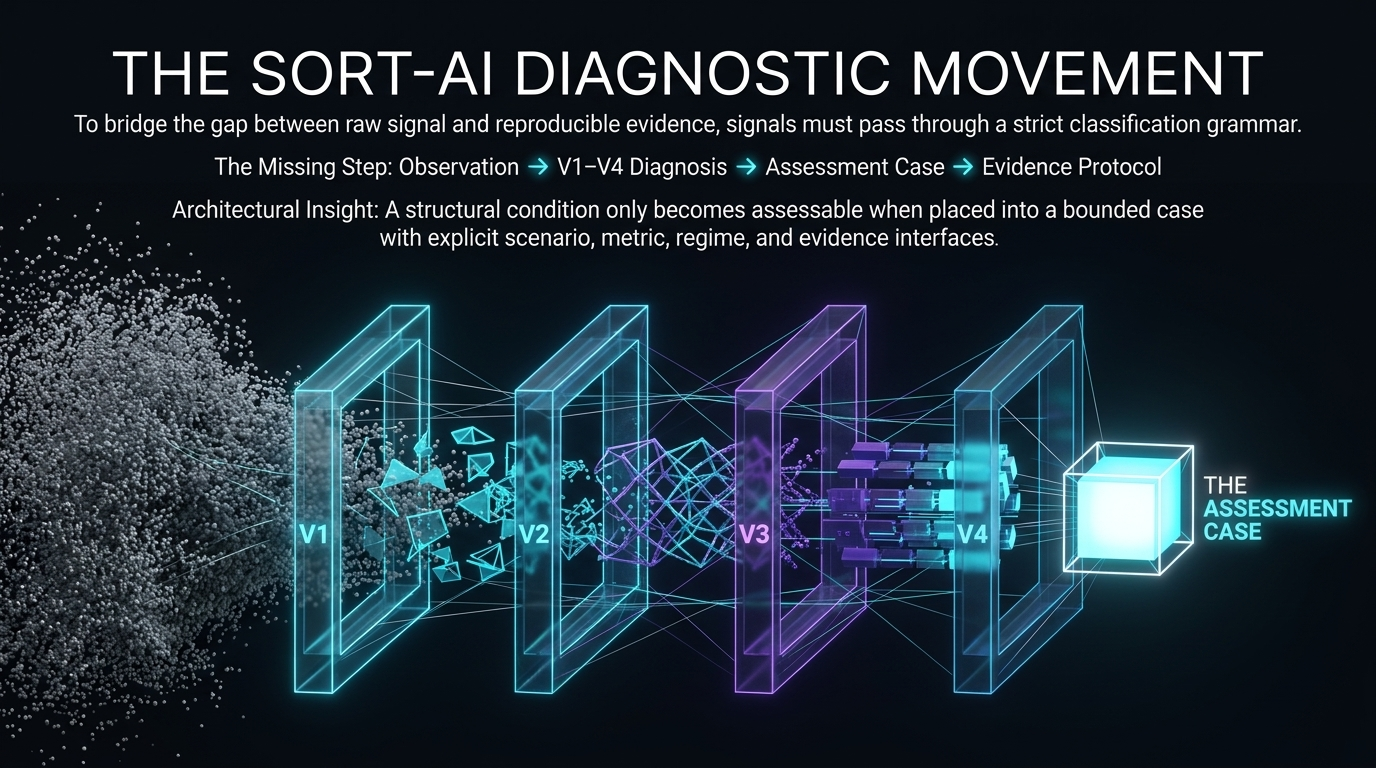
The Missing Step: From Diagnosis to Assessment

The first step is structural diagnosis. It asks what kind of condition is visible in the composed system. It does not stop at the local metric; it asks whether the observed behavior points to a coupling issue, a control issue, a boundary condition, an overlap between problem classes, or an emergent regime that no single component-level explanation captures. But diagnosis alone is not yet enough. The next step is structural assessment.

Step 1

Structural Diagnosis asks

What kind of structural condition is visible? A latency increase may be a local service issue, a memory-path effect, a scheduling artifact, an interconnect symptom, or a runtime-control interaction.

Step 2

Structural Assessment asks

Can this condition be turned into an inspectable, scenario-bound, metric-bound, reproducible assessment case — with an Application identity, a Scenario Class, a Metric Set, a Regime Classification, and an Evidence Interface?

This distinction matters because a structural term is not evidence by itself. Calling a condition "runtime-control incoherence" may be useful as a first diagnosis, but it becomes assessable only when the case is bounded: which Application does it instantiate, which scenario class is being evaluated, which metrics are structurally relevant, is the condition core, boundary, or overlap, and what evidence interface would make the assessment reproducible.

An observed AI-fabric condition becomes structurally assessable only when it can be placed into a bounded diagnostic case with explicit scenario, metric, regime, and evidence interfaces.

Explore Structural Assessment Methodology Diagnosis vs Assessment →

Structural Assessment vs. Telemetry

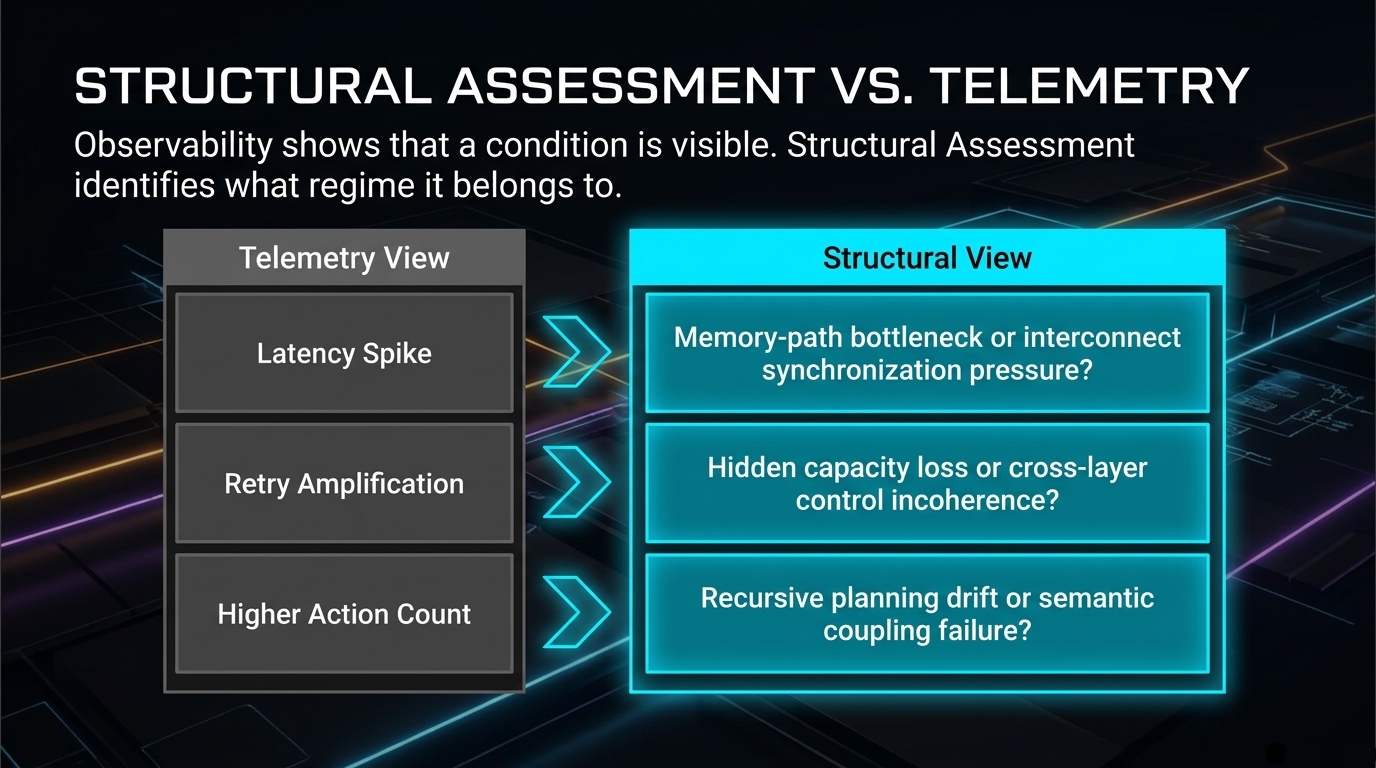
Observability and structural assessment answer different questions. The first establishes that a condition is visible. The second identifies which structural regime that condition belongs to.

Telemetry shows that a condition is visible; structural assessment identifies its regime

Observability shows that a condition is visible. Structural assessment identifies what regime it belongs to.

Telemetry View Structural View
Latency Spike Memory-path bottleneck or interconnect synchronization pressure?
Retry Amplification Hidden capacity loss or cross-layer control incoherence?
Higher Action Count Recursive planning drift or semantic coupling failure?

The same visible signal can belong to different structural regimes. The telemetry value alone does not resolve which one. That resolution is the role of the assessment grammar.

The V1–V4 Diagnostic Movement

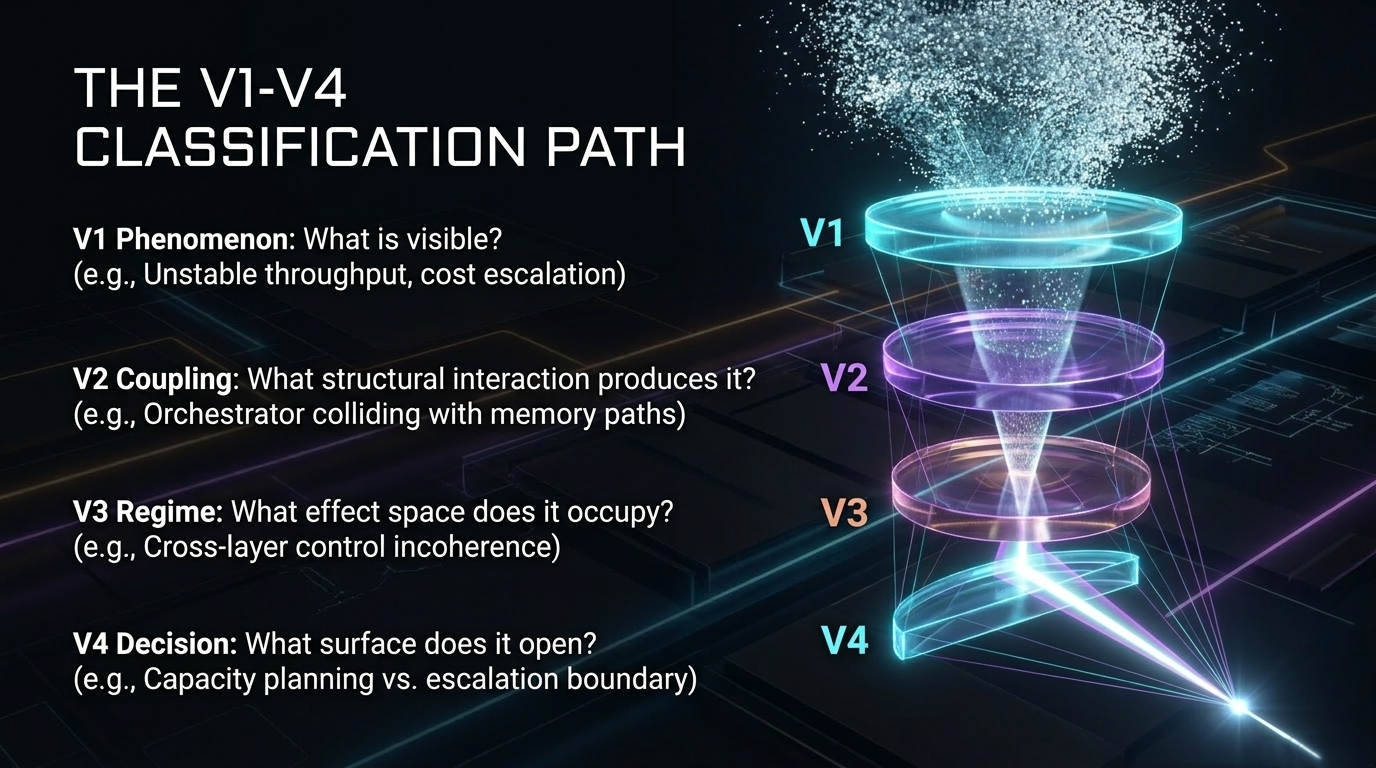
SORT-AI uses V1–V4 as a diagnostic movement. The purpose is not to rename existing observability signals but to order them. Each step changes the question being asked about the system.

The V1 to V4 diagnostic movement from phenomenon to decision surface

V1–V4 as a diagnostic movement: each step changes the question being asked about the composed system.

V1 — Phenomenon

What is visible? The object is the observed phenomenon: rising retry frequency, increasing tail latency, unstable throughput, cost escalation, tool-call amplification, benchmark-to-deployment divergence, or audit evidence that does not reconstruct the actual system condition.

V2 — Coupling

What structural interaction produces it? The question moves from symptom to structure. The relevant cause may lie in interconnect behavior, runtime scheduling, orchestration, memory paths, policy layers, retry logic, agentic planning, tool execution, verification loops, or interaction between these surfaces.

V3 — Regime

What effect space does it occupy? The condition is read as part of a structural regime: capacity loss, control incoherence, semantic drift, boundary occupation, evidence failure, instability amplification, or cross-layer coupling.

V4 — Decision

What decision surface does it open? The assessment becomes decision-relevant — not a prescription or implementation playbook, but a classification of the kind of decision that becomes possible: capacity planning, runtime-control review, escalation threshold analysis, audit reconstruction, risk-prioritization, architecture comparison, or evidence qualification.

A compact V1 to V4 example applied to AI.04 Runtime Control Coherence

A compact worked example: applying the V1–V4 movement to AI.04, Runtime Control Coherence.

Consider AI.04, Runtime Control Coherence. Suppose a system completes tasks successfully, but retry frequency, cost per completion, runtime variance, and capacity-planning error increase. A conventional reading treats these as separate operational signals. SORT-AI reads them as a possible runtime-control coherence condition:

Step AI.04 Reading
V1 Retries preserve task completion, but cost, variance, and attempt amplification rise.
V2 Retry logic, scheduler behavior, runtime policy, orchestration, and capacity allocation interact.
V3 The system enters a runtime-control risk space rather than a simple local failure state.
V4 The decision surface concerns control coherence, capacity planning, retry policy, escalation boundaries, and evidence requirements.

The movement does not claim that SORT-AI has improved the system, optimized it, or identified a specific vendor stack at fault. It performs the structural ordering step. The observed condition becomes a bounded assessment object that can be connected to an Application, a Scenario Class, a Metric Set, a Regime Classification, and an Evidence Interface.

V1–V4 Grammar → Methodology Overview →

Applications as Assessable Regime Spaces

An Application is not a customer use case. It is a recurrent structural problem form.

This distinction matters because many AI-fabric conditions repeat across different technical environments even when the concrete stack, workload, vendor, or implementation differs. A runtime-control problem can appear in different infrastructure contexts. An interconnect-coupling problem can appear across different distributed training or inference architectures. The concrete implementation changes; the structural problem form remains recognizable.

Applications as regime spaces with core, boundary, and overlap conditions

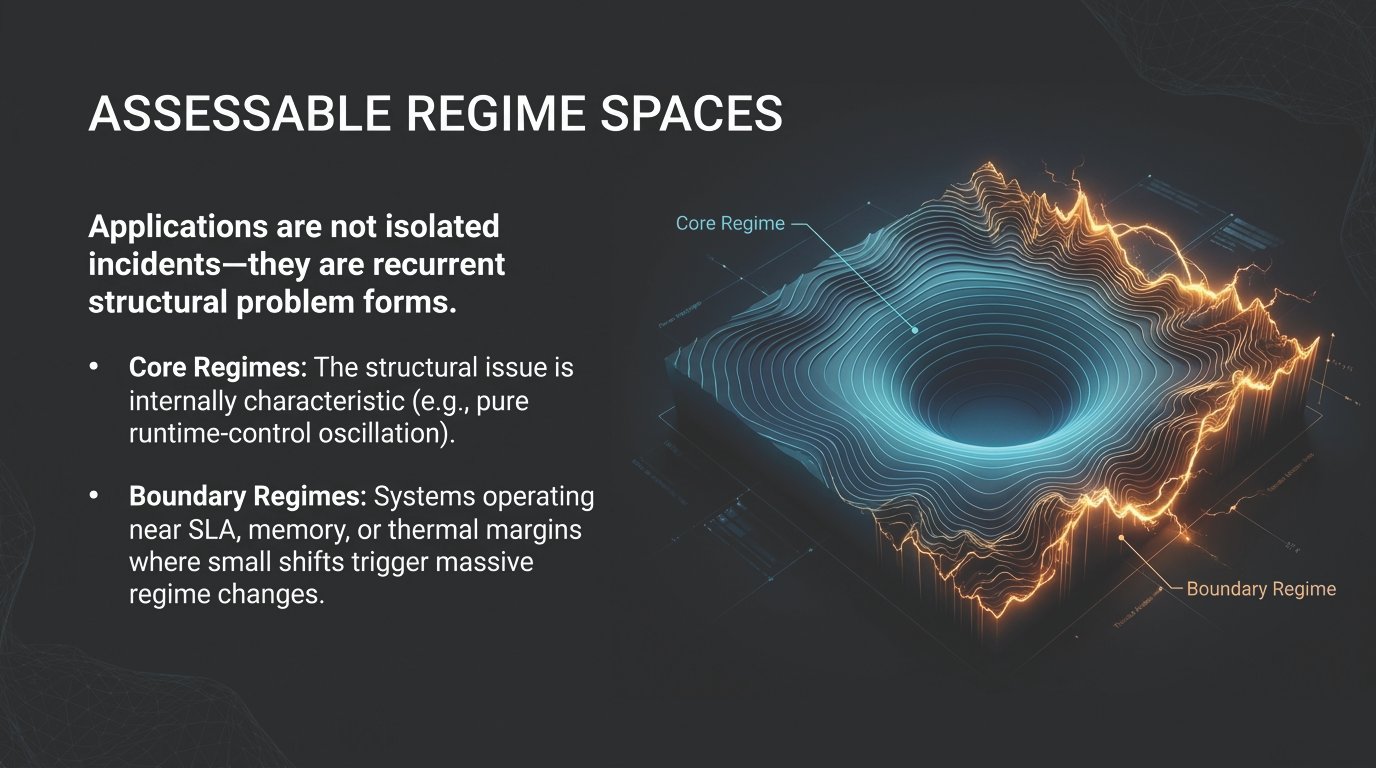
An Application is a regime space: a structured field in which core, boundary, and overlap manifestations of the same structural problem form can appear.

A regime space is a structured field in which different manifestations of the same underlying structural problem appear. Some sit near the center of the Application. Others occur near thresholds, operating margins, or system boundaries. Others arise between Applications, where two structural problem forms interact. This means the Application is not the endpoint of analysis — it is the starting space for structured assessment.

Application → Scenario Class → Metric Set → Regime Classification → Evidence Interface

Each step adds precision. The Application identifies the recurrent structural problem form. The Scenario Class identifies the specific manifestation. The Metric Set identifies which signals are structurally relevant. The Regime Classification determines whether the condition is core, boundary, overlap, drift, or breakdown. The Evidence Interface determines whether the case connects to a reproducible assessment protocol. This chain prevents two errors: overgeneralization (every runtime issue loosely called "control incoherence") and overlocalization (every incident treated as a purely local event).

The Core-3 illustrate the principle across three coupling axes — explore them directly: ai.01 Interconnect Stability, ai.04 Runtime Control Coherence, and ai.13 Agentic System Stability, or browse the full SORT-AI Catalog.

Core, Boundary, and Overlap Regimes

Once an Application is treated as a regime space, the next question is where a particular condition sits inside that space. SORT-AI distinguishes at least three basic regime types.

Regime Type 1

Core Regime — internally characteristic condition

A condition that belongs clearly to one Application. The structural pattern is internally characteristic and does not require another Application to explain its primary form. For AI.04, a core regime may be retry amplification, cross-layer control conflict, or control oscillation.

Regime Type 2

Boundary Regime — threshold / margin / operating-limit condition

A condition that appears near a threshold, margin, or operating limit. The system may still operate, but close to a structural edge where small changes in load, latency, control gain, memory pressure, retry pressure, context saturation, or SLA constraint can shift the regime. Many advanced AI systems degrade before they fail.

Regime Type 3

Overlap Regime — condition produced between Applications

A condition produced between Applications, where no single Application fully explains the observed behavior. The condition emerges from the interaction of two or more structural problem forms — especially important in AI fabrics, where physical, logical, and semantic coupling often interact.

Overlap regimes between Core-3 Applications in advanced AI systems

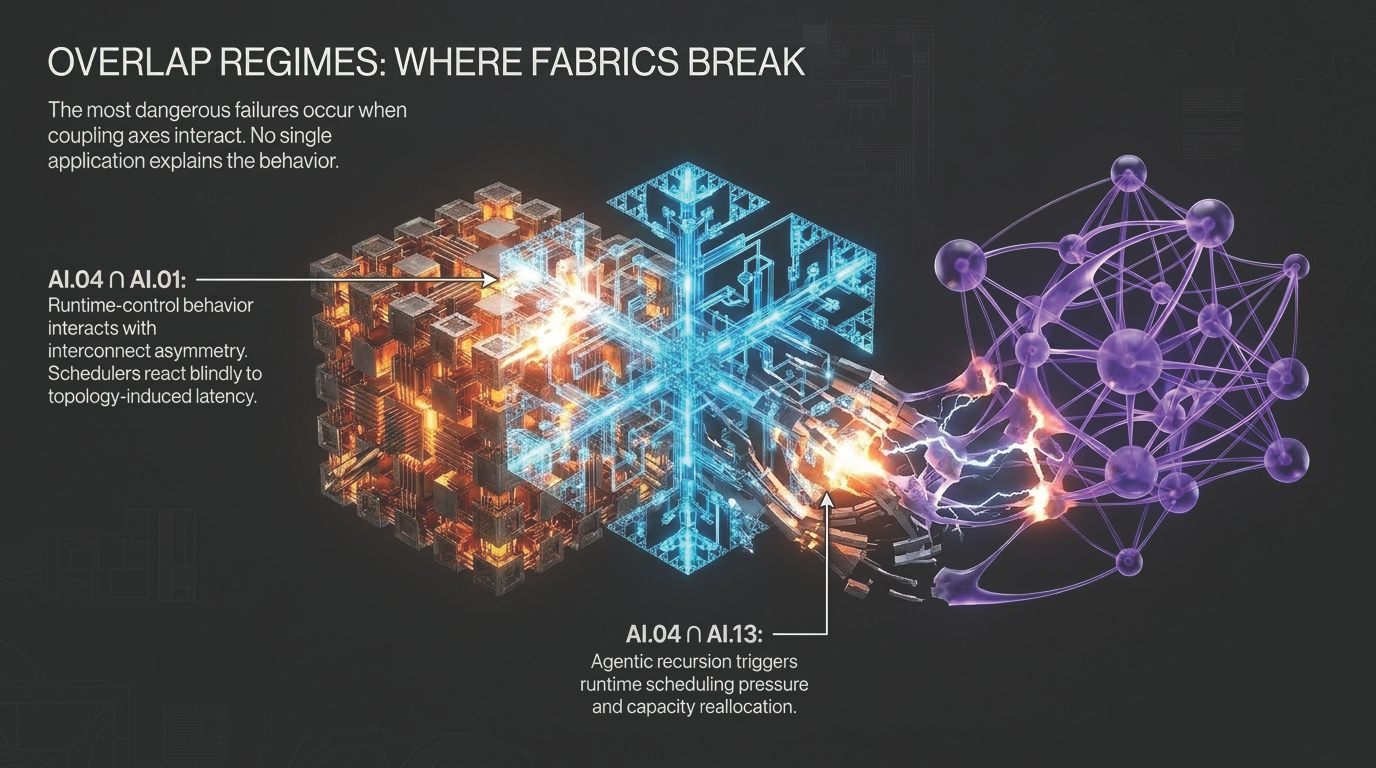
Overlap regimes: where physical, logical, and semantic coupling interact, no single Application fully explains the observed behavior.

The Core-3 provide the most compact example of overlap. Rendered as structural intersections:

AI.04 ∩ AI.01  =  control plus infrastructure coupling

A scheduler may react correctly to local information while interconnect asymmetry, topology-induced capacity loss, latency variance, or synchronization pressure changes the effective control environment. The result is neither purely interconnect instability nor purely runtime-control incoherence.

AI.04 ∩ AI.13  =  control plus agentic execution

An agentic system may increase planning depth, tool-call frequency, retries, or verification loops. Runtime control responds through scheduling, batching, prioritization, escalation, or capacity allocation. The result is a coupled condition between semantic execution and logical control.

Without core, boundary, and overlap classification, structural assessment becomes too coarse. A condition may be assigned to the right general Application but still be misread at the regime level. Retry amplification near an SLA margin is not the same as retry amplification under ordinary load. This is why SORT-AI does not stop at Application identity — it asks whether the condition is a core case, a boundary case, or an overlap case. That question turns the Application from a label into an assessment space.

From Metric Set to Evidence Interface

Once a condition is bounded into a scenario class with a coherent metric set, a further question becomes possible — the evidence question. It is important to state precisely what that question is, and what it is not.

The evidence question is NOT

Did SORT-AI improve a production system?

SORT-AI makes no production-validation claim. It does not assert runtime optimization, benchmark superiority, or vendor-specific deployment results.

The evidence question IS

Can declared risk transitions be represented under a reproducible structural protocol?

The narrower question is whether a declared, bounded risk-transition scenario can be reconstructed deterministically through an inspectable calculation layer.

From metric set to evidence interface via kernel-damping representation

The evidence interface: declared risk transitions represented through a deterministic kernel-damping layer, not a runtime implementation.

The transition from a declared risk vector to its damping representation is expressed through two minimal relations, where ri(0) is the baseline risk mode, ri(1) the transitioned risk mode, and κi the kernel quotient:

κi = ri(1) / ri(0)

ri(1) = κi · ri(0)

This shows the transition from risk vector to damping representation without turning the analysis into a mathematical note. The point is the interface, not the production claim: an Evidence Interface, not a production claim; a deterministic reproducibility layer, not a runtime implementation.

View Kernel-Damping Evidence Protocol Publication Sequence →

The Core-3 Evidence Line

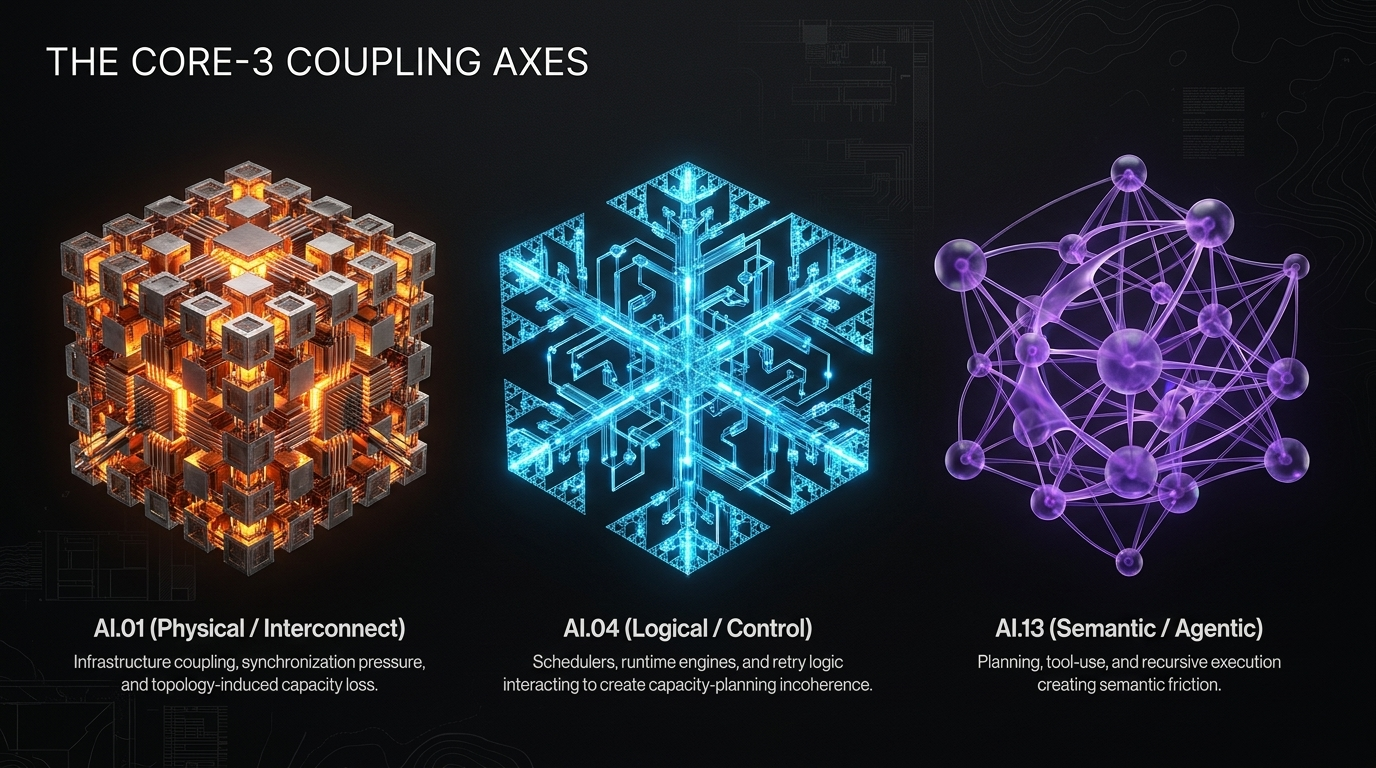
The Core-3 evidence line matters because it tests the structural assessment logic across three different coupling regimes of advanced AI systems. AI.01, AI.04, and AI.13 are not arbitrary examples — they represent three complementary ways in which AI-fabric behavior becomes structurally coupled.

The Core-3 coupling axes: AI.01 physical, AI.04 logical, AI.13 semantic

The Core-3 coupling axes: physical/interconnect (AI.01), logical/control (AI.04), and semantic/agentic (AI.13).

The Core-3 line provides a minimal test of cross-regime applicability. It asks whether the same structural assessment logic can be applied across physical coupling, logical control coupling, and semantic agentic coupling. The point is not that all AI systems reduce to these three Applications — SORT-AI contains a broader application space. The point is that they form a compact methodological baseline covering three major coupling axes difficult to reduce to model-centric evaluation alone.

Together, the Core-3 show that structural assessment can be applied across physical, logical, and semantic coupling regimes in advanced AI systems.

Browse the Full SORT-AI Catalog →

What the Kernel-Damping Evidence Note Shows

The Kernel-Damping Evidence Note is the reproducibility layer behind the Core-3 line. Its purpose is not to claim that SORT-AI has been deployed in a production AI infrastructure. It does not claim vendor-specific telemetry analysis, benchmark superiority, runtime optimization, or production validation. The claim is narrower: declared structural risk-transition scenarios across AI.01, AI.04, and AI.13 can be processed through a deterministic and reproducible evidence protocol.

The protocol starts with declared scenario inputs. These are translated into risk variables. Risk transitions are then evaluated through a kernel-damping representation, producing kernel quotients, implied structure-mode values, scenario-level statistics, dispersion measures, and aggregate summaries. The evidence release contains the machine-readable inputs, scripts, expected outputs, generated outputs, and reproduction manifest required to inspect and repeat the calculation.

Scenario Inputs → Risk Variables → Kernel Quotients → Structure Modes → Scenario Evidence

This does not turn SORT-AI into an observability product. It does not replace system telemetry, prescribe a runtime mechanism, or disclose implementation-specific operator selection, telemetry mapping, scoring, weighting, thresholds, intervention playbooks, or production integration architecture. Instead, it defines an evidence interface. For technical readers, this is the important point: the note does not ask them to accept a production claim — it gives them an inspectable calculation layer.

Why This Matters for AI Fabric Teams

For hyperscaler infrastructure teams, AI platform teams, frontier AI labs, enterprise AI governance teams, AI infrastructure architects, and distinguished engineers, the practical challenge is rarely a complete absence of signals. Most advanced AI environments already contain observability stacks, tracing systems, runtime metrics, cost dashboards, benchmark reports, incident histories, audit trails, and governance records. These tools are necessary — but they usually answer different questions.

A team may know that latency increased, retries expanded, utilization stayed stable, cost per output rose, and task completion remained acceptable. The harder question is what this combination means structurally. SORT-AI gives AI fabric teams a way to ask:

Structural Question Why It Matters
Is this a core regime, a boundary regime, or an overlap regime? The same signal may require different interpretation depending on where it sits structurally.
Which Application does the condition instantiate? The issue may belong to interconnect coupling, runtime control, agentic execution, evidence failure, or another structural problem form.
Which metric set is structurally coherent? Not every available metric belongs to the assessment case.
Does the observed transition connect to reproducible evidence? A structural diagnosis becomes stronger when it can be inspected and reconstructed.
Is the issue local, coupled, or emergent across layers? Local fixes may not address coupled-system behavior.

SORT-AI does not replace the tools engineers already use. It provides the missing assessment grammar between signals and structural evidence.

Methodology Pages

The structural assessment layer described in this article is documented across three connected methodology pages. They define the public analysis layer, the assessment protocol, and the reproducible evidence protocol.

Research Line / Publication Sequence

The methodology is organized across three linked research artefacts. The Domain Paper defines the canonical domain architecture; the V1–V4 Diagnostic Protocol formalizes how an observed condition becomes a structurally assessable case; the Kernel-Damping Evidence Protocol defines how selected declared risk-transition cases can be reproduced mathematically as analysis-layer evidence.

Domain Paper → V1–V4 Diagnostic Protocol → Kernel-Damping Evidence Protocol

Core Applications Referenced in This Article

Additional Resources

From Observation to Structural Evidence

Advanced AI systems do not only need more monitoring. They need a way to determine which observations can become assessable structural conditions. The next stage of AI infrastructure will not be defined only by larger models, faster accelerators, higher throughput, or more detailed observability. It will also depend on whether teams can interpret composed-system behavior across physical infrastructure, runtime control, agentic execution, and evidence surfaces.

From observation to structural evidence: the disciplined assessment path

The disciplined path: Signal → Structural Phenomenon → Assessment Case → Evidence Interface.

This is the role of structural assessment. It does not claim that every signal is meaningful, that every anomaly belongs to a new structural class, or that reproducible evidence replaces engineering judgment. It provides a disciplined path. The Structural Assessment Protocol defines how observed AI-fabric behavior becomes bounded assessment cases. The Kernel-Damping Evidence Protocol shows how declared structural risk transitions across the Core-3 can be processed through a deterministic reproducibility layer. Together, they move SORT-AI from structural vocabulary toward structural assessment.

The next step for AI infrastructure is not only to observe more. It is to know which observations can become structural evidence.

If Your AI Fabric Produces Signals but Remains Structurally Ambiguous

If your AI fabric already produces signals but still remains structurally ambiguous, the next problem is not observability volume. It is structural classification.

← Read Previous Article Explore SORT-AI Methodology Explore Core Applications View Kernel-Damping Evidence Protocol