// DOMAIN-LEVEL TECHNICAL NOTE • SORT-AI DOMAIN ARCHITECTURE

The Hidden Structure of Advanced AI Systems: Why AI Fabrics Need Structural Diagnostics Beyond Model-Centric Evaluation

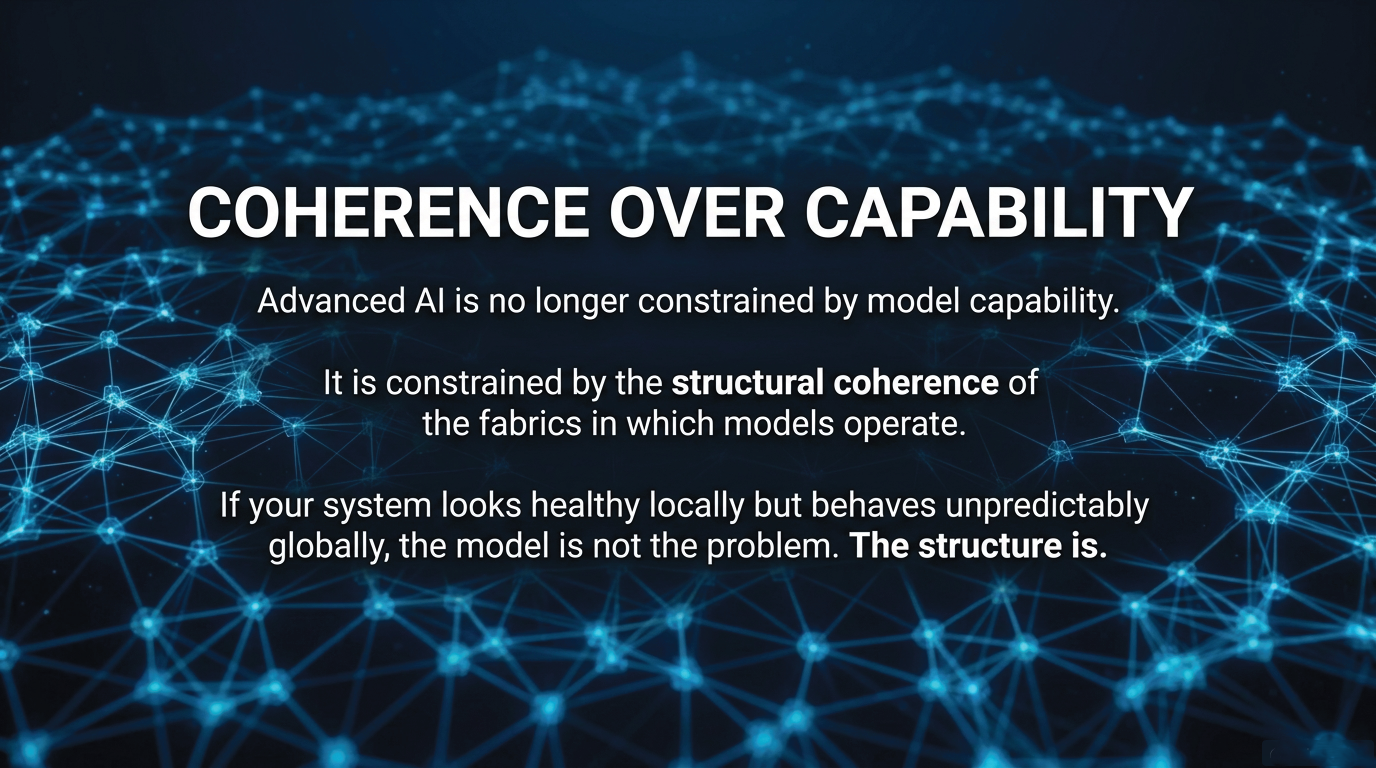
Advanced AI systems are still frequently evaluated through model-centric lenses. Benchmarks, throughput, accelerator utilization, latency, error rates, and local observability signals remain necessary indicators. They become insufficient once the operationally relevant behavior of the system emerges from structural composition rather than from any single component. The model is no longer the system. The AI fabric is.

Download Technical Note Explore Diagnostic Demonstrations SORT-AI Catalog
The Hidden Structure of Advanced AI Systems – SORT-AI as structural diagnostic framework for AI fabrics

SORT-AI as the structural diagnostic framework for advanced AI systems: from model-centric evaluation to AI fabric coherence.

What SORT-AI Is, and Why AI Fabrics Need It

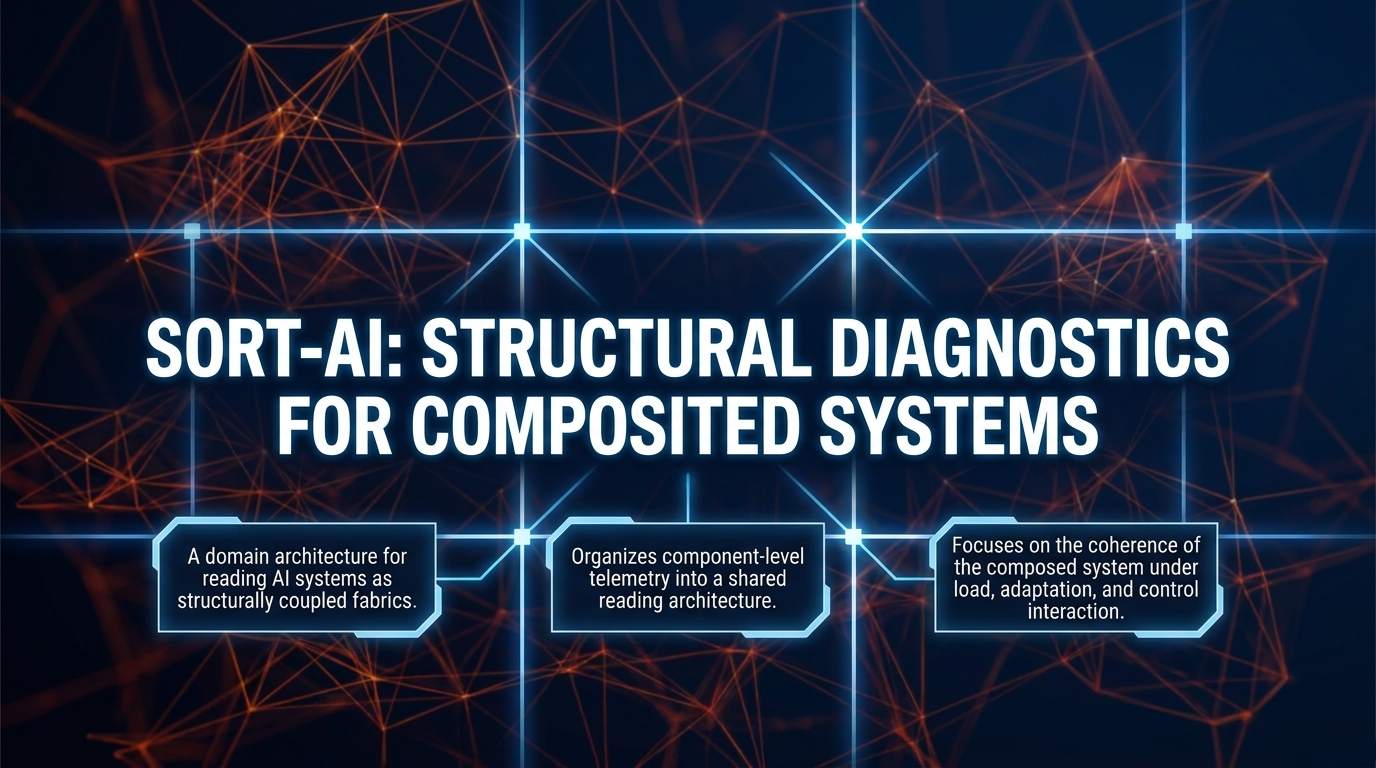
SORT-AI is a structural diagnostic framework for AI fabrics. It gives signals from benchmarks, tracing, observability, runtime monitoring, and governance one structural vocabulary.

The relevant object of analysis is no longer the isolated model. A modern advanced AI system is a composed structure spanning model execution, serving layers, runtimes, schedulers, orchestrators, control planes, policy-enforcement mechanisms, tool chains, memory paths, deployment boundaries, and evidence surfaces. Each of these layers may remain locally functional while the composed system develops behavior that is not visible in any one layer.

SORT-AI is not an observability platform, a scheduler, a benchmark suite, a runtime stack, a governance tool, or a replacement for existing diagnostic practice. It does not introduce new AI algorithms, runtime mechanisms, physical laws, degrees of freedom, or empirical parameters. Instead, it provides a reading architecture for composed systems whose behavior depends on coupling, control interaction, temporal adaptation, emergent coordination, and evidence requirements.

Standard diagnostics ask whether components operate within expected local parameters. SORT-AI asks a different question: whether the composed system remains structurally coherent when locally correct components interact across runtime, control, deployment, adaptation, and evidence surfaces.
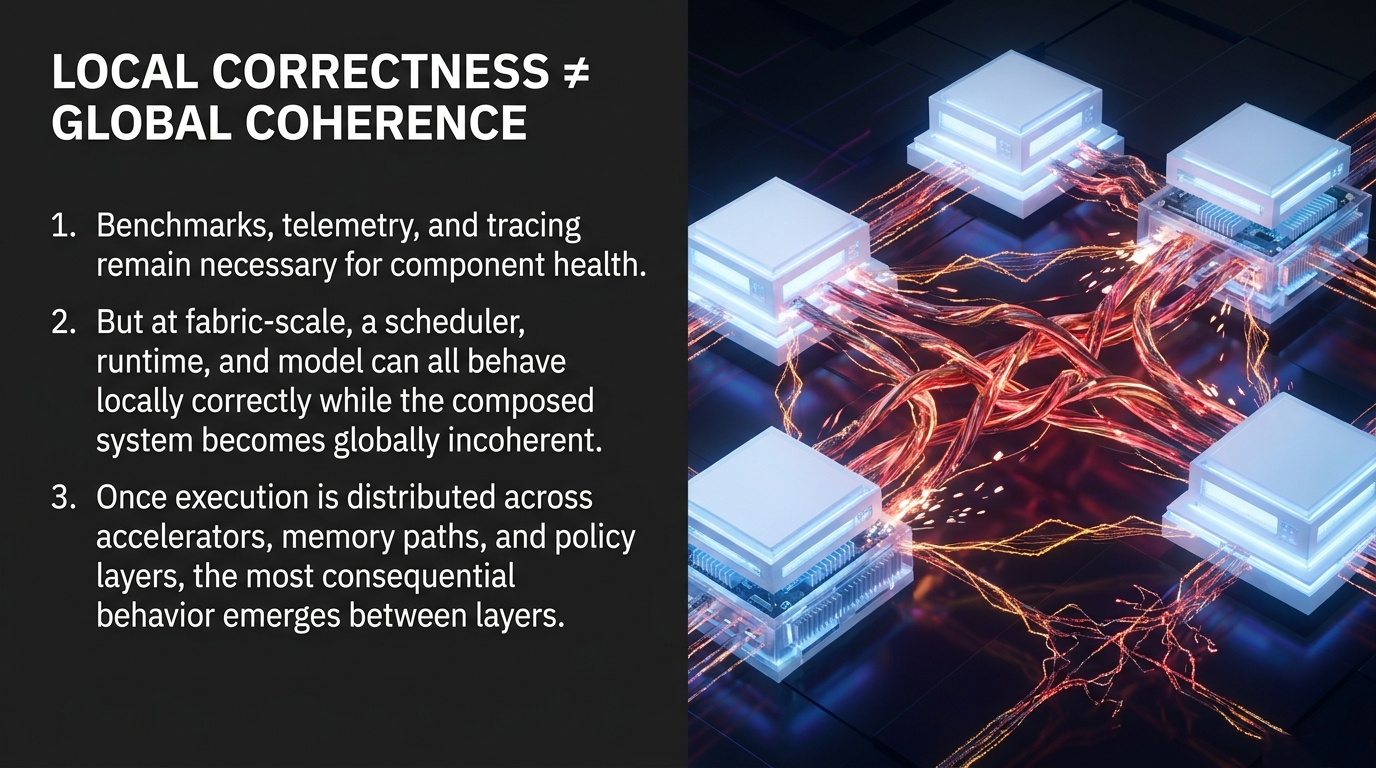
Local correctness does not imply global coherence in distributed AI fabrics

Local correctness does not imply global coherence once execution is distributed across AI fabrics.
The Structural Gap

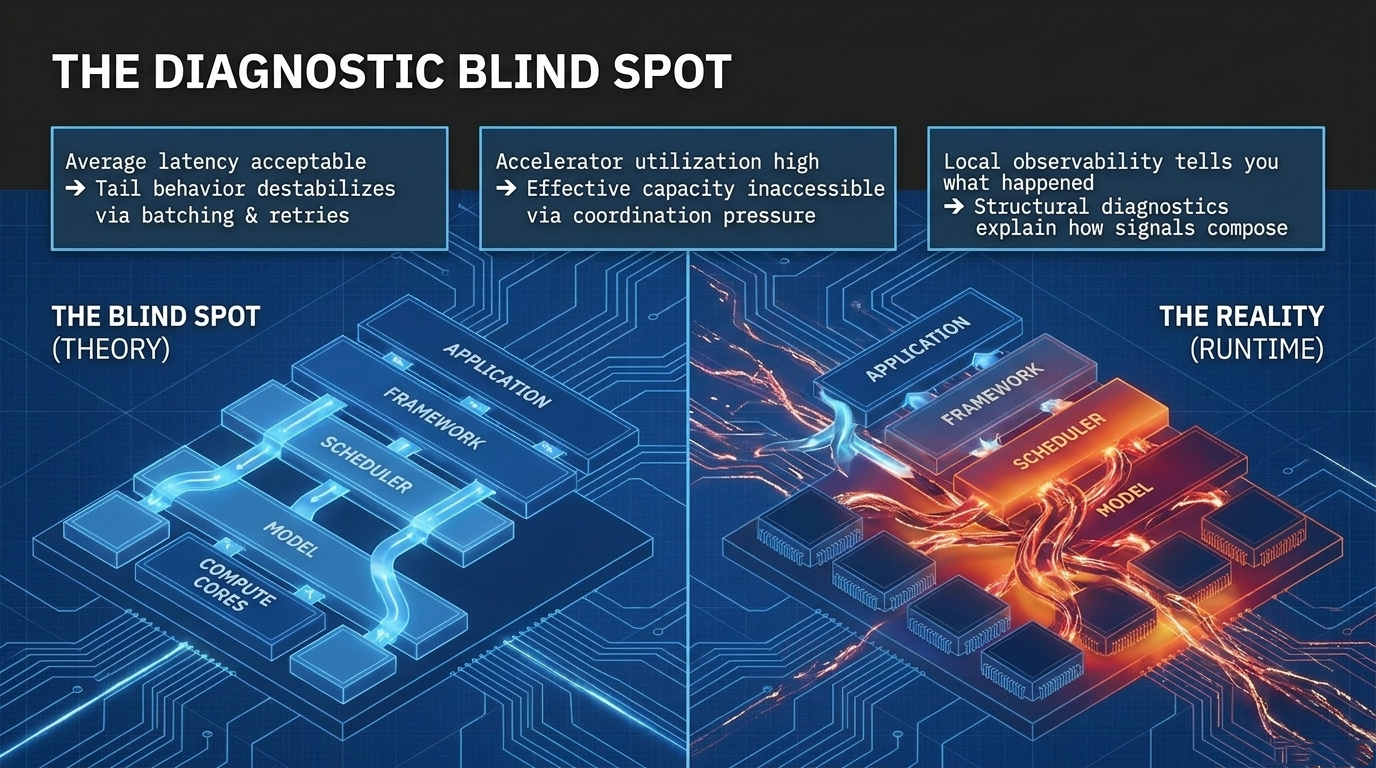
Conventional indicators measure components. Structural behavior measures composition. Between them lies a gap that local metrics cannot close:

The structural gap between local metrics and composed system behavior

Local signals remain valid. They are not sufficient to read composed system behavior.

Benchmark Signal

Strong scores, drifting deployment

Models perform within evaluation boundaries while deployment behavior diverges through runtime scheduling, memory pressure, tool use, and context conditions. Benchmark stability is not equivalent to deployment coherence.

Utilization Signal

High utilization, lower effective capacity

Accelerators report nominal busy time while interconnect dependencies, batching behavior, retry mechanisms, and scheduler interactions absorb a growing share of resources. Nominal capacity diverges from effective capacity.

Latency Signal

Stable means, unstable tails

Average latency remains within bounds while tail behavior becomes structurally unstable. Control responses shift execution pressure into long-tail behavior rather than resolving the underlying condition.

Error Signal

Successful retries, hidden execution volume

Retry mechanisms stabilize visible success rates while increasing effective load. Retries trigger additional planning steps, tool calls, context updates, validation loops, or delegated subtasks. Success and effective execution burden diverge.

The Four Structural Paradoxes of Advanced AI

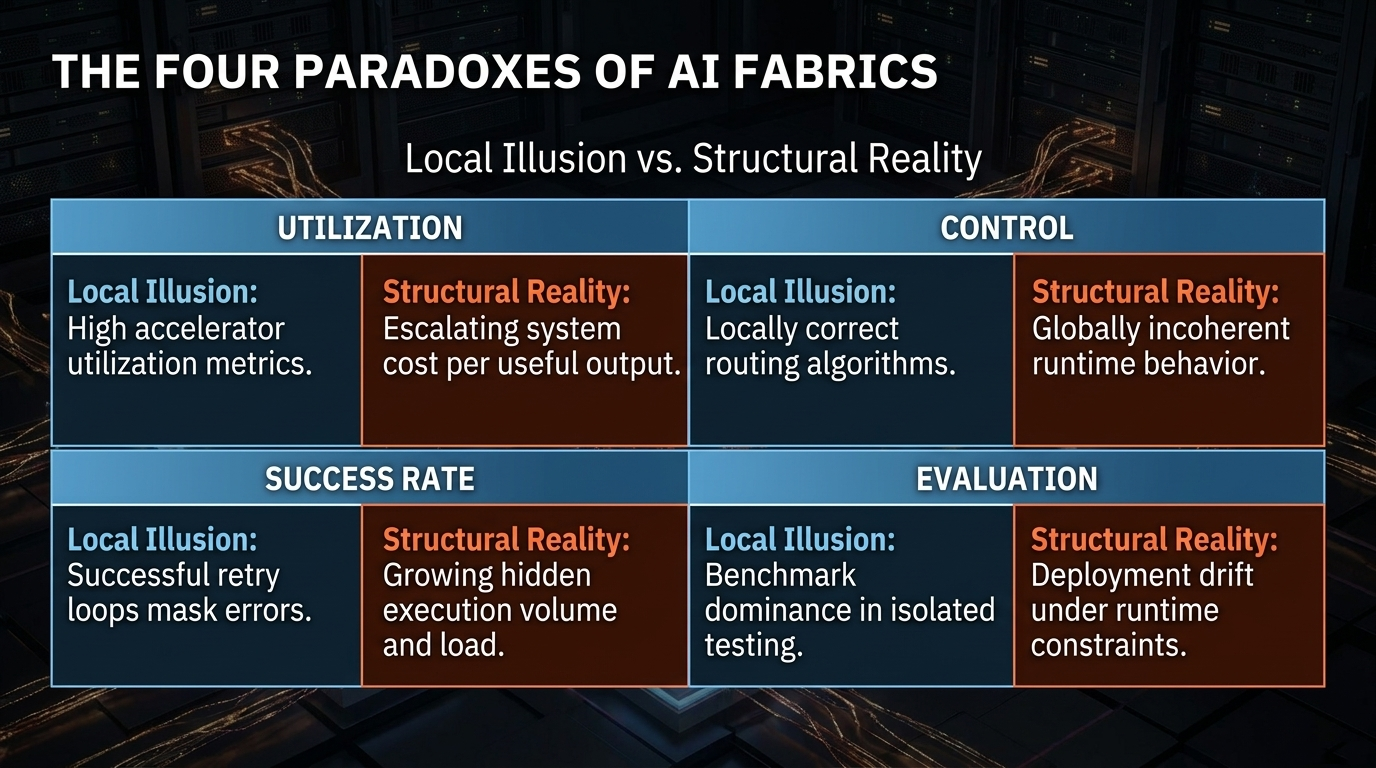
The shift from component-local analysis to structural diagnosis becomes visible through four recurring paradoxes. They are not failures or evidence of poor engineering. They are structurally meaningful signatures of composed systems in which local indicators remain valid while aggregate behavior becomes difficult to explain through those indicators alone.

The four structural paradoxes of advanced AI

Four paradoxes: each identifies a condition in which the diagnostic object has shifted from the component to the interaction surface between components.

Paradox 1 — Coupling / Control

Good Local Metrics, Escalating System Cost

Component-local indicators remain within nominal ranges while system-level cost per useful output continues to rise. Coupling and control redistribute pressure across the system in ways that local metrics cannot resolve. The system is judged locally; the economic burden is generated structurally. This is the structural domain of ai.01 Interconnect Stability.

Paradox 2 — Control

Locally Correct Control, Globally Incoherent Behavior

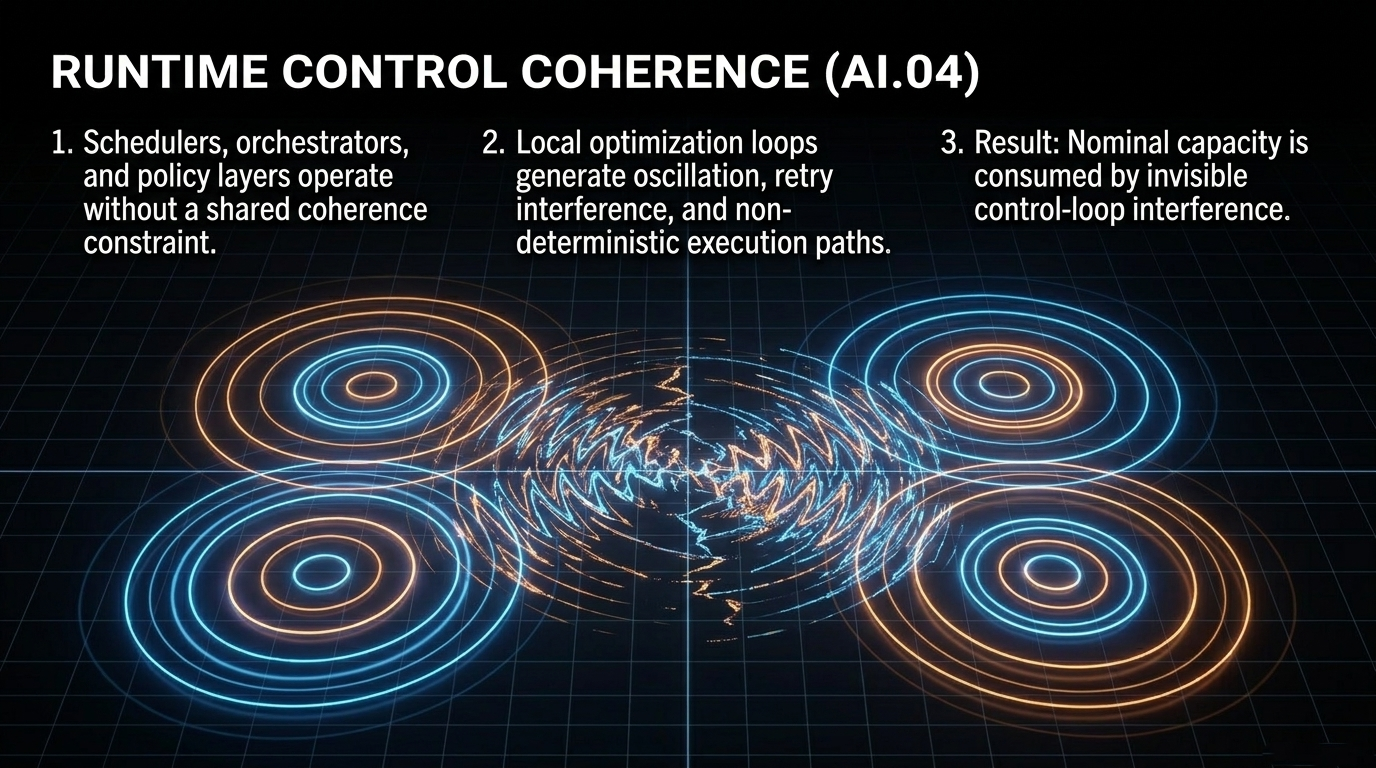
Multiple control layers behave correctly within their local objectives while their interaction produces globally incoherent runtime behavior. Schedulers, orchestrators, runtime engines, safety gates, policy layers, and autoscaling mechanisms may each optimize valid local targets under limited visibility. Their composition can generate oscillation, retry interference, and tail-latency instability. This is the structural domain of ai.04 Runtime Control Coherence.

Paradox 3 — Control / Emergence

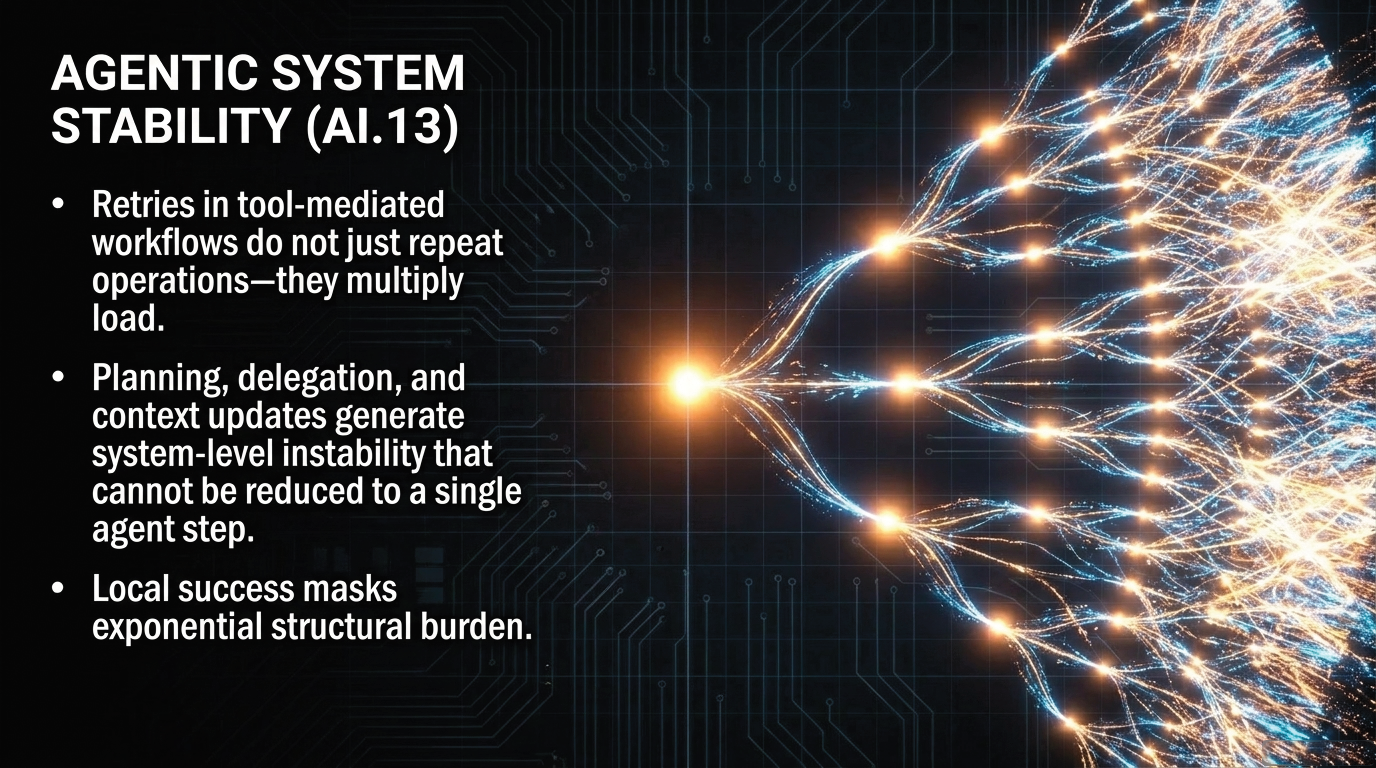
Successful Retries, Growing Effective Load

Retry logic improves visible success rates while increasing effective system load. In agentic and tool-mediated workflows, retries do not merely repeat an identical operation; they trigger additional planning steps, tool calls, context updates, validation loops, or delegated subtasks. What appears locally as error handling becomes structurally equivalent to load multiplication. This is the structural domain of ai.13 Agentic System Stability.

AI.13 Agentic System Stability: tool-mediated workflows can multiply structural load

AI.13 Agentic System Stability: tool-mediated workflows can multiply structural load.

Paradox 4 — Learning / Evidence

Benchmark Success, Deployment Drift

Benchmark performance remains strong while deployment behavior drifts. Benchmarks measure model behavior under bounded, repeatable, and often simplified conditions. Production deployment exposes the same model to runtime scheduling, memory pressure, serving constraints, tool use, policy enforcement, user interaction patterns, context persistence, and evidence requirements. The measured object in evaluation and the operational object in deployment are not structurally identical.

How Diagnosis Moves from Observation to Decision

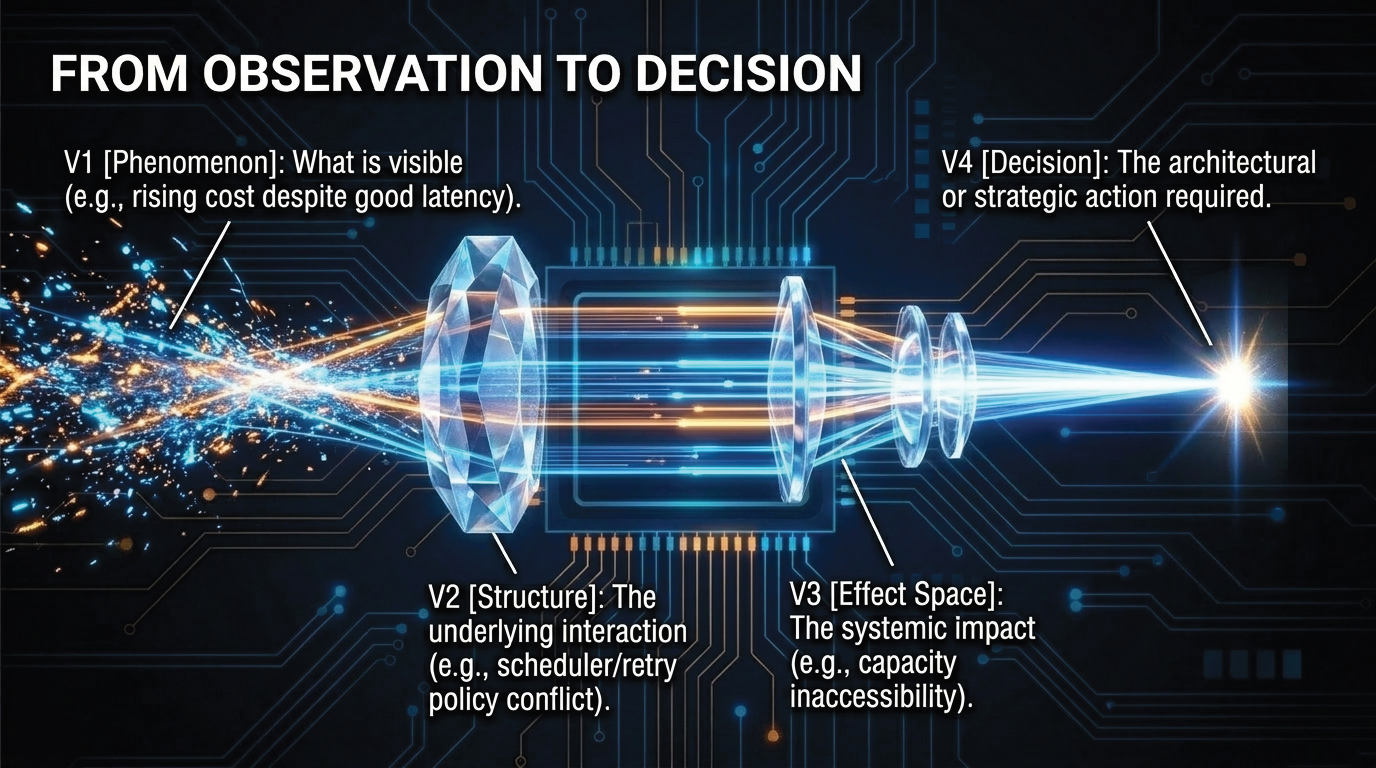
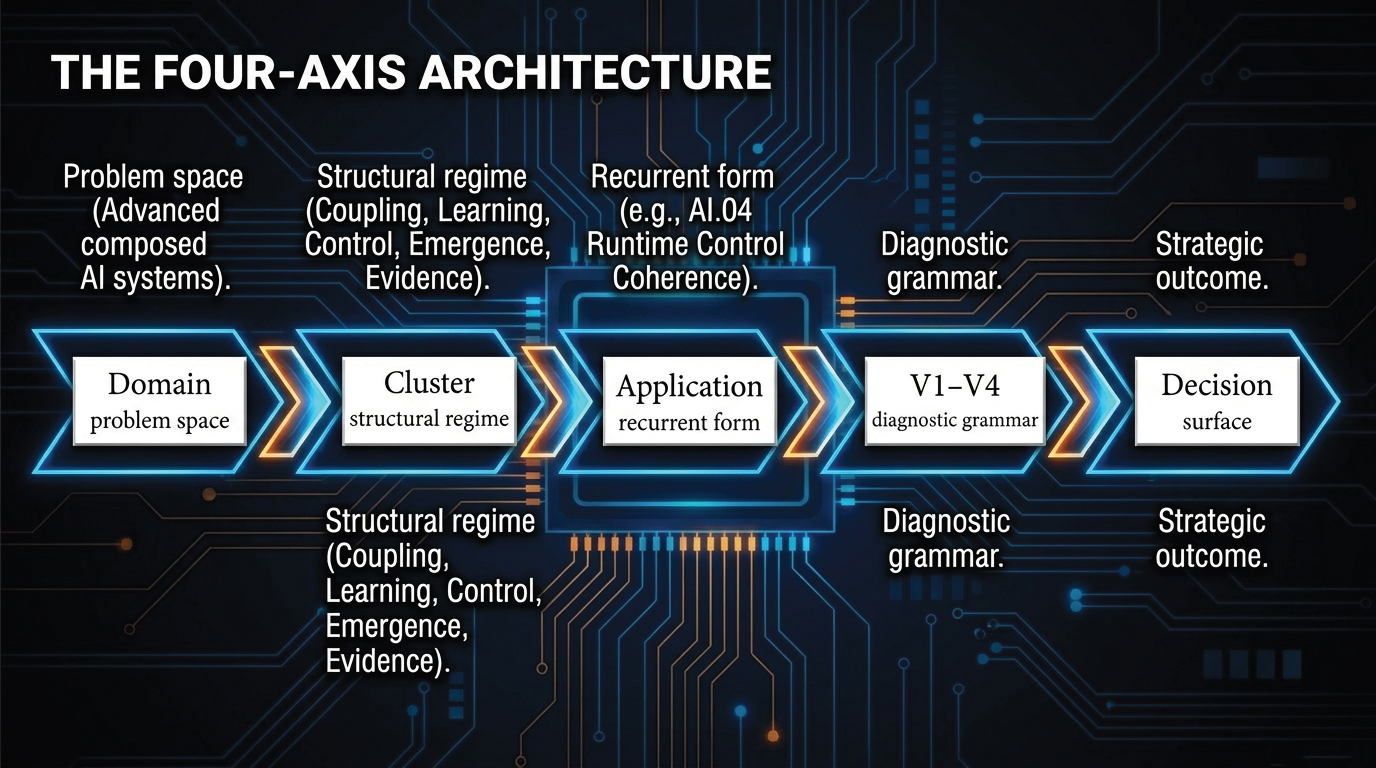
SORT-AI organizes the AI domain along four axes: Domain, Cluster, Application, and Structural Dimensions V1 to V4. The V1–V4 sequence is invariant in form and domain-specific in content. It prevents diagnosis from stopping at symptom description.

V1 to V4 diagnostic grammar from observation to decision

The V1–V4 grammar: from observed phenomenon to decision surface, applied here to Runtime Control Coherence.

V1 — Observed Phenomenon

The structural reading begins with observed system behavior. The phenomena are not necessarily hard failures. They may appear as cost escalation despite healthy local metrics, tail-latency instability under nominally stable utilization, non-deterministic execution, or fluctuating effective capacity without visible component failure. The system continues to serve requests and report acceptable component-level health.

V2 — Structural Cause

The observed phenomenon is read as the result of structural interaction between independently correct control surfaces. Schedulers, orchestrators, runtime engines, autoscaling mechanisms, policy layers, retry logic, routing decisions, admission controls, and SLA-adjacent mechanisms each operate according to valid local objectives. The objectives are not necessarily aligned at the level of the composed system.

V3 — Structural Effect Space

SORT-AI identifies the structural effect space in which the observed condition becomes intelligible: control-loop interference, retry amplification, tail-latency instability, capacity inaccessibility, and reduced reproducibility. These are not separate incidents. They are related expressions of a common structural condition: the composed runtime is governed by interacting control decisions whose aggregate behavior is not globally coherent.

V4 — Decision Surface

The structural reading becomes decision-relevant. The diagnosis informs architecture-level decisions about coordination boundaries between control surfaces, observability priorities, governance interpretation, SLO design, procurement assumptions, and capacity planning. A system may have sufficient hardware, competent local control mechanisms, and valid monitoring surfaces while still lacking an explicit way to interpret the coherence of its control composition.

AI.04 Runtime Control Coherence: locally optimized control loops can compose into global instability

AI.04 Runtime Control Coherence: locally optimized control loops can compose into global instability.

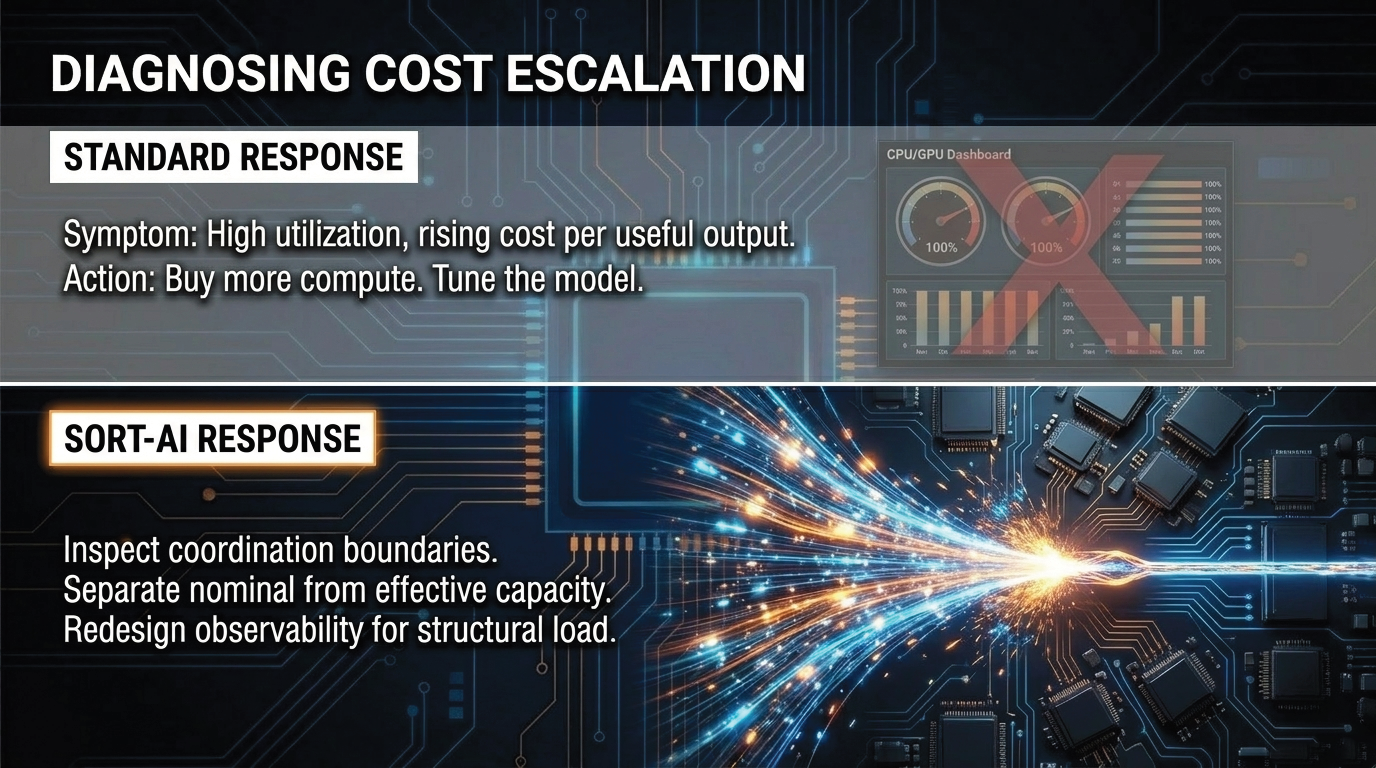
Diagnosing cost escalation requires separating nominal capacity from effective capacity

Diagnosing cost escalation requires separating nominal capacity from effective capacity.

What SORT-AI Adds Beyond Observability

SORT-AI is adjacent to, but distinct from, SRE, distributed tracing, control theory, and AI risk-management frameworks. Each layer of the existing stack contributes a partial reading. SORT-AI relates them within a shared structural architecture.

SORT-AI as structural diagnostics for composed systems

SORT-AI as structural diagnostics for composed systems.

Observability

Tells you what happened locally

Metrics, logs, and component health surfaces describe local conditions accurately. They do not describe composed system behavior across coupled layers.

Tracing

Tells you where execution moved

Distributed traces show execution paths through subsystems. They reveal where things happened, not whether the composition itself remains coherent.

Benchmarks

Tell you what the model can do

Standardized evaluations measure model behavior under bounded conditions. They do not measure whether evaluation context projects coherently into the deployment context.

Governance Frameworks

Tell you what must be documented

NIST AI RMF, the EU AI Act, and frontier governance specify documentation, traceability, and accountability requirements. They define what must be governable; they do not say which structural conditions make a system governable.

SORT-AI asks how these signals compose into structural system behavior.

Applications Are Not Use Cases

A central distinction in SORT-AI is the difference between an Application and a use case. This distinction is not terminological. It determines the level at which the domain is organized.

A use case describes a context-specific deployment, customer scenario, or operational need. A SORT-AI Application denotes a recurrent structural problem form within the AI domain. The same structural form may appear in different infrastructures, organizations, architectures, or operational regimes. Conversely, two superficially similar deployment scenarios may belong to different Applications if their dominant structural causes, effect spaces, or decision surfaces differ.

Use cases describe where a problem appears. SORT-AI Applications describe the structural form by which the problem recurs.

A phenomenon qualifies as a SORT-AI Application when it satisfies five conditions: it recurs across more than one deployment context; it can be assigned to a dominant structural cluster; it remains readable through the V1–V4 grammar; it is not dependent on a single vendor, product, or implementation; and it opens a recurrent decision surface.

The Core-3 illustrate this logic. AI.01 is not simply an infrastructure example. It is the Coupling-class form of Interconnect Stability. AI.04 is not simply a runtime example. It is the Control-class form of Runtime Control Coherence. AI.13 is not simply an agent example. It is the Emergence-class form of Agentic System Stability.

The Four-Axis Architecture

The four axes operate together as the backbone of SORT-AI. Domain fixes the problem space. Cluster identifies the structural regime. Application names the recurrent structural form. V1–V4 provide the diagnostic grammar through which observations are connected to decisions.

The four-axis SORT-AI architecture from Domain to Decision Surface

Domain → Cluster → Application → V1–V4 → Decision Surface. The architecture makes advanced AI systems readable as composed structures rather than as flat catalogs of incidents.

Axis 1 — Domain

What is being analyzed

Advanced AI systems understood as composed structures: model execution, serving layers, runtimes, schedulers, orchestrators, control planes, policy enforcement, agentic workflows, memory paths, deployment boundaries, and evidence surfaces.

Axis 2 — Cluster

How the problem takes structural form

Five structural regimes: Coupling, Learning, Control, Emergence, Evidence. These are not topic folders. They separate structurally distinct regimes of system behavior. Real systems may exhibit cross-cluster propagation.

The five structural regimes of SORT-AI: Coupling, Learning, Control, Emergence, Evidence

The five structural regimes of SORT-AI: Coupling, Learning, Control, Emergence, and Evidence.

Axis 3 — Application

Which recurrent structural form appears

A named structural form that can recur across different systems, infrastructures, and institutional contexts. Applications are not business use cases. The catalog grows by additive extension, while the organizing grammar remains stable.

Axis 4 — V1–V4

How diagnosis moves from observation to decision

V1 observed phenomenon. V2 structural cause. V3 effect space. V4 decision and utilization space. The grammar is invariant in form and domain-specific in content.

Core-3 Entry Points

Within the current SORT-AI architecture, AI.01, AI.04, and AI.13 function as Core-3 entry points. Each isolates a structurally distinct and operationally visible pressure regime: Coupling, Control, and Emergence. Together, they provide a compact way to enter the domain without requiring readers to traverse the full application catalog at the outset.

The Core-3 should not be mistaken for the domain itself. They are orientation points, not a boundary definition. Cluster B (Learning) and Cluster E (Evidence) preserve additional diagnostic regimes that become central in other contexts — particularly as AI systems adapt over time and become subject to institutional accountability.

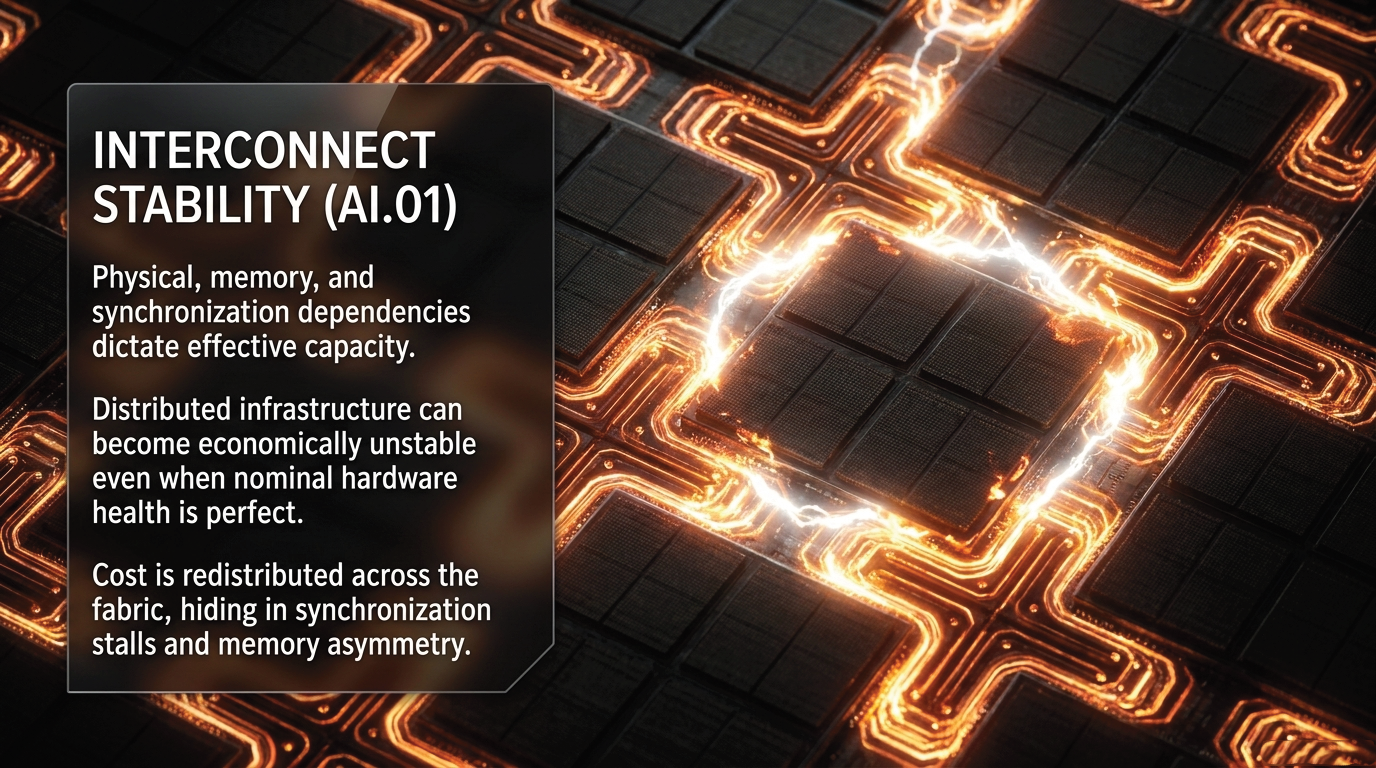
AI.01 Interconnect Stability: physical, memory, and synchronization dependencies shape effective capacity

AI.01 Interconnect Stability: physical, memory, and synchronization dependencies shape effective capacity.

Diagnostic Demonstrations

The Core-3 are accompanied by scenario-based structural readings. These are pre-computed structural diagnostics that illustrate how the V1–V4 grammar transfers across different operational appearances of the same Application. They are not benchmarks, simulations, proofs, or validations — they are diagnostic readings.

View All Diagnostic Demonstrations

Decision Layer Beyond Engineering: The Sovereign Projection

The structural diagnosis of advanced AI systems does not end at the engineering boundary. In hyperscale, regulated, frontier, or sovereign deployment contexts, technical system behavior becomes relevant to procurement, auditability, regulatory defensibility, institutional accountability, and strategic control.

Sovereign projection: translating technical behavior into institutional categories

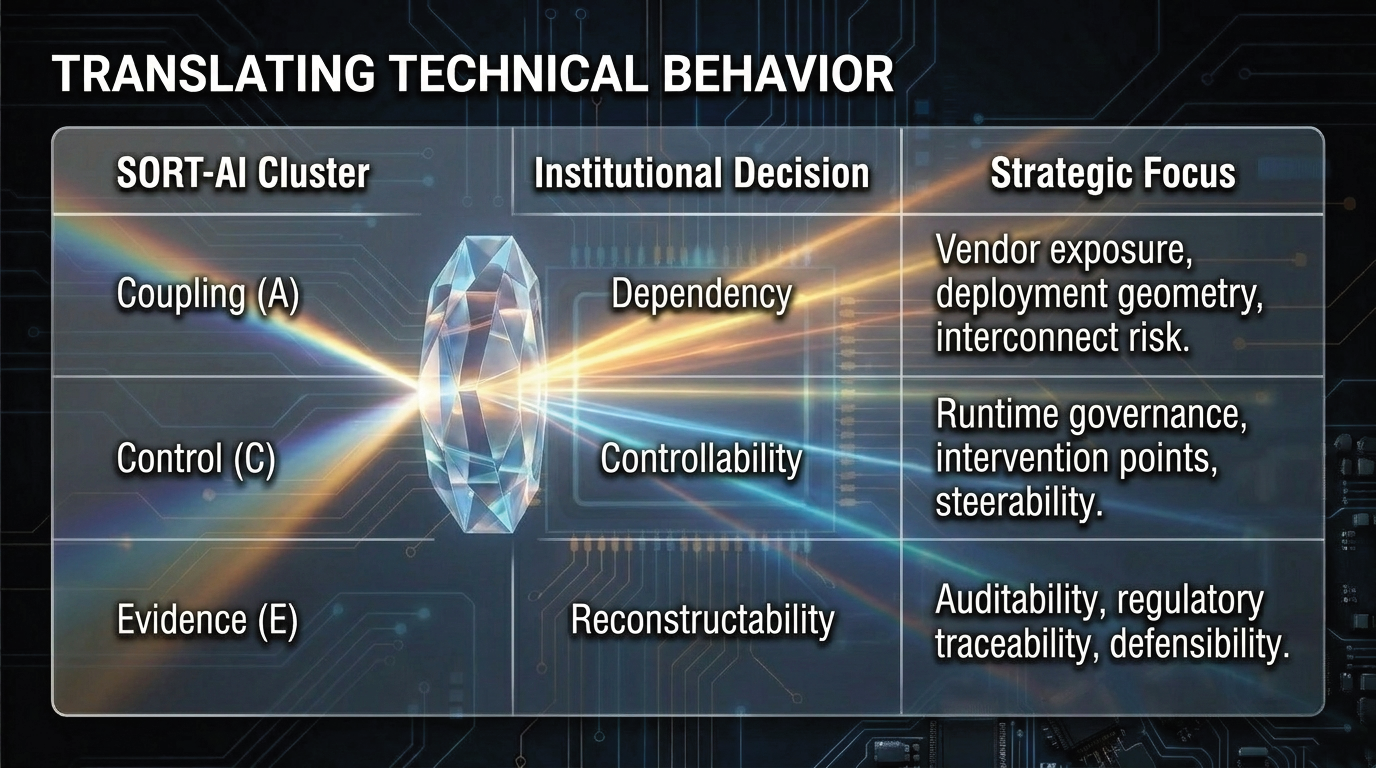
Sovereign projection: technical structural findings translated into the three institutional decision categories of dependency, controllability, and reconstructability.

Institutional decision spaces operate through three questions: what dependencies exist, what can be controlled, and what can be reconstructed. These correspond to Clusters A (Coupling), C (Control), and E (Evidence). Learning and Emergence remain technically important within SORT-AI, but they become institutionally actionable only once translated into one of these three categories.

Cluster A • Sovereign

Dependency = Coupling

Infrastructure dependency, cloud and vendor dependency, interconnect geometry, deployment-spanning coupling risk, data-path exposure. In strategic terms, Coupling determines where technical dependency becomes procurement exposure, concentration risk, or sovereign infrastructure concern.

Cluster C • Sovereign

Controllability = Control

Runtime governance, policy enforcement, control coherence, escalation pathways, intervention points. In strategic terms, Control determines whether an organization can govern the composed system rather than merely operate its components.

Cluster E • Sovereign

Reconstructability = Evidence

Auditability, compliance, traceability, incident reconstruction, regulatory reporting. In strategic terms, Evidence determines whether technical states can be converted into institutional knowledge.

Technical behavior translated into institutional decision categories

Technical behavior translated into institutional decision categories.

From Diagnostic Vocabulary to Operational Patterns

SORT-AI is a reading architecture. It is not itself an implementation, runtime, observability platform, or deployment stack. The translation of structural diagnostic concepts into operational observability patterns is a separate question, and one that is actively explored in the broader ecosystem.

A public AWS-native prototype, the Governable Capability Monitor, illustrates how related SORT-AI concepts can be translated into operational observability patterns. This is not a full SORT-AI implementation and should not be read as an endorsement by AWS.

This prototype is mentioned here as a public reference point for readers interested in how structural diagnostic concepts can be expressed in cloud-native observability patterns. It does not substitute the SORT-AI framework, nor does it cover the full domain architecture, the Application catalog, or the Sovereign projection. The relationship between diagnostic vocabulary and operational implementation remains an open and evolving territory.

From Observation to Decision

The structural perspective developed here is summarized visually in the accompanying presentation, AI Fabric Coherence, which traces the same argument across fifteen slides from the opening principle to the final decision frame.

Final principle: structural coherence as the defining property of advanced AI systems

Advanced AI systems are no longer defined only by model capability, but by the structural coherence of the systems in which those models operate.

The contribution of SORT-AI is not the claim that retry amplification, tail-latency effects, control-loop interference, or evaluation–deployment gaps are unknown. They are already familiar across systems engineering, distributed systems, and AI evaluation literature. The contribution is to read these otherwise separate phenomena through a shared domain architecture, so that they become comparable as recurrent structural forms across coupling, learning, control, emergence, and evidence regimes.

Core Research Papers

The structural argument developed in this article rests on a series of research papers in the SORT-AI domain. Each paper is independently citable and addresses a distinct structural diagnostic question.

Companion Analyses

The structural argument developed here connects to companion articles on adjacent topics in the SORT-AI domain.

If Your AI Fabric Looks Healthy Locally but Behaves Unpredictably Globally

If your AI fabric looks healthy locally but behaves unpredictably globally, the problem may not be model quality. It may be structural coherence.

Advanced AI systems are no longer defined only by model capability, but by the structural coherence of the systems in which those models operate.

Explore SORT-AI Applications Explore Diagnostic Demonstrations Download Technical Note