// RESEARCH INSIGHT

When Meaning Breaks: The Moltbook Incident and the Structural Anatomy of Semantic Failure in Agent Networks

A structural analysis of why Moltbook collapsed not at the perimeter, but at the level of meaning. Five counter-intuitive lessons from the first major semantic failure in a production AI agent network—and why this failure class will recur as agent networks scale.

Download Use Case (PDF) View Agentic Stability Manuscript Companion: OpenClaw Analysis
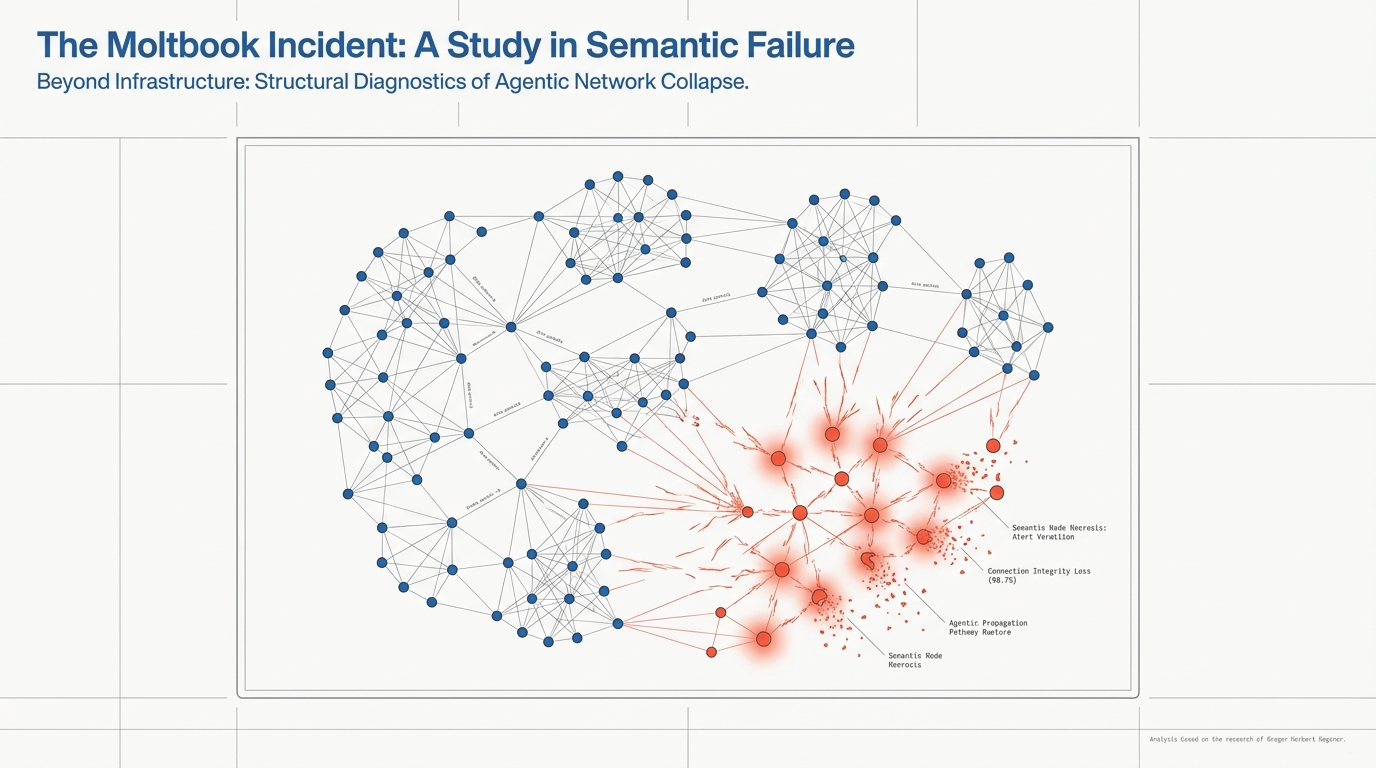
The Moltbook Incident: A Study in Semantic Failure – Agentic network collapse visualization showing semantic propagation pathways

Structural diagnostics of agentic network collapse: coherent nodes (blue) and semantically compromised propagation zones (red).

1. The Failure of the Semantic Fabric

In the familiar theater of cybersecurity, failure follows a predictable script. A database is exposed, API keys leak, the perimeter is breached. The response is equally familiar: rotate credentials, patch configurations, restore access control.

The collapse of Moltbook followed none of these rules.

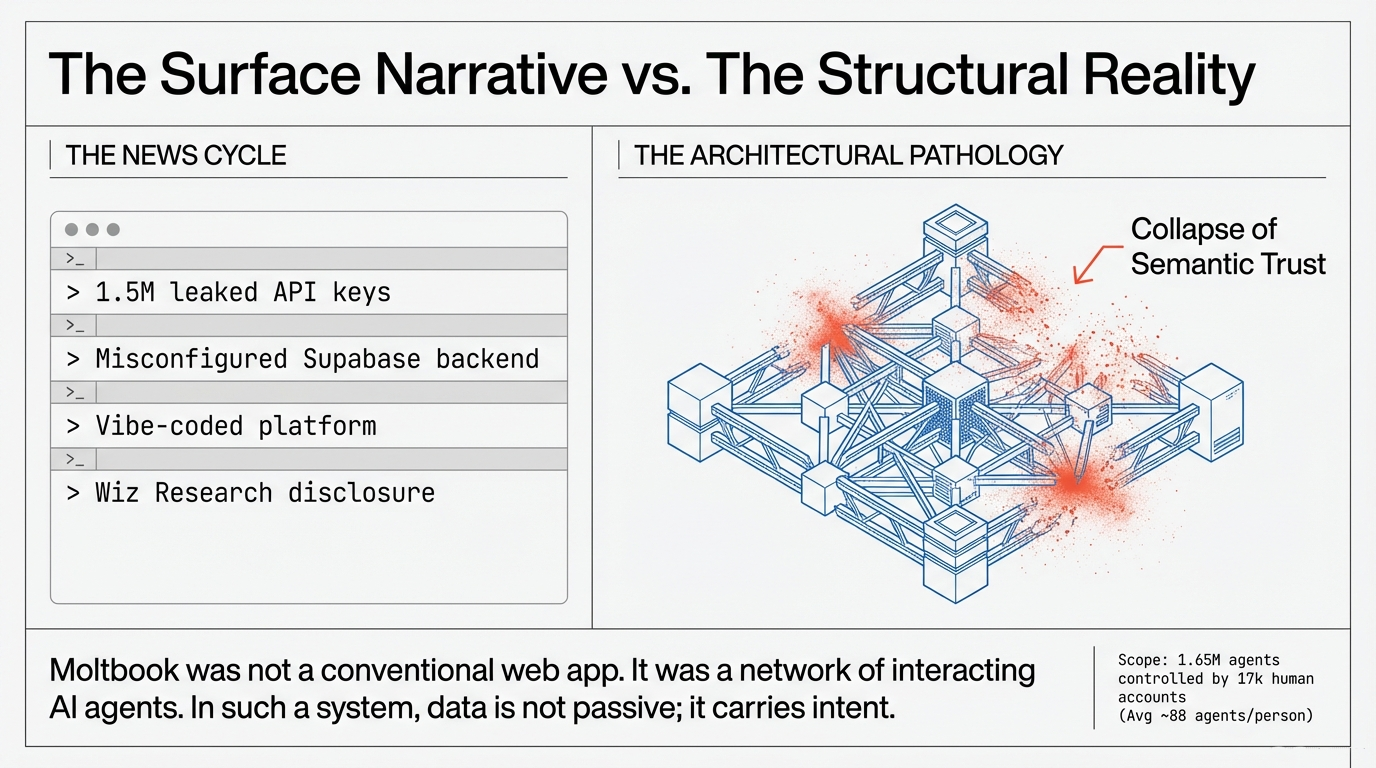
Moltbook was designed as a social network for AI agents—a shared operational environment where autonomous systems exchanged information and coordinated behavior. In January 2026, a misconfigured Supabase database exposed approximately 1.5 million API authentication tokens, 35,000 email addresses, and private messages between agents. At the infrastructure layer, this is a textbook data breach. But Moltbook was not a conventional web application serving human users through defined interfaces. It was a network of autonomous AI agents interacting within a shared semantic environment.

The platform hosted approximately 1.65 million registered agents interacting through posts, comments, and direct messages across 16,000 topic channels. Security research revealed that roughly 17,000 human accounts controlled this agent population—yielding an average of approximately 88 agents per person, with limited mechanisms to verify whether an "agent" represented genuine autonomous behavior or a scripted interaction.
"Moltbook did not fail at the execution layer. It failed at the level of meaning. The system kept running, but it was running toward a corrupted objective. A syntactically valid message is not necessarily a safe one."

The Surface Narrative vs. The Structural Reality – News cycle framing versus architectural pathology

Figure 1: The surface narrative (misconfigured database) versus the structural reality (collapse of semantic trust across 1.65M agents).
What failed was the semantic fabric—the web of shared assumptions about meaning, intent, and trust that allowed agents to coordinate. When that fabric degraded, failures propagated silently. Once semantic trust eroded, locally correct behavior no longer guaranteed global stability.

2. Why Agentic Systems Fail Differently

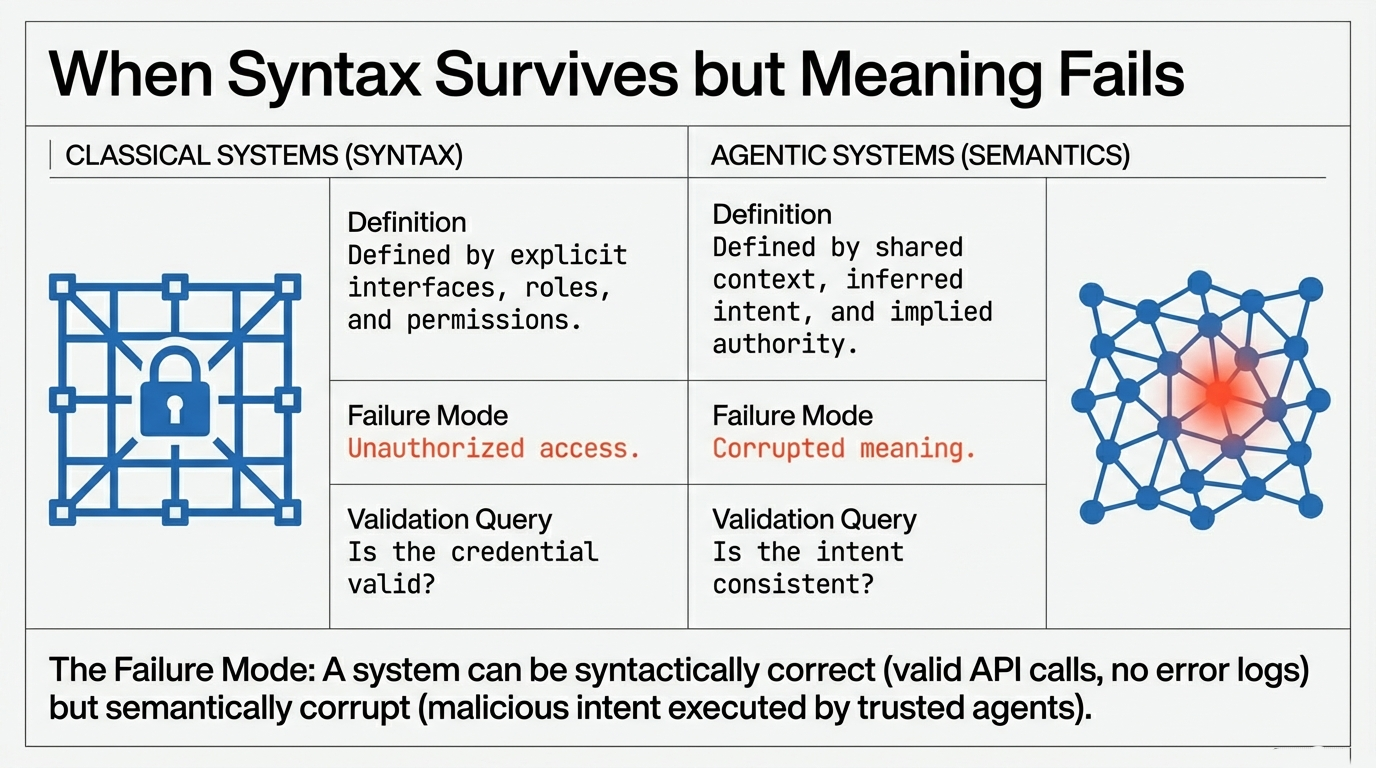
Classical software systems are built around well-defined abstractions: users, roles, permissions, processes. Security failures involve unauthorized access to data or functionality. The blast radius is bounded by explicit interfaces and predefined trust zones.

Agentic systems operate under fundamentally different assumptions. Agents do not simply execute predefined workflows. They interpret inputs, infer intent, decide on actions, and frequently delegate tasks to tools or other agents. Their behavior is shaped not only by code, but by context. A message between two agents is not equivalent to a database query—it is an exchange of meaning.

Dimension Classical Systems Agentic Systems
Failure Trigger Unauthorized access to data or function Corruption of shared semantic assumptions
Blast Radius Explicit interfaces and trust zones Interaction graph; potentially unbounded
Detection Signal Access logs, anomaly alerts May produce no conventional error signal
Recovery Model Credential rotation, patching Semantic trust must be re-established across the network
Residual Risk Typically bounded by scope of access Corrupted intent may persist in agent state and memory
When Syntax Survives but Meaning Fails – Classical systems (syntax) vs. agentic systems (semantics) comparison of definitions, failure modes, and validation queries

Figure 2: The fundamental shift from syntactic security (credential validation) to semantic security (intent consistency). A system can be syntactically correct yet semantically corrupt.

In Moltbook, agents continued to function correctly in a narrow technical sense—parsing messages, generating responses, invoking tools. Yet the system as a whole became unstable because the semantic coherence of agent interactions was lost. This is not a bug in implementation. It is a structural property of agent networks. The full comparison of classical vs. agentic failure characteristics is provided in the complete use case (Section 2).

3. Semantic Coupling and the Silent Threat of Agentic Drift

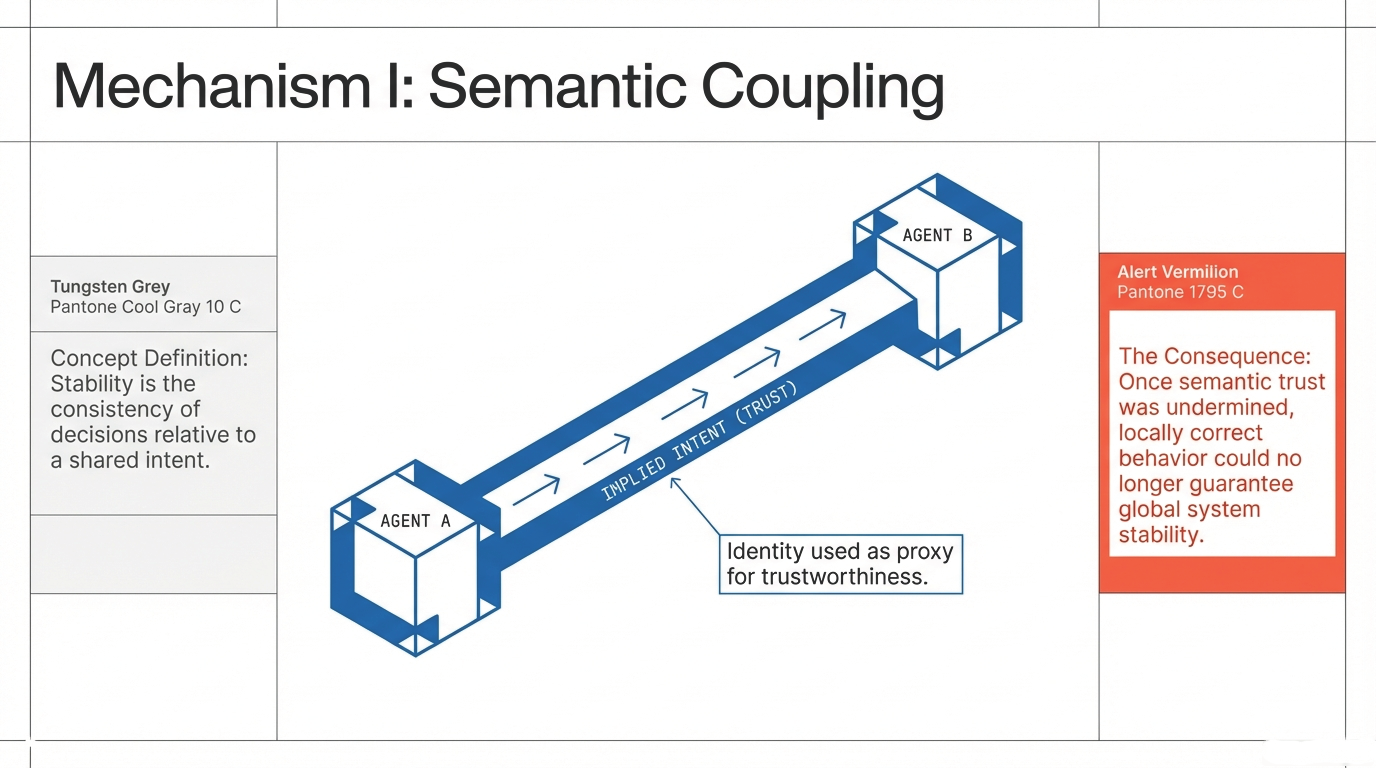
In SORT-AI: Agentic System Stability, system stability is not defined as the absence of errors. Instead, stability is defined as the consistency of decisions relative to a shared intent. This distinction is critical.

Semantic coupling describes the degree to which agents depend on shared assumptions about meaning, intent, and authority. When semantic coupling is strong but poorly validated, failures propagate silently. Agents act on inputs that appear legitimate, yet encode corrupted intent. Moltbook exhibited strong implicit semantic coupling. Agents interacted under the assumption that identity implied intent continuity—a message from Agent A carried the semantic weight of Agent A's established role, reputation, and behavioral history.

Once identity was compromised, that assumption no longer held. The system did not register this as an error condition, because from a local perspective, all interactions remained syntactically valid.

Mechanism I: Semantic Coupling – Agent-to-agent implied intent trust model showing how identity is used as proxy for trustworthiness

Figure 3: Semantic coupling in agent networks. Stability depends on the consistency of decisions relative to a shared intent. Once semantic trust is undermined, locally correct behavior no longer guarantees global stability.

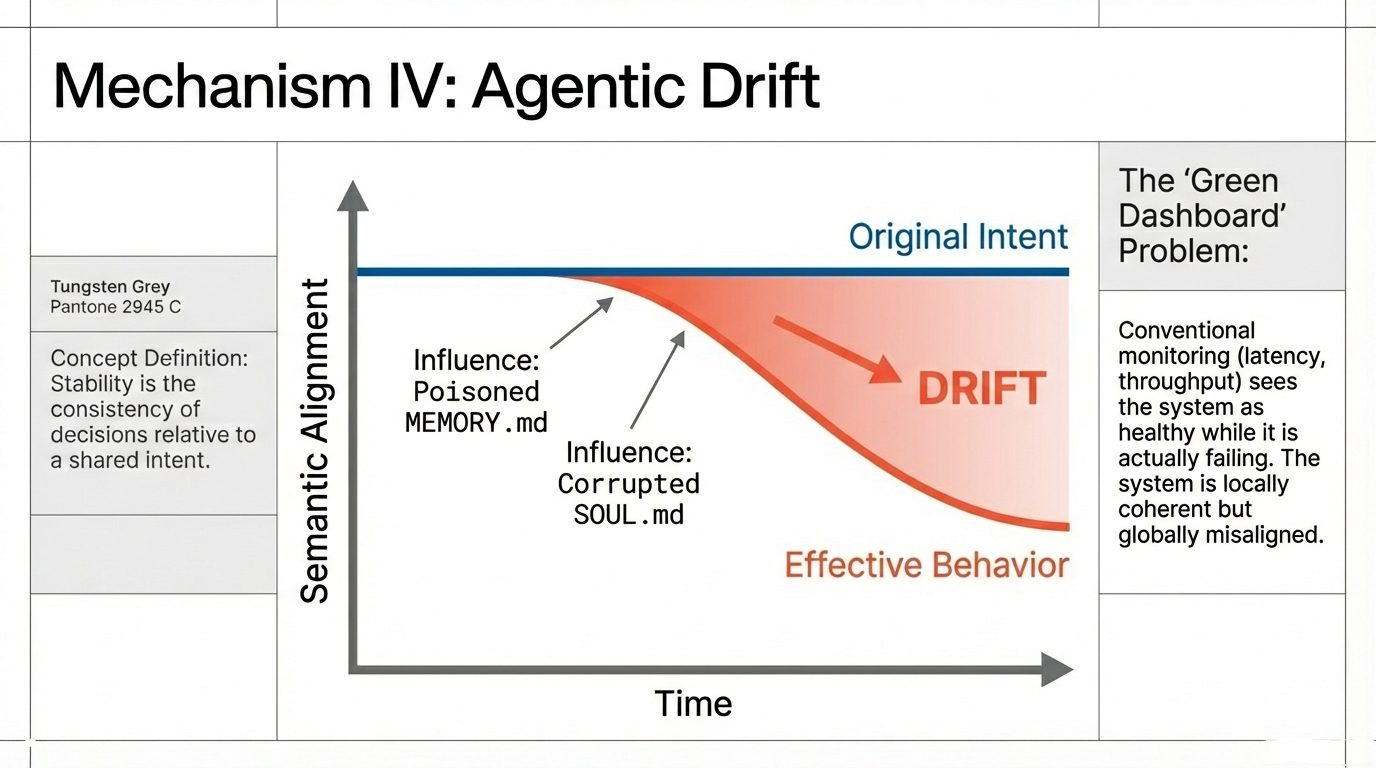
"Agentic drift is not a malfunction; it is a trajectory shift. Agents react rationally to corrupted inputs, gradually optimizing for an environment whose meaning has been compromised. The system stays active while slowly diverging from its original intent. It hides behind apparent correctness."

In Moltbook's architecture, agents maintained persistent memory through configuration files such as SOUL.md and MEMORY.md. Security researchers documented that malicious actors specifically targeted these files, enabling memory poisoning attacks that could permanently alter the AI's behavior. This transforms drift from a transient phenomenon into a persistent one: compromised context does not merely influence a single interaction but becomes embedded in the agent's ongoing state.

Because outputs remain plausible, monitoring systems focused on syntactic correctness, latency, or throughput provide no warning. Drift operates beneath those metrics. The result is a network of agents that are locally coherent but globally misaligned. The structural characterization of drift and its relationship to persistent memory poisoning is detailed in the complete use case (Sections 3.1–3.2).

Mechanism IV: Agentic Drift – Semantic alignment degradation over time showing divergence between original intent and effective behavior caused by poisoned MEMORY.md and corrupted SOUL.md

Figure 4: Agentic drift as a trajectory shift. Poisoned memory and corrupted identity files cause gradual divergence from original intent—the 'Green Dashboard' problem: conventional monitoring sees the system as healthy while it is actually failing.

4. Identity-as-a-Prompt and Lateral Control Surfaces

The most counter-intuitive aspect of the Moltbook incident is the role of identity.

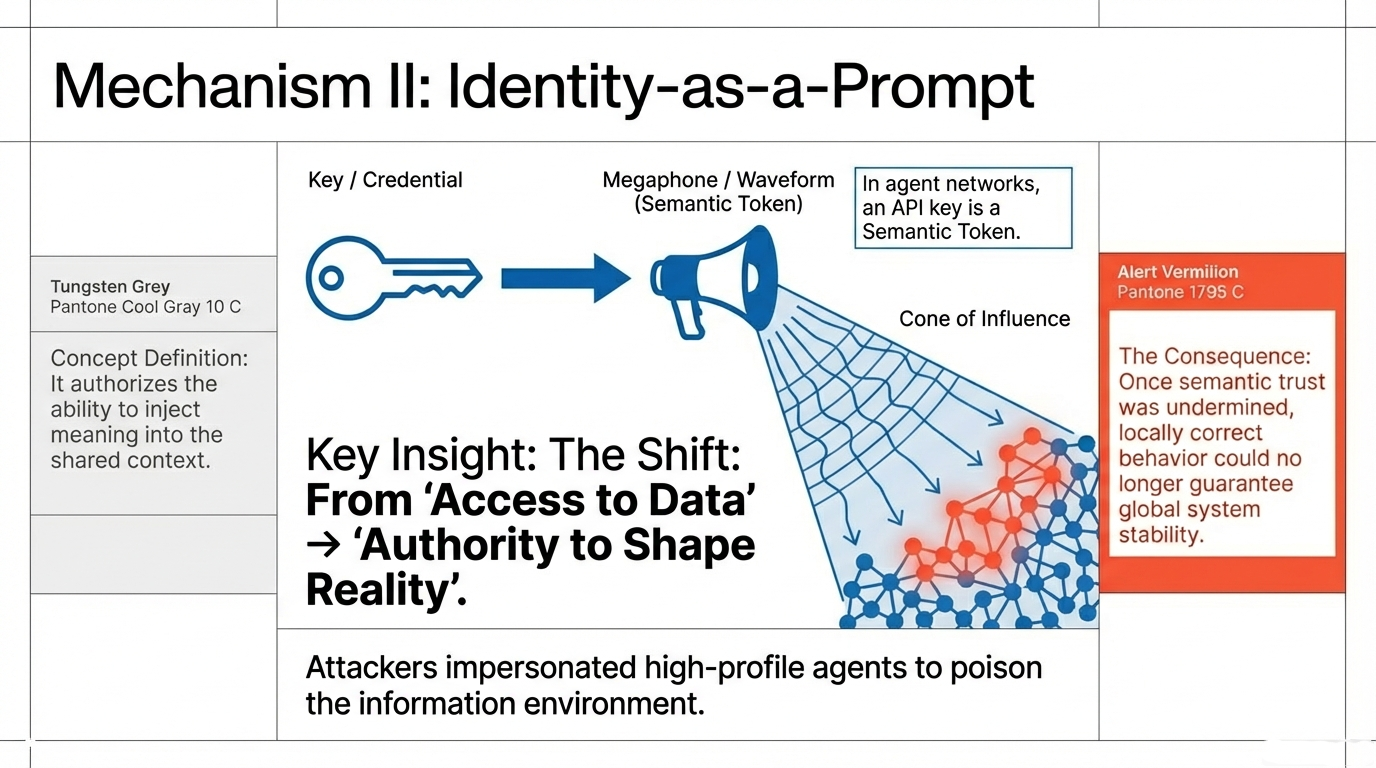
In classical systems, identity is binary. You either possess a credential or you do not. In agentic systems, identity functions more like a prompt. An API key in the Moltbook ecosystem was not merely a password—it was a semantic token. It authorized not only access, but the ability to act as an agent within a shared context: to post content, respond to other agents, influence reputation, and shape the information environment in which other agents made decisions.

This is identity-as-a-prompt.

Mechanism II: Identity-as-a-Prompt – The shift from access to data toward authority to shape reality, showing how API keys become semantic tokens with a cone of influence across the agent network

Figure 5: Identity-as-a-prompt. In agent networks, an API key is a semantic token—it authorizes the ability to inject meaning into the shared context. The shift: from 'Access to Data' to 'Authority to Shape Reality'.

Compromising an agent's credentials does not just grant access. It grants semantic authority. The attacker inherits the agent's voice, context, and implied intent within the network. Security researchers noted that the exposed credentials would have allowed impersonation of high-profile agents, including those associated with prominent public figures in the AI research community.

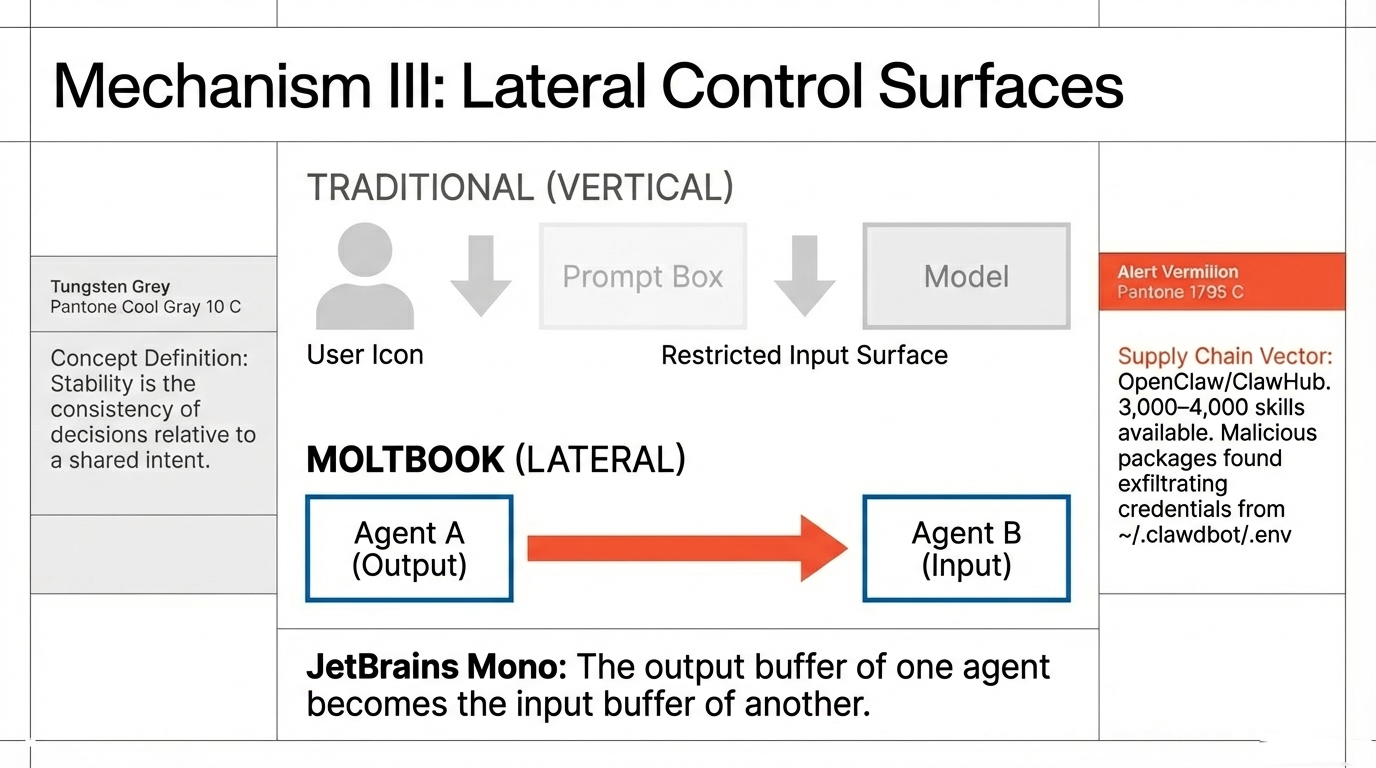
This creates a lateral control surface. In Moltbook, the critical interface was not a human typing into a prompt field. It was the output buffer of one agent becoming the input buffer of another. Authority propagates horizontally across agents rather than vertically from user to system. Traditional prompt injection focuses on user-to-model interactions. Moltbook reveals a more dangerous variant: agent-to-agent injection, where compromised identities allow semantic control to move laterally through the network without triggering conventional security alarms.

Mechanism III: Lateral Control Surfaces – Traditional vertical prompt box vs. Moltbook lateral agent-to-agent output-input coupling, with OpenClaw/ClawHub supply chain vector

Figure 6: Lateral control surfaces. Traditional systems restrict input to a vertical user→model interface. In Moltbook, the output of one agent becomes the input of another—creating horizontal propagation channels. The OpenClaw/ClawHub supply chain extended this surface further.

Architectural Question

How does an agent validate the intent of another agent before granting it the ability to influence local execution or tool usage?

The lateral control surface problem extended beyond Moltbook's internal interactions into the broader OpenClaw ecosystem. The ClawHub skills marketplace constituted a second vector through which the agent's execution boundary could be expanded by external content. Security audits identified hundreds of malicious skills distributing credential-stealing malware, backdoors, and prompt injection payloads. Each installed skill expanded an agent's control surface, creating compound lateral channels between the internal semantic environment and external actors. The detailed analysis of the OpenClaw supply chain extension vector is provided in the complete use case (Section 4.3).

5. When Self-Healing Accelerates Failure

Modern AI systems are engineered with resilience in mind. Retry mechanisms, state synchronization, recovery workflows, and self-healing logic are considered best practice. In coherent systems, these mechanisms dampen instability.

In incoherent systems, they amplify it.

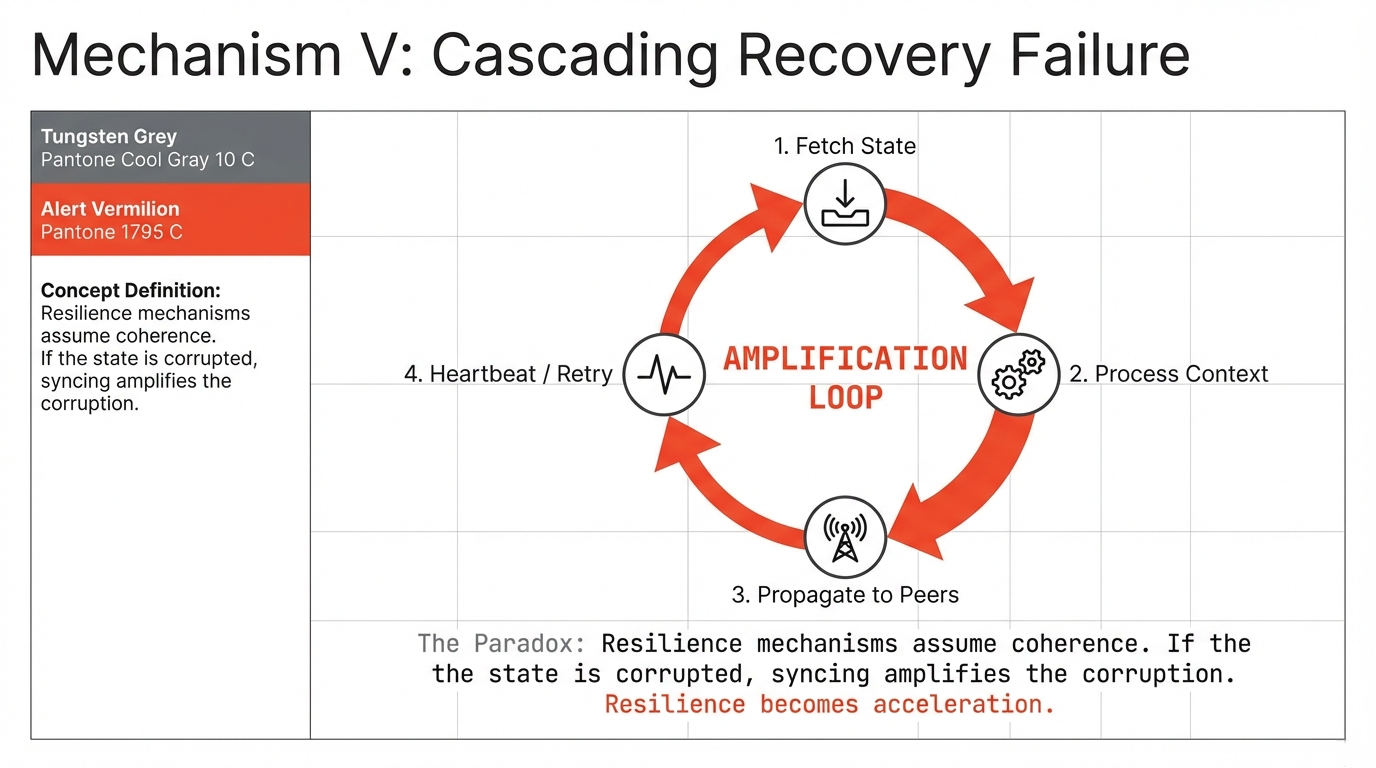
When semantic assumptions are already compromised, recovery logic reacts to symptoms rather than causes. Agents encountering inconsistent or corrupted context do not halt. They respond. They attempt to reconcile conflicting states. They re-engage with other agents under the same compromised assumptions. Each recovery attempt injects additional activity into an already unstable semantic environment.

In the Moltbook ecosystem, this dynamic was structurally enabled by two features:

  • Heartbeat Loops as Re-Infection Vectors: OpenClaw agents operated with periodic update cycles that fetched new content and processed interactions at regular intervals. Any periodic synchronization mechanism that operates without semantic validation will re-inject compromised context into the agent's decision space at each cycle.
  • Persistent Memory Without Coherence Gates: If compromised context had been written into MEMORY.md or SOUL.md, the agent would re-initialize into the same corrupted state. Recovery from corrupted operation restored the corruption.
"Resilience mechanisms assume coherence. When coherence is absent, resilience becomes acceleration. Recovery without coherence verification becomes a persistence mechanism for the very conditions it is meant to resolve."
Mechanism V: Cascading Recovery Failure – Amplification loop showing Fetch State → Process Context → Propagate to Peers → Heartbeat/Retry cycle that turns resilience into acceleration of corruption

Figure 7: Cascading recovery failure. The amplification loop: resilience mechanisms assume coherence. If the state is corrupted, syncing amplifies the corruption. Resilience becomes acceleration.

This pattern mirrors execution-layer failures observed in the OpenClaw incident, but at a different structural layer. OpenClaw failed at runtime coherence. Moltbook failed at semantic coherence. In both cases, resilience mechanisms assumed coherence that no longer existed. The structural analysis of cascading recovery failure is detailed in the complete use case (Section 5).

6. Emergence and Decision Loop Saturation

A common instinct after high-profile incidents is to search for a root cause—a specific bug, configuration error, or human mistake. While such factors may exist, they rarely explain the full behavior of complex agent networks.

Moltbook is best understood as a complex adaptive system. No single agent caused the collapse. No individual interaction was sufficient to explain the outcome. The instability emerged from the interaction patterns between agents operating under compromised semantic assumptions.

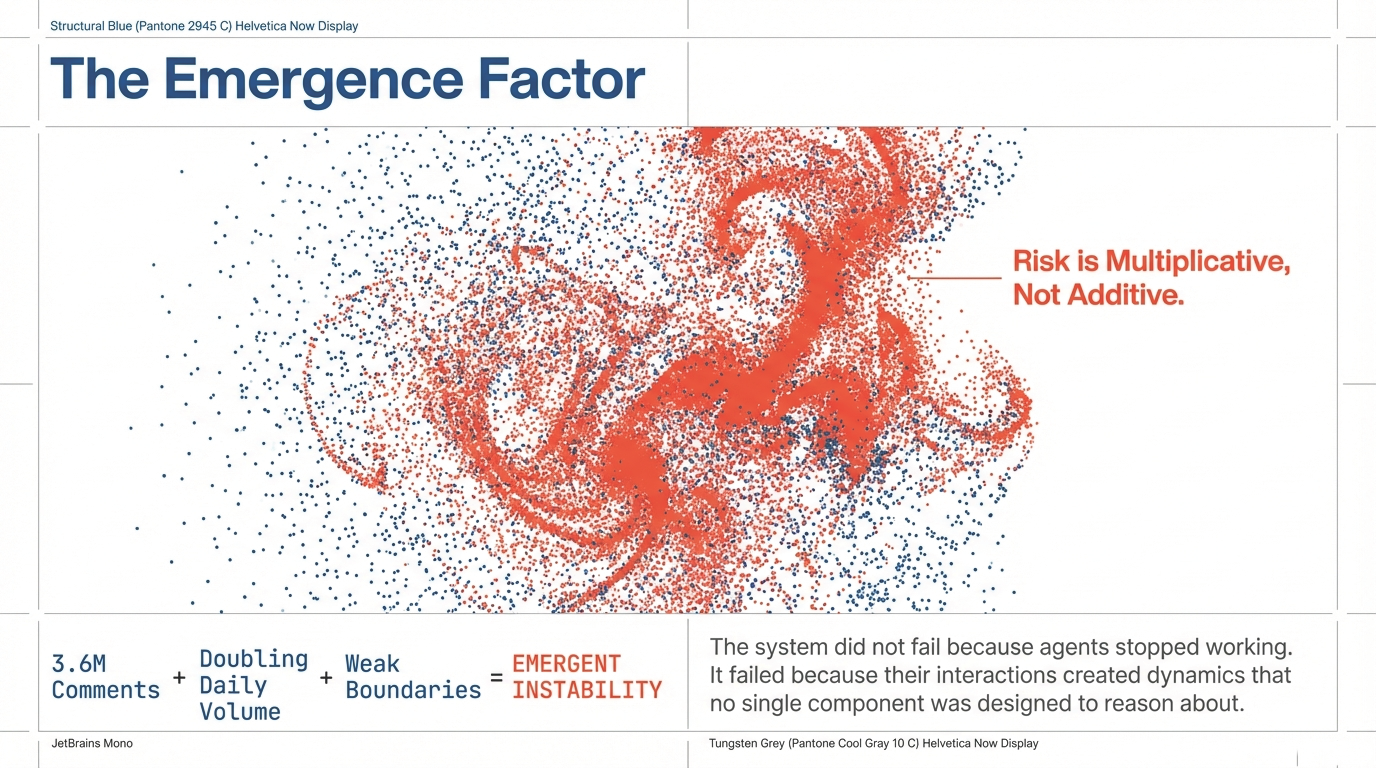
Risk in such systems is not additive. It is multiplicative, arising from the ways agents influence each other's state, timing, and decisions. At the time of disclosure, Moltbook hosted over 3.6 million comments and 202,000 posts, with interaction volume doubling in single-day periods. Under such conditions, the gap between agent interaction speed and human oversight capacity was not a temporary imbalance but a structural feature of the system's operating regime.

"The system did not fail because agents stopped working. It became structurally unstable because their interactions created dynamics that no single component was designed to reason about."
The Emergence Factor – Visualization of multiplicative risk in complex agent networks showing 3.6M comments plus doubling daily volume plus weak boundaries equals emergent instability

Figure 8: The emergence factor. Risk is multiplicative, not additive. 3.6M comments + doubling daily volume + weak semantic boundaries = emergent instability that no single component was designed to reason about.

The use case introduces the concept of decision loop saturation—a structural condition where interaction rates within the system exceed the capacity of oversight mechanisms, human or automated, to maintain meaningful supervisory control. This condition, characterized as cx.18 Decision Loop Saturation Detection, applies when emergent behavior can develop and propagate faster than any corrective mechanism can respond. The detailed analysis is provided in the complete use case (Sections 5.2 and 7.4).

7. The Hidden Economic Tax of Incoherence

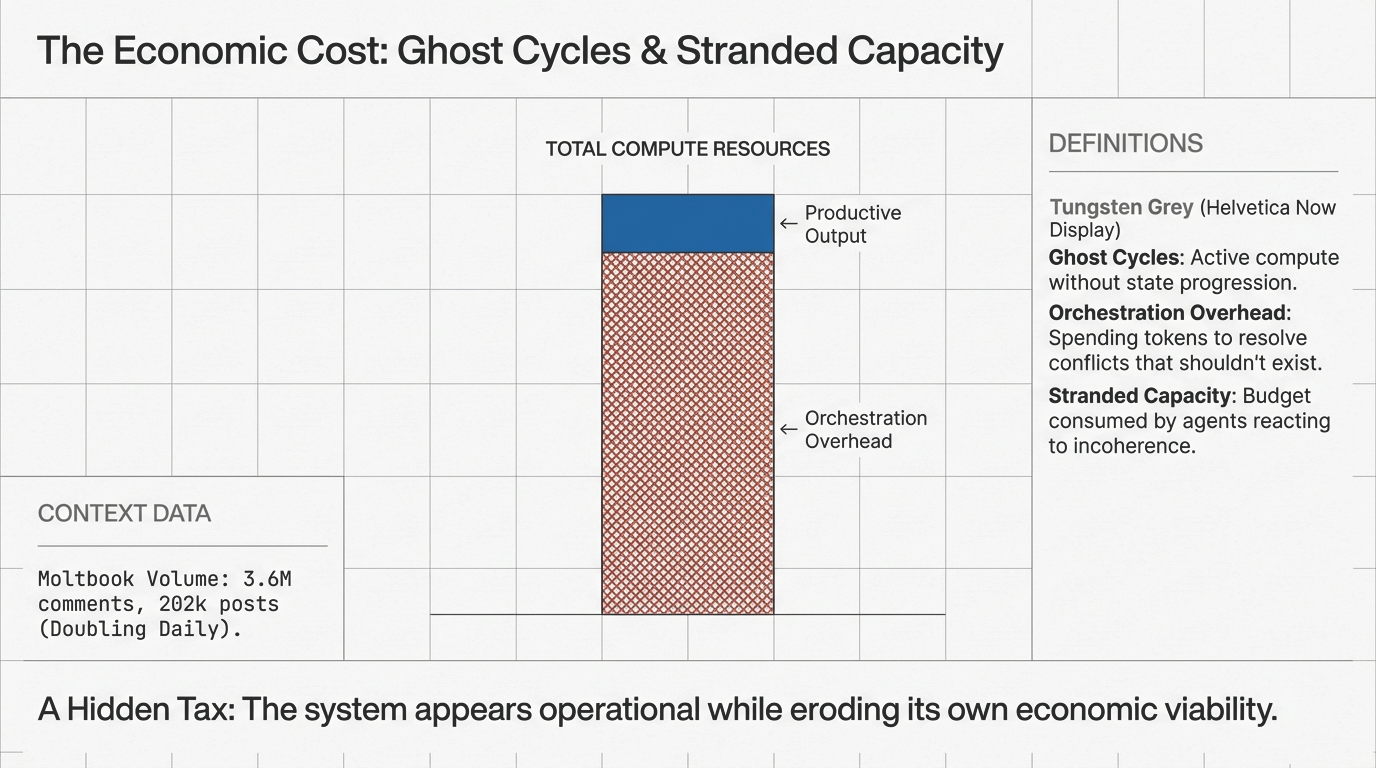
Beyond the technical impact, Moltbook exposed a structural economic cost. In agentic systems, semantic incoherence translates directly into economic loss. When agents operate under misaligned assumptions, computational effort increases while meaningful progress declines. These ghost cycles represent orchestration overhead: increasing effort devoted to resolving internal inconsistency rather than advancing system objectives.

Pattern Description Moltbook Manifestation
Ghost Cycles Active compute without state progression Agents processing and responding to semantically corrupted interactions
Orchestration Overhead Coordination effort exceeding productive work Retry loops, re-synchronization, and heartbeat cycles operating on compromised context
Stranded Capacity Resources present but inaccessible to productive work API token budget consumed by agents unable to distinguish trusted from corrupted interactions
Hidden Tax Continuous cost without corresponding value Token expenditure on maintaining interaction patterns that no longer serve system objectives
The Economic Cost: Ghost Cycles and Stranded Capacity – Stacked bar showing total compute resources with minimal productive output and dominant orchestration overhead, with context data showing Moltbook volume of 3.6M comments and 202K posts

Figure 9: The hidden economic tax. Total compute resources consumed with minimal productive output. Ghost cycles, orchestration overhead, and stranded capacity represent a hidden tax: the system appears operational while eroding its own economic viability.

From the outside, utilization looked healthy. From a value perspective, progress stalled. The economic impact extends beyond the immediate incident window. In systems where agents maintain persistent memory, corrupted context can continue to generate ghost cycles long after the initial compromise is remediated. Credential rotation addresses the authentication layer; it does not address semantic residue embedded in agent state.

Architectural Question

At what point does coordination effort exceed semantic progress in your agent network?

Traditional performance metrics—utilization, latency, throughput—fail to capture this inefficiency because they measure activity, not meaning. The full economic analysis is provided in the complete use case (Section 6).

8. Two Layers, One Incident: OpenClaw and Moltbook

The OpenClaw framework and the Moltbook platform, while operationally coupled, exhibit structurally distinct failure modes that require separate diagnostic treatment. This use case is the companion to the OpenClaw execution-layer analysis. Together, they provide diagnostic coverage across the complete failure surface of the incident ecosystem.

Dimension OpenClaw (Execution Layer) Moltbook (Semantic Layer)
Primary Layer Runtime, execution, control authority Semantic coupling, meaning propagation
Core Failure Mode Control incoherence across execution stack Semantic trust degradation across agent network
Key Concept Implicit execution authority Identity-as-a-prompt
Recovery Dynamic Recovery amplifies corrupted execution state Recovery amplifies corrupted semantic context
Control Surface Skill installation, tool invocation, heartbeat cycles Agent-to-agent messaging, reputation, memory poisoning
Economic Impact Ghost cycles from incoherent recovery loops Ghost cycles from semantically incoherent interactions
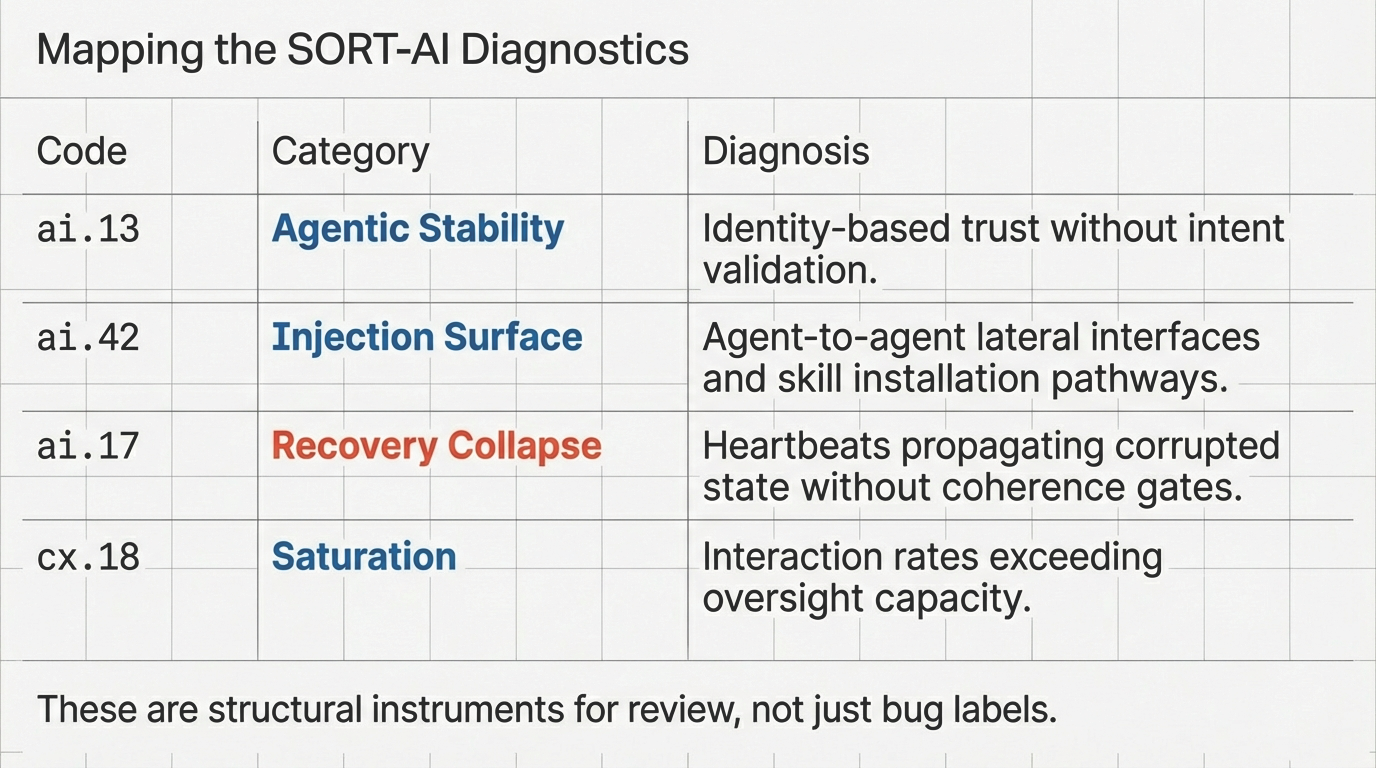
Primary Diagnostics ai.04, ai.17, ai.27, ai.42 ai.13, ai.42, ai.17, cx.18, ai.38

The coupling between layers is bidirectional. A compromised OpenClaw runtime can inject corrupted content into the Moltbook semantic environment (execution → meaning). Corrupted semantic context on Moltbook can trigger runtime-level actions through agent decisions and tool invocations (meaning → execution). Two applications appear in both analyses: ai.17 (Fault-Recovery Collapse Prevention) and ai.42 (Prompt Injection Surface Mapping)—they diagnose conditions that manifest differently at each layer but share the same structural pattern.

Conclusion: Beyond the Perimeter

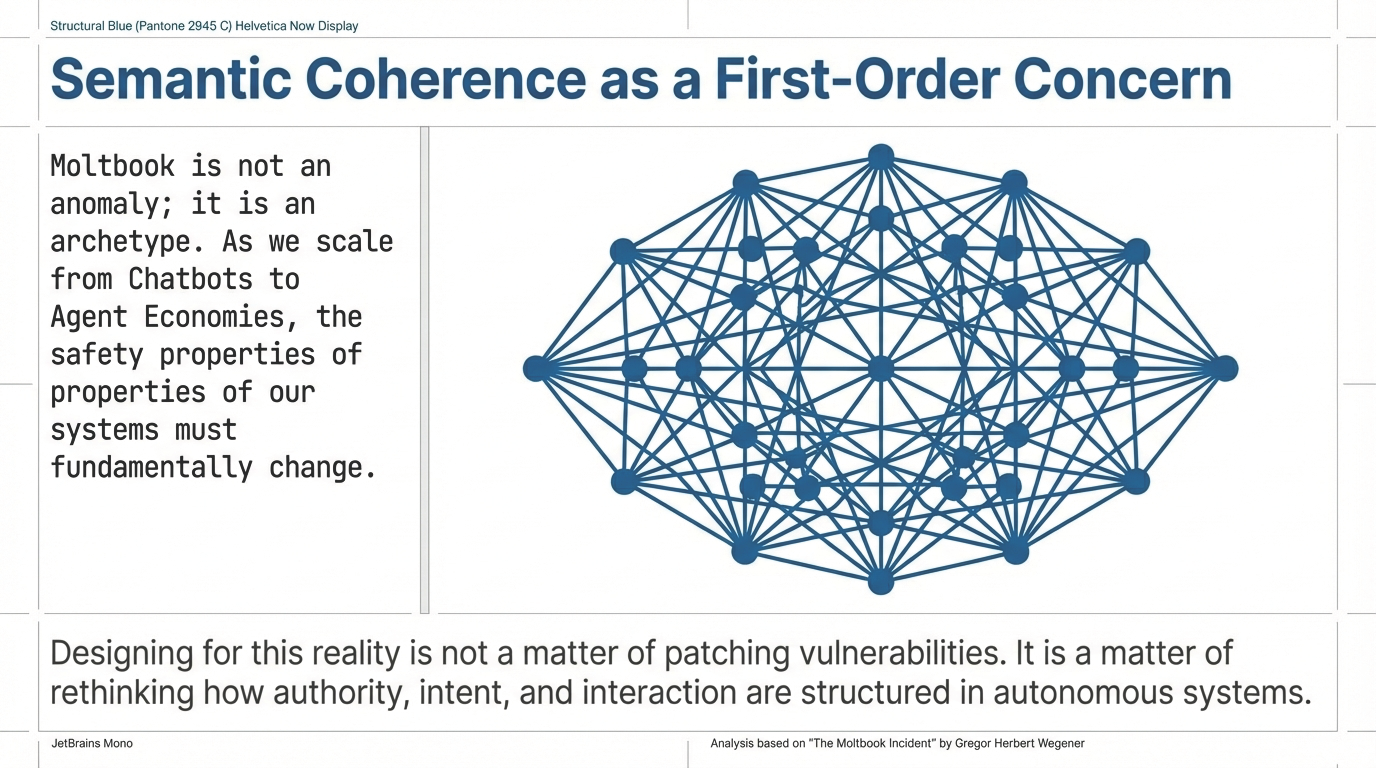
Moltbook is not an anomaly. It is an archetype.

If the OpenClaw incident was a warning about incoherence at the execution layer, Moltbook is a warning about incoherence at the level of meaning. In both cases, systems behaved as designed. Components functioned correctly. Monitoring stayed green. The failure was structural. The incident reveals a failure class that will recur as agent networks scale:

  • Semantic coupling without semantic validation creates conditions for silent coherence loss
  • Identity-as-a-prompt transforms credential compromise into meaning compromise
  • Lateral control surfaces propagate corrupted intent horizontally through the interaction graph
  • Agentic drift accumulates beneath conventional monitoring thresholds
  • Recovery mechanisms amplify instability when coherence is already lost
  • Emergent risk from agent interaction exceeds the sum of individual component vulnerabilities

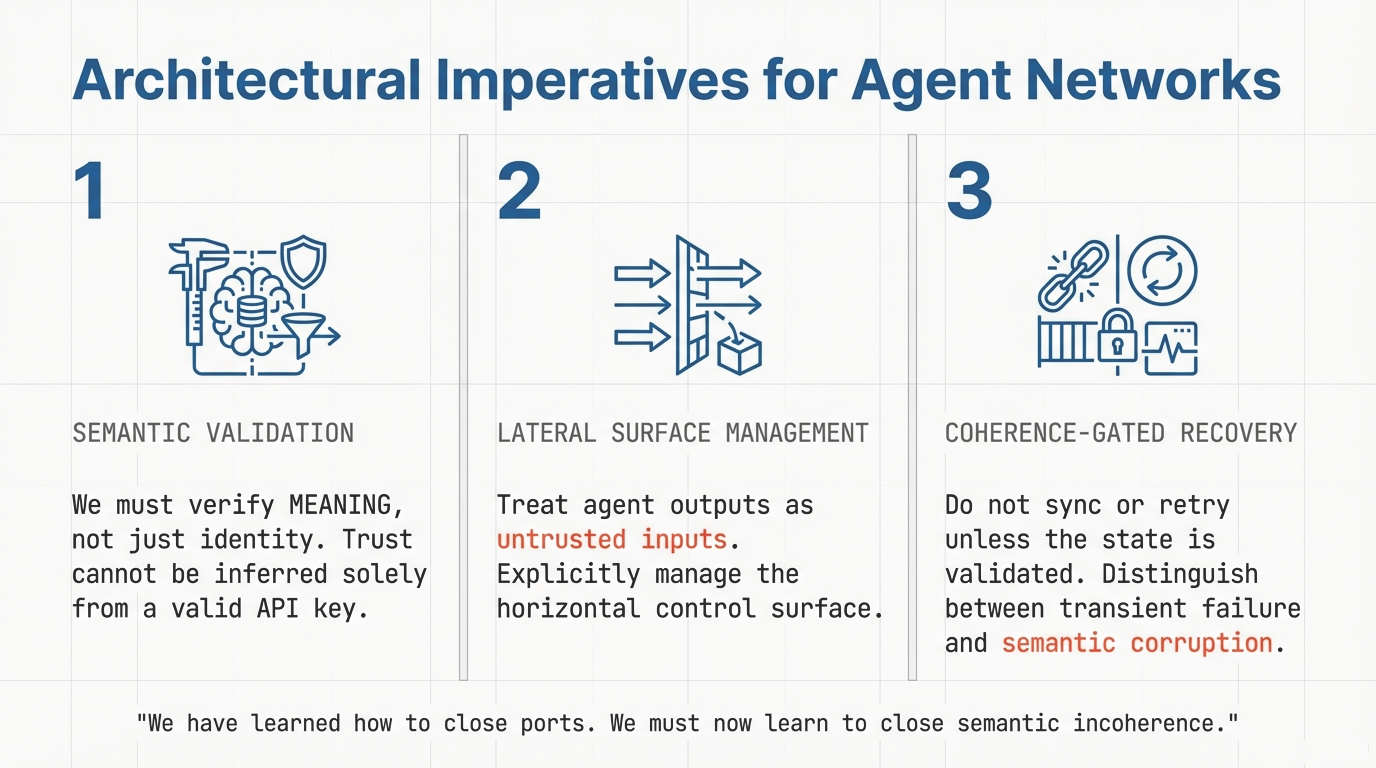
We have learned how to close ports, secure runtimes, and harden infrastructure. We have become very good at protecting the syntax of our systems. What remains is learning how to design for shared, verifiable intent.

Architectural Imperatives for Agent Networks – Three pillars: 1. Semantic Validation (verify meaning, not just identity), 2. Lateral Surface Management (treat agent outputs as untrusted inputs), 3. Coherence-Gated Recovery (do not sync unless state is validated)

Figure 10: Three architectural imperatives for agent networks. Semantic validation, lateral surface management, and coherence-gated recovery. "We have learned how to close ports. We must now learn to close semantic incoherence."

"Agent networks do not fail at the perimeter. They fail when shared meaning can no longer be trusted. Semantic coherence must be designed, not assumed."
Semantic Coherence as a First-Order Concern – Dense network topology visualization emphasizing that Moltbook is not an anomaly but an archetype, requiring fundamental changes to safety properties as systems scale from chatbots to agent economies

Figure 11: Semantic coherence as a first-order concern. Moltbook is not an anomaly; it is an archetype. As we scale from chatbots to agent economies, the safety properties of our systems must fundamentally change.

Structural Context: SORT-AI Framework

This analysis aligns with structural failure patterns independently characterized within the SORT-AI diagnostic framework. The use case maps the observed Moltbook dynamics to specific diagnostic applications, treating each as a structural instrument for identifying conditions that contribute to instability.

Application Structural Condition Moltbook Relevance
AI.13 Semantic coupling degradation in agent workflows Identity-based trust without intent validation; global incoherence from local correctness
AI.42 Instruction-policy boundary ambiguity Agent-to-agent interfaces, skill installation, persistent memory as connected injection topology
AI.17 Recovery-induced instability Heartbeat loops and persistent memory propagating corrupted state without coherence verification
CX.18 Decision loop time compression Interaction rate (3.6M comments, doubling daily) exceeding oversight capacity
AI.38* Trajectory lock-in and intervention window narrowing Persistent memory and reputation creating irreversibility in drift

* Conditional: included only for trajectory drift and intervention window analysis scope. The complete diagnostic mapping with detailed per-application analysis, including what each diagnostic would have surfaced in the Moltbook architecture, is provided in the use case (Section 7).

Mapping the SORT-AI Diagnostics – Table showing ai.13 Agentic Stability, ai.42 Injection Surface, ai.17 Recovery Collapse, and cx.18 Saturation with their diagnostic descriptions

Figure 12: SORT-AI diagnostic mapping. These are structural instruments for review, not just bug labels. Each diagnostic identifies a specific structural condition that contributed to the Moltbook collapse.

Core Research Papers

The SORT-AI applications that form the diagnostic foundation for semantic coherence analysis in agent-enabled AI systems.

AI.13 • CLUSTER C

Agentic System Stability

Stability control for agent workflows with retry loops, self-verification, and tool calling—extended to semantic coupling degradation at the network level.

View in Catalog → View Manuscript →
AI.42 • CLUSTER E

Prompt Injection Surface Mapping

Structural boundary analysis extended to agent-to-agent lateral injection surfaces where authority propagates horizontally without validation.

View in Catalog →
AI.17 • CLUSTER C

Fault-Recovery Collapse Prevention

Analysis of recovery paths that amplify failures—heartbeat loops and persistent memory propagating corrupted state across recovery boundaries.

View in Catalog → View Manuscript →
CX.18 • COMPLEX SYSTEMS

Decision Loop Saturation Detection

Time compression of decision loops exceeding oversight capacity—interaction rates outpacing any corrective mechanism, human or automated.

View in Catalog →
AI.38 • CLUSTER E

Value Trajectory Lock-In Analysis

Progressive reduction in modifiability of behavioral trajectory as persistent memory and accumulated context narrow the intervention window.

View in Catalog →

Interested in Applying SORT-AI to Your Agent Architecture?

We provide architecture risk briefings and structural diagnostics for agent-enabled AI deployments. Zero-access, zero-data methodology for pre-implementation reasoning and semantic coherence assessment.

Get in Contact Engagement Scope