// SYSTEMS ANALYSIS • INFERENCE ARCHITECTURE

The Cost-Reliability Paradox: Why AI Systems Become Less Predictable as Inference Gets Cheaper

Reducing inference cost alters the structural geometry of the system that produces model behavior. The result is not model degradation—it is architectural reconfiguration. A structural analysis of how cost optimization reshapes execution topology, control geometry, and agent reasoning depth.

Download Presentation Companion: Efficiency Paradox View Core Papers
The Cost-Reliability Paradox – Why AI Systems Become Less Predictable as Inference Gets Cheaper: structural analysis of execution topology reconfiguration under cost optimization

The Cost-Reliability Paradox: cost efficiency and reliability operate through the same structural variables.

1. The Paradox

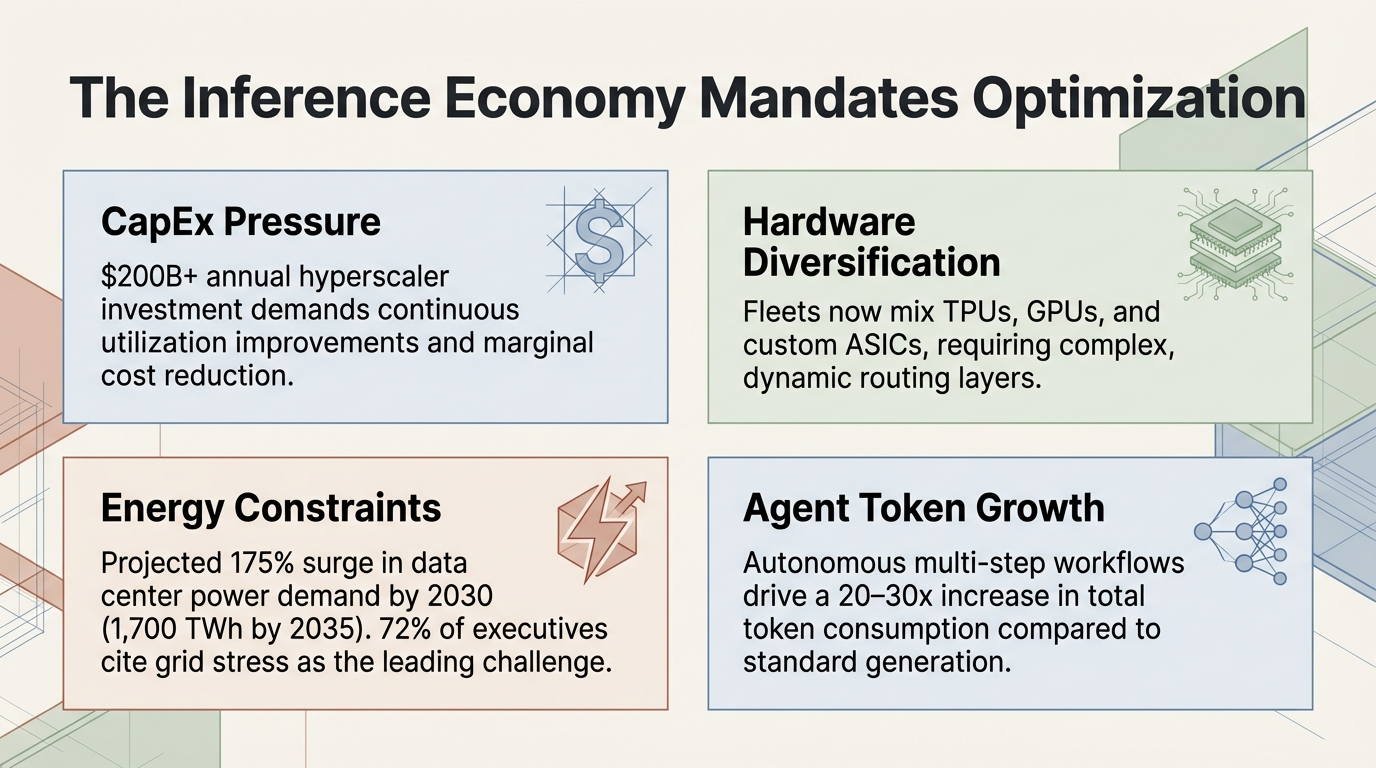
In the past two years, the economics of AI inference have changed dramatically. Token prices have fallen by orders of magnitude. Hardware throughput has increased. Infrastructure utilization has improved across the industry. From an operational perspective, this is a remarkable success.

Yet many organizations report a subtle and puzzling pattern: their systems are cheaper to run than ever before, but agent workflows behave less predictably. Task completion rates fluctuate. Tool-calling chains terminate earlier than expected. Complex reasoning workflows occasionally lose coherence.

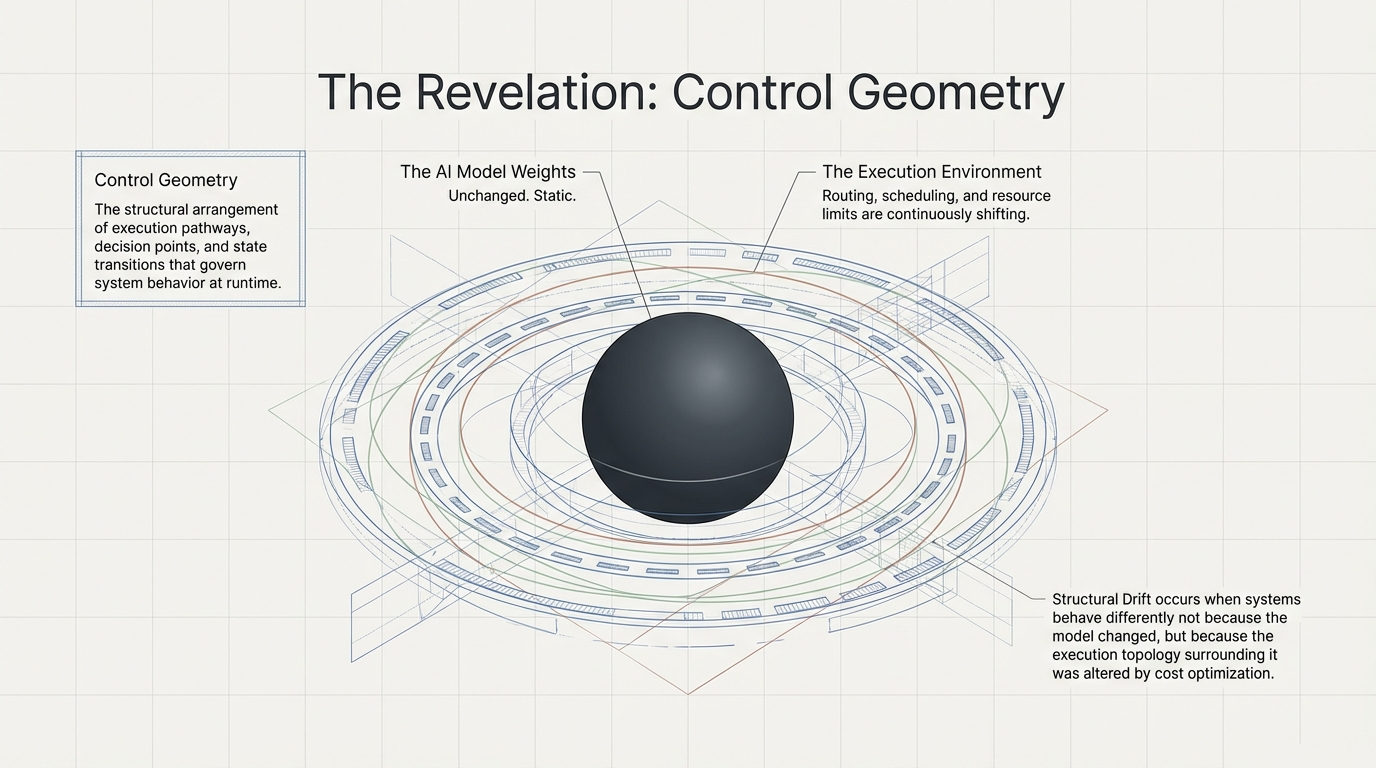
The models themselves have not changed. What changed is the execution environment surrounding them.
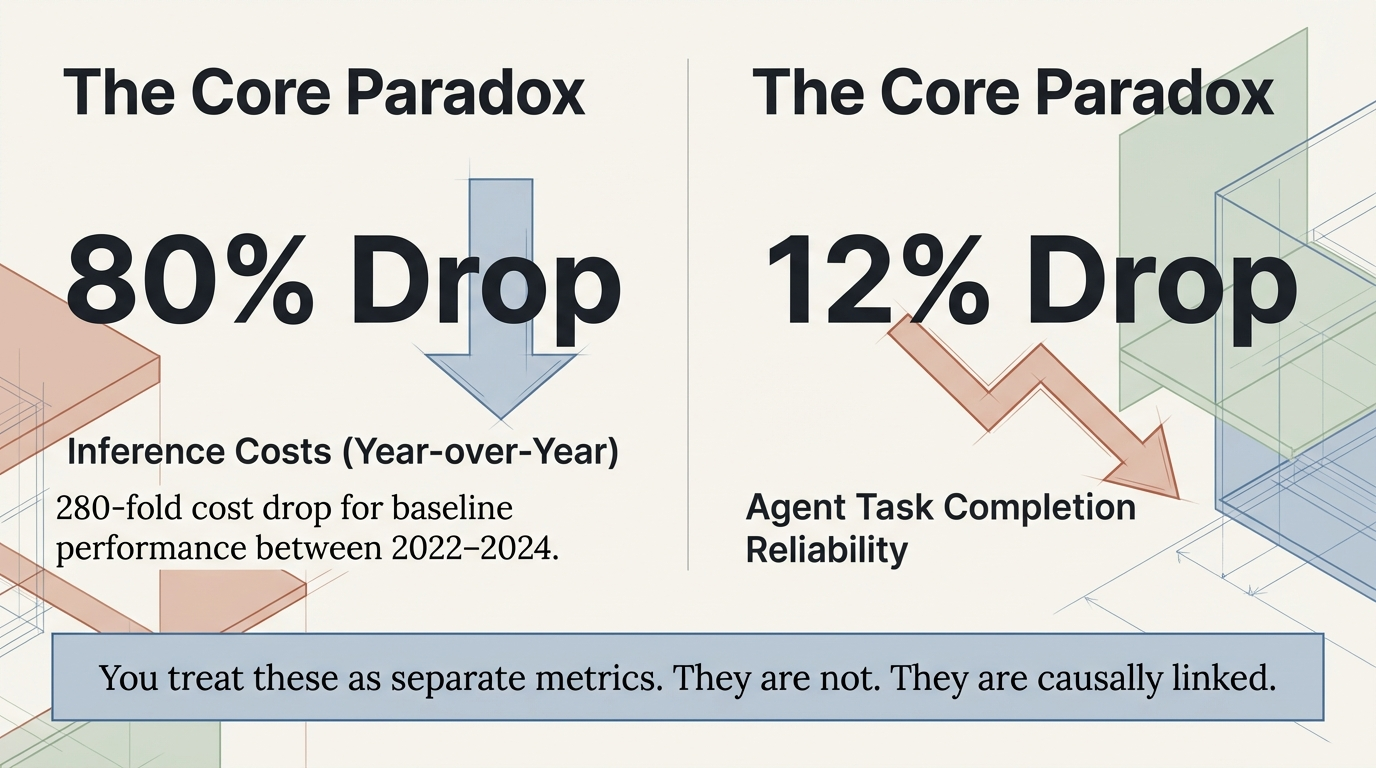
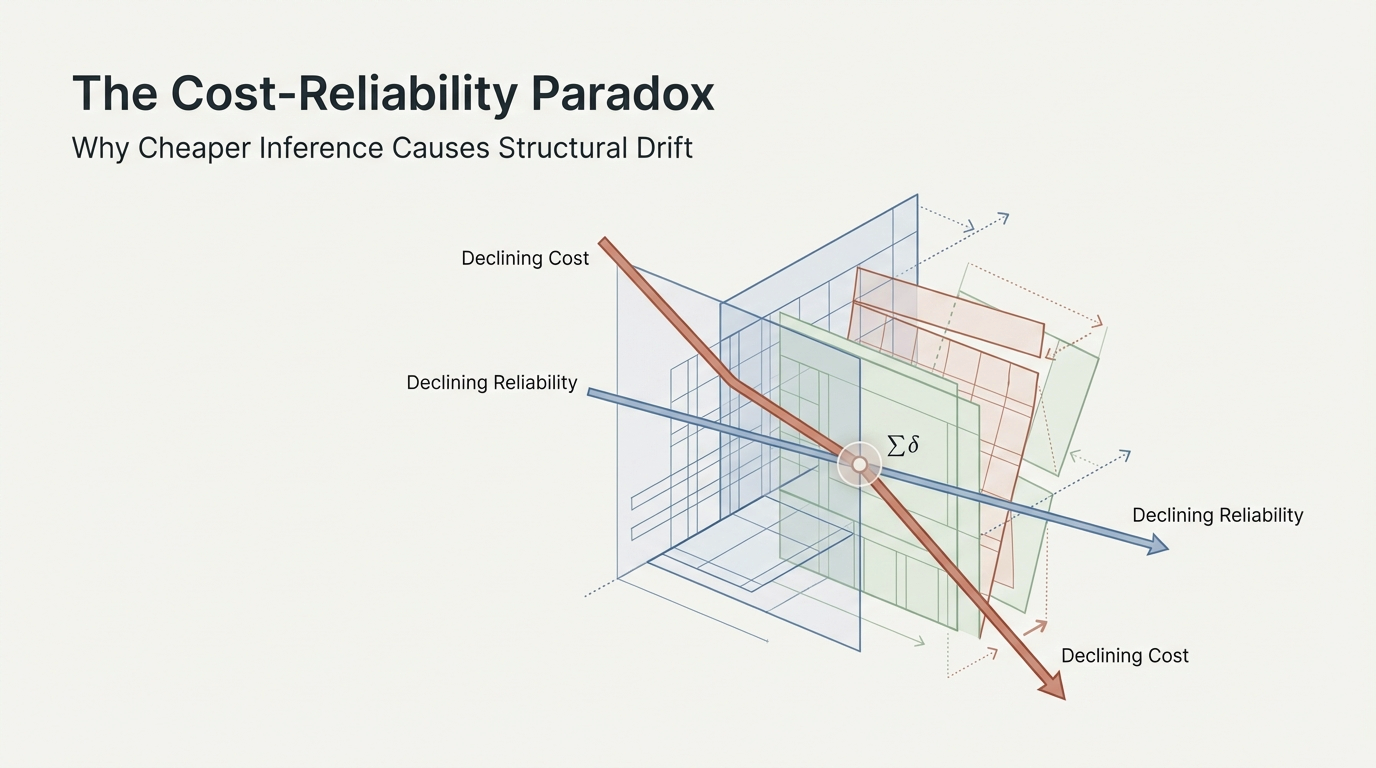
The Paradox – Systems are cheaper to run but agent workflows behave less predictably, despite unchanged model weights

Figure 1: The paradox – cost optimization succeeds operationally while reliability degrades structurally.
"The model is constant. The geometry around it evolves. A static model embedded in a changing execution topology will naturally exhibit different behavior. This is structural drift."

2. Cost Optimization Is an Architectural Force

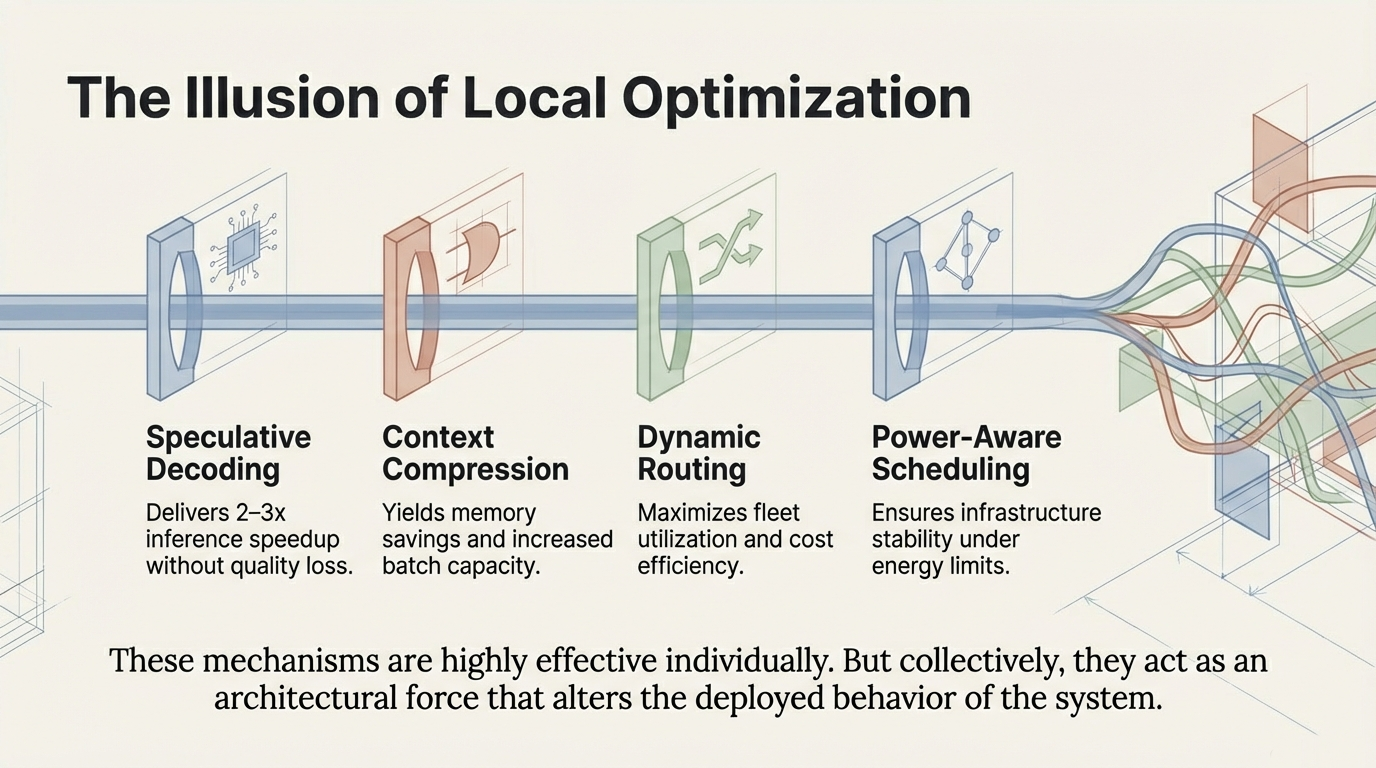
In large AI systems, cost optimization is often treated as a financial adjustment. In reality, it acts as an architectural force. When inference systems are optimized for token budgets, latency targets, and GPU utilization, the control surfaces surrounding the model evolve. Scheduling policies change. Hardware routing shifts. Runtime budgets tighten.

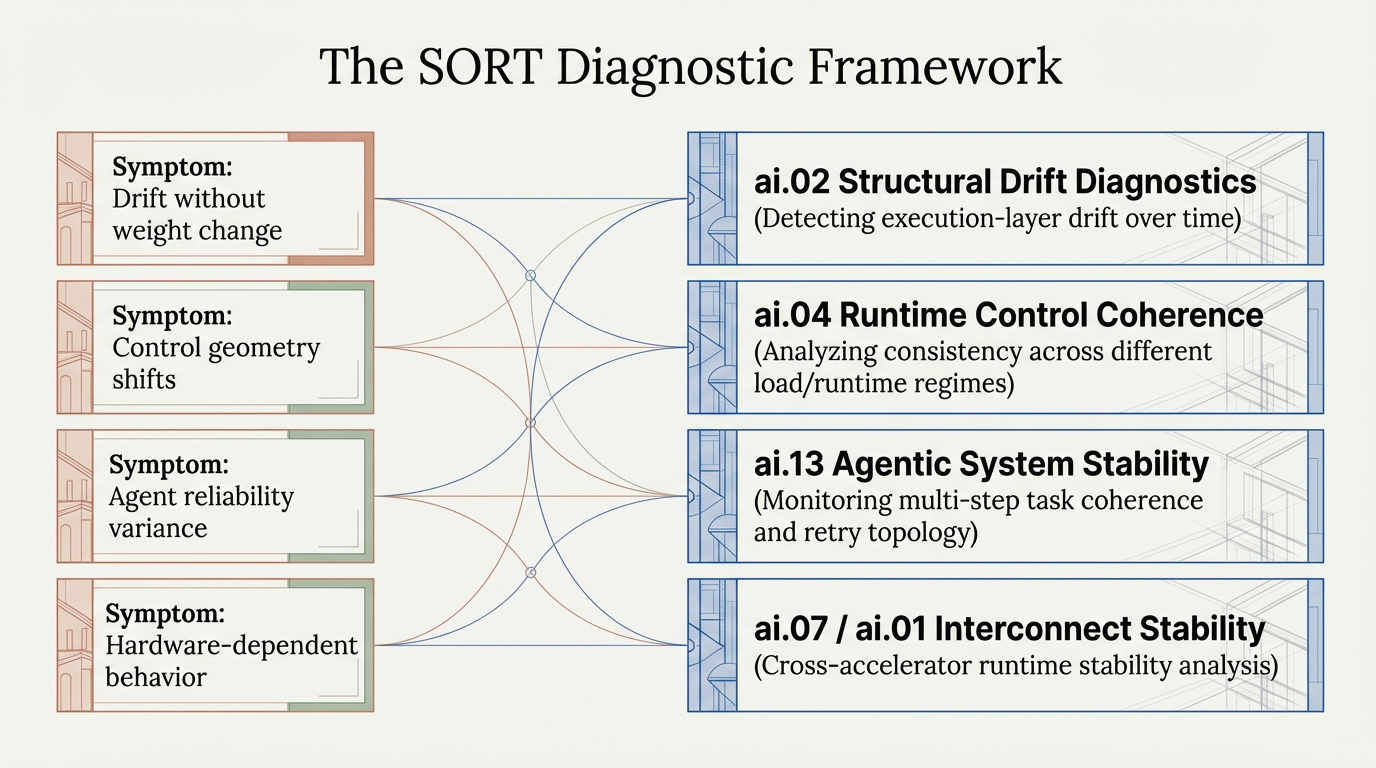
None of these adjustments modify model weights. Yet together they alter the decision environment in which the model operates. This phenomenon—analyzed in depth through ai.02 Structural Drift Diagnostics—reveals that structural drift is not a model problem. It is an execution topology problem.

Cost Optimization as Architectural Force – Scheduling policies, hardware routing, and runtime budgets reshape the decision environment without modifying model weights

Figure 2: Cost optimization reshapes the control surfaces surrounding the model—scheduling, routing, and budget allocation evolve independently of model weights.

3. Hardware Heterogeneity Expands the Decision Surface

Modern inference fleets rarely operate on a single homogeneous hardware stack. Large deployments combine multiple accelerator types: high-end GPUs, cost-optimized inference accelerators, and regional infrastructure with varying latency characteristics. Routing a request across this heterogeneous environment is not merely a scheduling decision—it changes the physical constraints under which the model executes.

Memory bandwidth differs. Context window performance varies. Token generation dynamics shift. From the perspective of the orchestration layer, this improves cost efficiency. From the perspective of the reasoning process, the execution boundary conditions have changed. Under certain load regimes, identical requests can follow slightly different reasoning trajectories depending on where they are executed.

Hardware Heterogeneity – Multiple accelerator types create varying execution boundary conditions for identical requests

Figure 3: Hardware heterogeneity introduces execution-dependent reasoning variance—identical requests may traverse different reasoning trajectories depending on the physical execution target.

This effect becomes visible only at scale. It is a structural coupling problem between the orchestration layer and the inference substrate, analyzed through ai.01 Interconnect Stability Control and ai.04 Runtime Control Coherence.

Execution boundary conditions – Memory bandwidth, context window performance, and token generation dynamics vary across heterogeneous hardware

Figure 4: Execution boundary conditions vary across heterogeneous fleet targets, creating load-dependent reasoning variance.

4. The Five Hidden Levers of Control Geometry

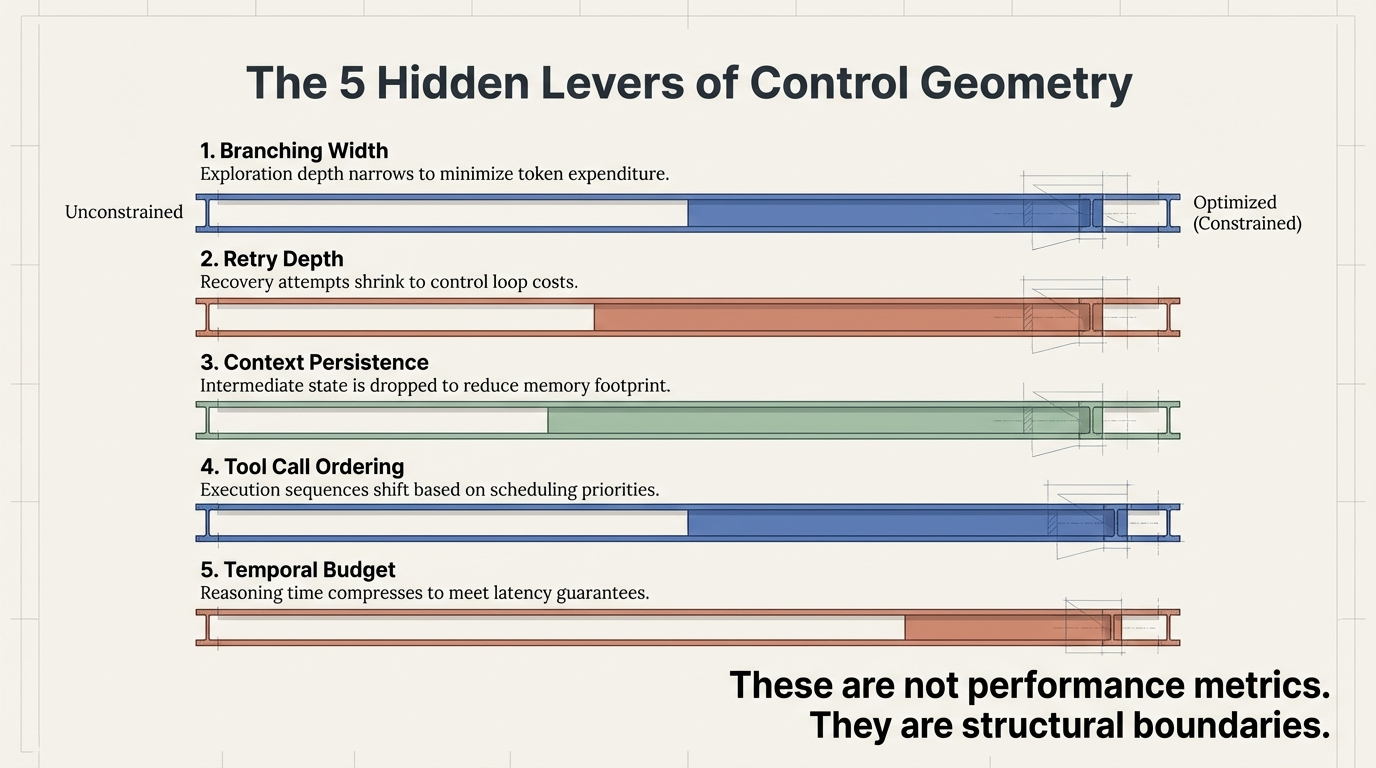
Cost optimization rarely modifies the model itself. Instead, it reshapes the control geometry of the surrounding system. Five structural variables typically shift during cost-driven optimization:

Five Hidden Levers of Control Geometry – Branching Width, Retry Depth, Context Persistence, Tool Call Ordering, Temporal Budget

Figure 5: The five structural variables that shift during cost-driven optimization—each individually improves efficiency, together they reshape the reasoning space.

  • Branching Width – Exploration depth within reasoning workflows narrows when token budgets tighten. Agents explore fewer speculative paths.
  • Retry Depth – Cost-bounded retry policies reduce the number of recovery attempts during tool failures or reasoning loops.
  • Context Persistence – Context compression and KV-cache optimization reduce memory footprint but may remove intermediate reasoning state.
  • Tool Call Ordering – Schedulers optimizing for latency and throughput may reorder external calls, altering execution timing.
  • Temporal Budget – Generation limits and early termination thresholds shorten the reasoning horizon.
Control geometry detail – How individual optimizations compose to reshape the reasoning space in which the model operates

Figure 6: Each lever individually improves efficiency. Together, they reshape the reasoning space in which the model operates.

Structural Question

If your model is unchanged but your cost optimization stack has evolved over the last six months—have you validated that the reasoning space is still structurally equivalent?

5. Why Traditional Observability Rarely Detects It

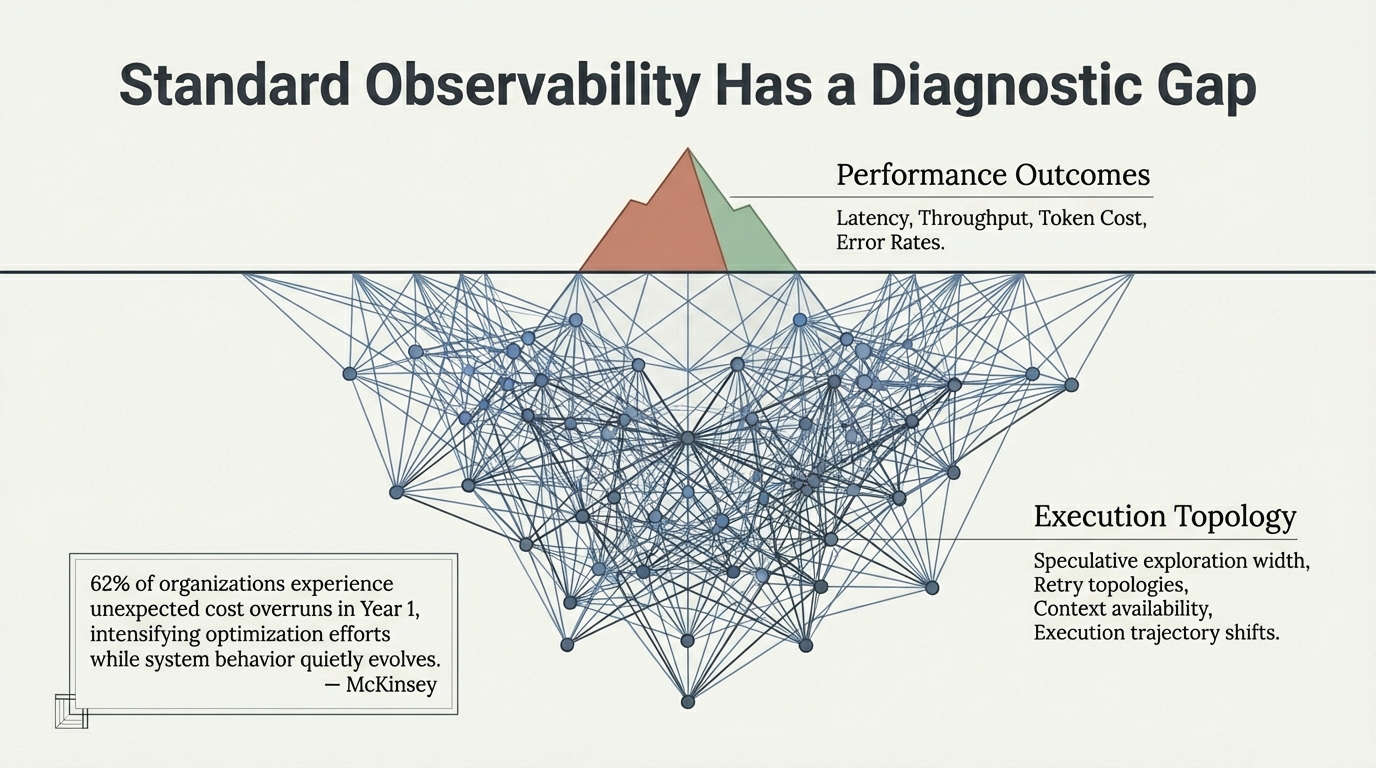
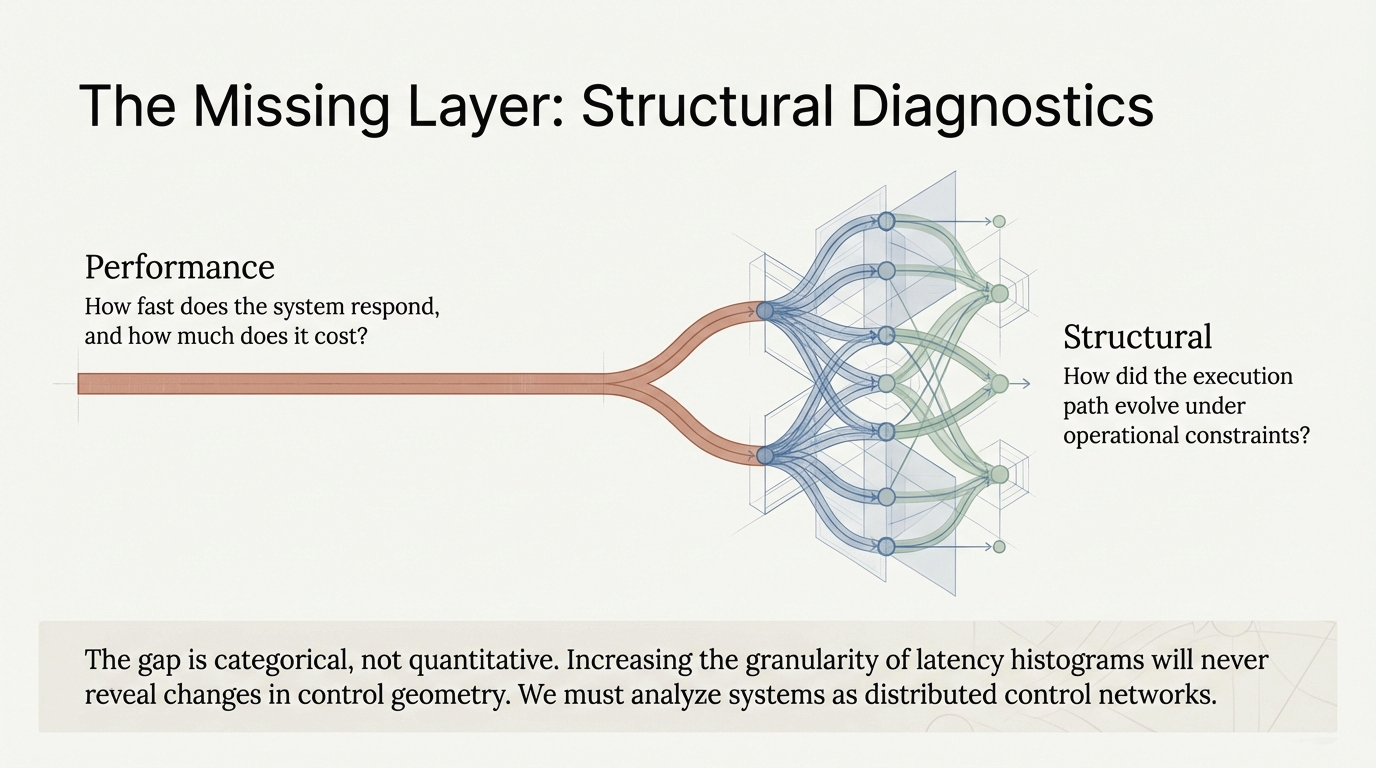
Standard monitoring systems focus on outcome metrics: latency, throughput, token cost, utilization. These indicators remain healthy during most cost optimizations. The structural shift occurs one layer deeper, inside the execution topology.

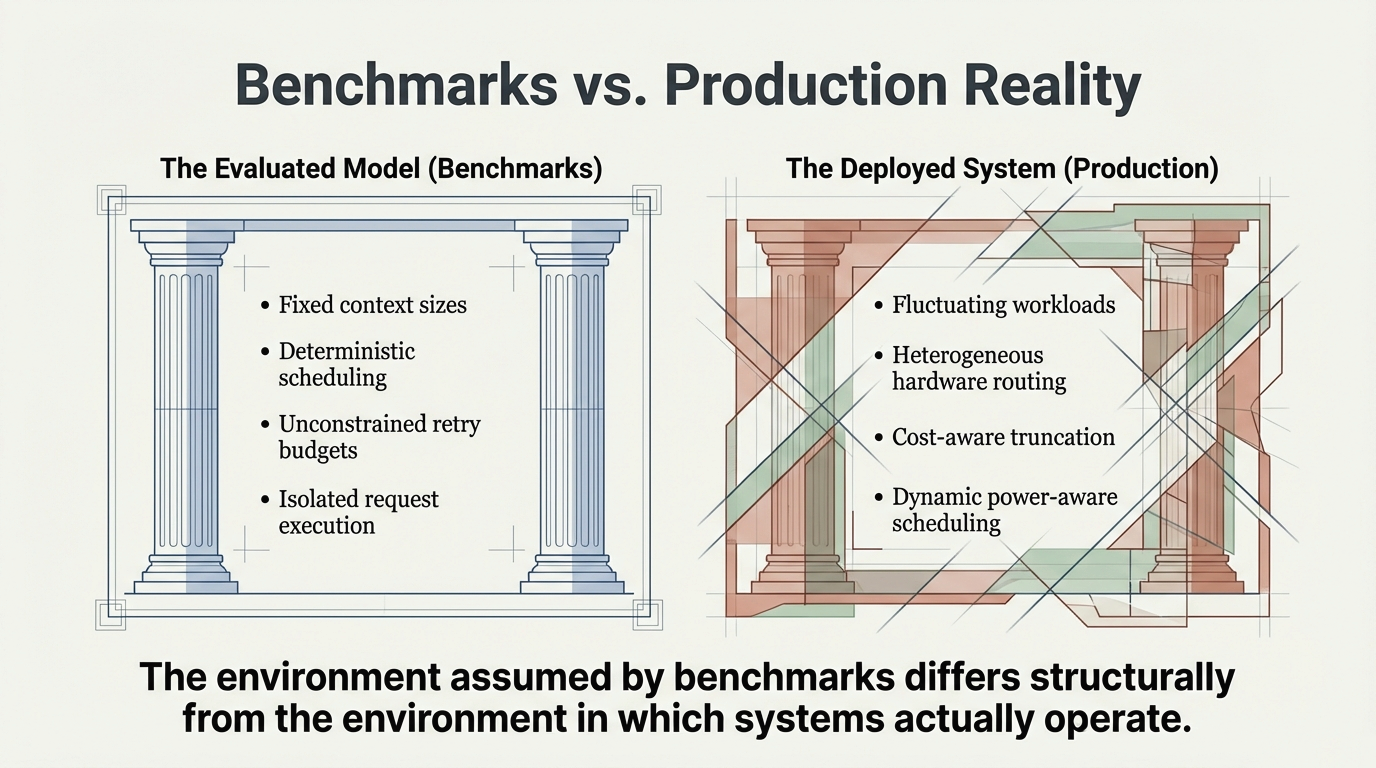
Evaluation benchmarks operate in stable environments where structural constraints are absent. Production environments introduce adaptive scheduling, hardware routing, and cost-aware truncation. The model that was evaluated and the system that is deployed are therefore not structurally identical.

Observability Gap – Standard telemetry remains healthy while structural drift occurs one layer deeper inside execution topology

Figure 7: The observability gap—standard telemetry remains healthy while the execution topology drifts beneath.

This is precisely the gap that ai.47 Evaluation Context Projection Instability is designed to diagnose: the structural divergence between evaluation context and deployment context. Complemented by ai.02 Structural Drift Diagnostics and ai.04 Runtime Control Coherence, these diagnostics examine whether identical requests traverse the same reasoning pathways under different runtime conditions.

Evaluation vs. Production – Structural divergence between benchmark environments and production execution topology

Figure 8: Evaluation and production environments are not structurally identical—adaptive scheduling, hardware routing, and cost-aware truncation introduce structural variables absent from benchmarks.

6. Agents Amplify the Effect

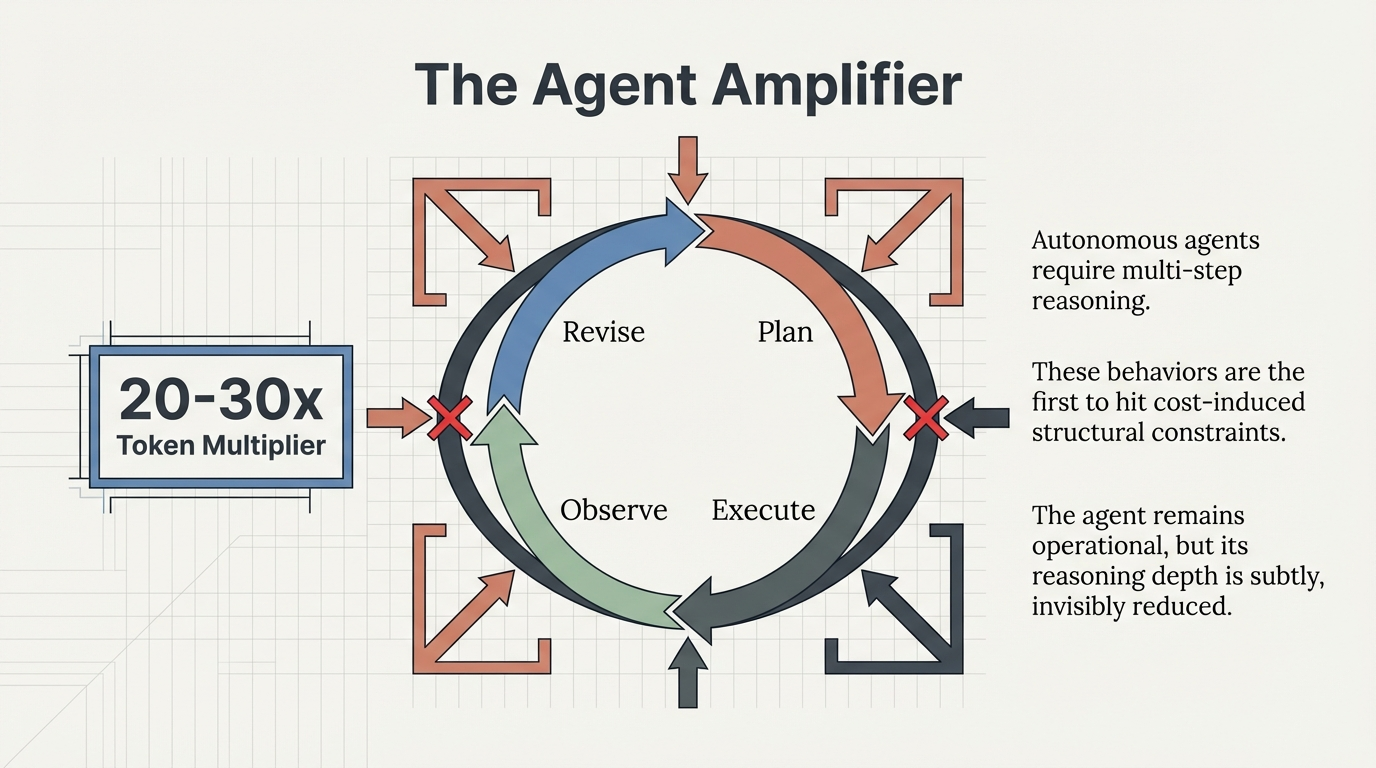
Autonomous agents are particularly sensitive to these structural changes. Unlike chat systems that produce a single response, agents rely on multi-step reasoning loops: plan → execute → observe → revise. These loops consume significantly more inference compute.

As cost optimization intensifies, agent workflows are often the first components to be constrained. Planning horizons shorten. Retry budgets tighten. Context buffers shrink. The agent remains operational, but its reasoning depth is subtly reduced.

Agent Amplification – Multi-step reasoning loops are the first components constrained by cost optimization, reducing planning horizons and retry budgets

Figure 9: Agents amplify the cost-reliability paradox—multi-step reasoning loops are disproportionately affected by control geometry changes.

In many deployments this produces the impression that the system is “less logical” than before, even though the model itself is unchanged. This is the domain of ai.13 Agentic System Stability, which provides stability control for agent workflows with retry loops, self-verification, and tool calling patterns.

7. Emergent Effects from Optimization Composition

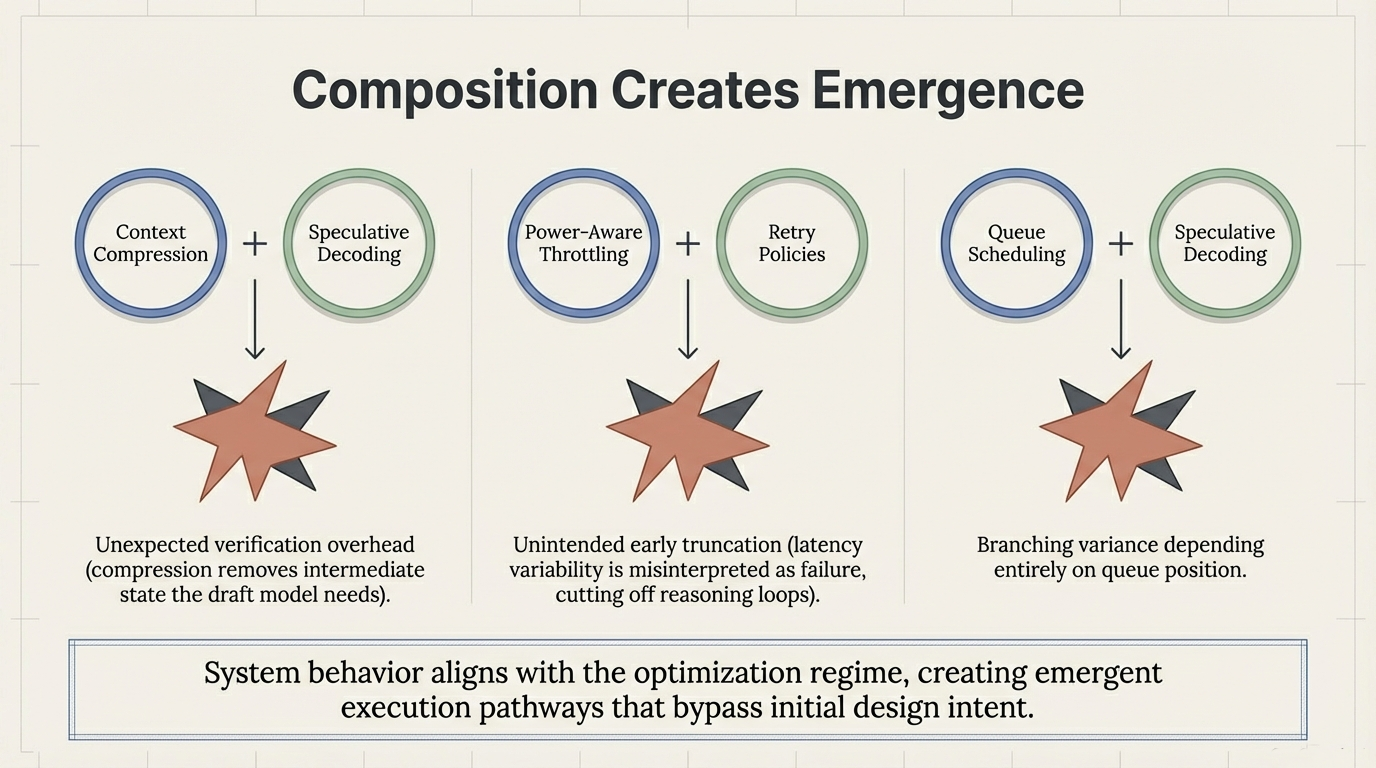
The most interesting dynamics rarely arise from a single optimization. They emerge through composition. Two optimizations that work well independently may interact in unexpected ways.

Optimization Composition – Context compression combined with speculative decoding creates unexpected verification overhead

Figure 10: Optimization composition—individually efficient optimizations can interact to reshape execution timing and reasoning behavior.

Composition Example 1

Context Compression + Speculative Decoding

Context compression reduces memory usage. Speculative decoding improves generation speed. Combined, compression may remove intermediate state required for the draft model's predictions, increasing verification overhead.

Composition Example 2

Power-Aware Scheduling + Retry Policies

Energy-aware data center scheduling introduces latency variability. Fixed retry policies may interpret this variability as failure, truncating reasoning loops earlier than intended.

Composition effects detail – How independent optimizations interact to produce emergent structural behavior

Figure 11: Composition effects in practice—each optimization improves efficiency in isolation; their interaction reshapes execution timing and reasoning behavior.

This compositional dynamic is what ai.24 Structural Cost Amplification and Budget Explosion Diagnostics is designed to detect: amplification paths through feedback loops, retry logic, and nonlinear control coupling.

8. The Structural Perspective

As the AI industry transitions into an inference-dominated operating model, system architecture becomes as important as model capability. Cost efficiency and reliability are not opposing objectives. They operate through the same structural variables.

Understanding how those variables interact is therefore increasingly valuable. The Cost-Reliability Paradox is not a failure of AI systems. It is a signal that execution topology has become a first-order design variable. Making that topology explicit allows architects to preserve both efficiency and predictability as systems scale.

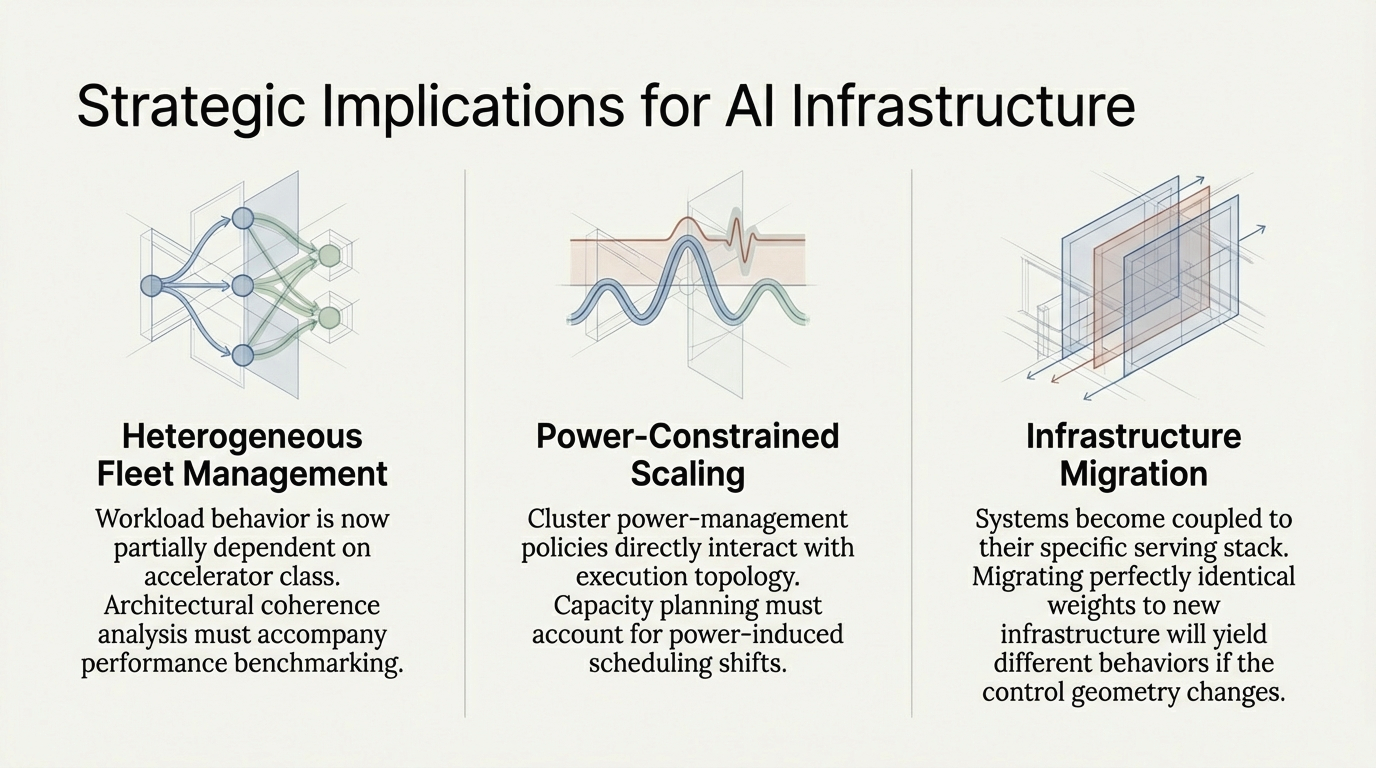
The Structural Perspective – Execution topology as first-order design variable, enabling architects to preserve both efficiency and predictability

Figure 12: The structural perspective—execution topology as a first-order design variable.

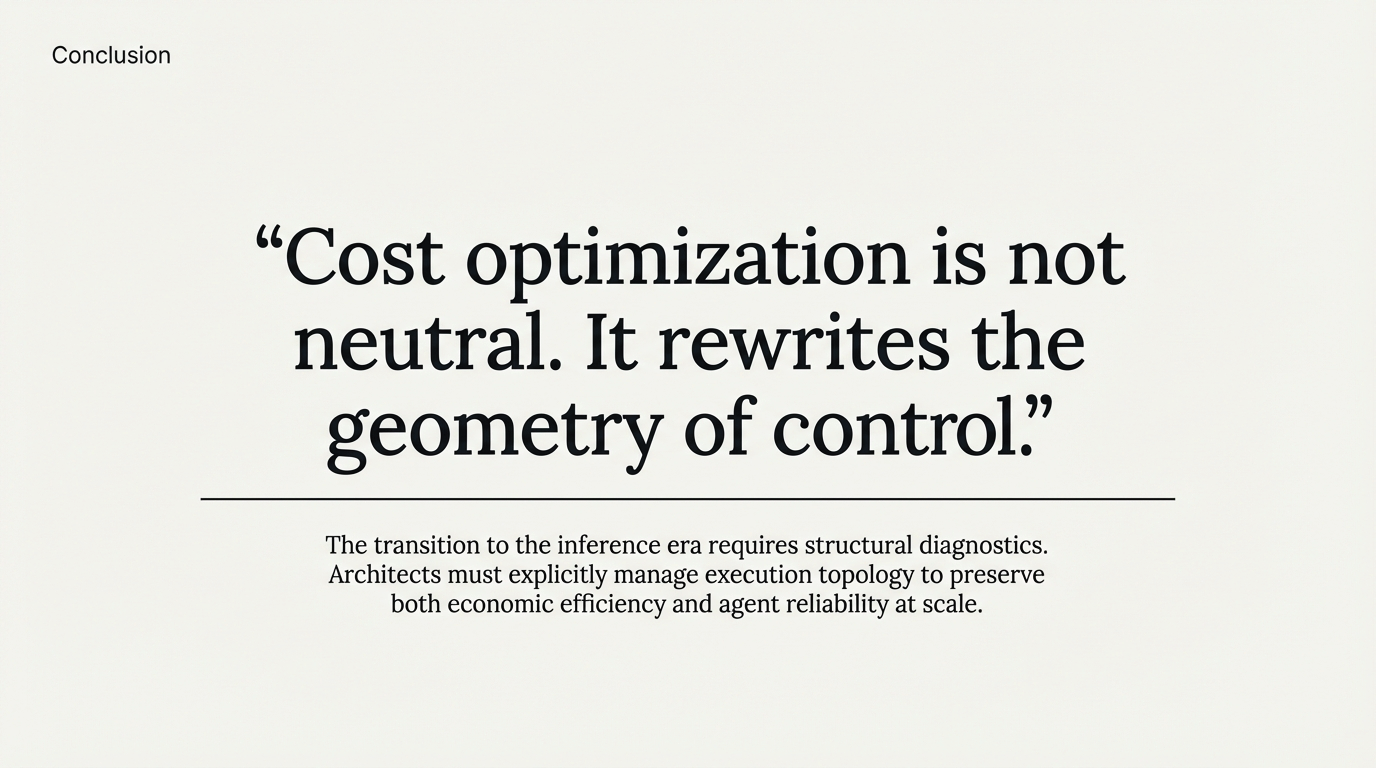
Closing – Structural diagnostics for cost-driven inference optimization

Figure 13: Cost efficiency and reliability operate through the same structural variables—making them explicit is the path to preserving both.

Core Research Papers

The SORT-AI applications that form the diagnostic foundation for structural analysis of cost-reliability dynamics in inference-dominated AI systems.

AI.02 • CLUSTER A

Structural Drift Diagnostics

Detect structural drift across training and inference pipelines beyond metrics and telemetry—the foundational diagnostic for identifying execution topology changes that escape standard observability.

View Application Brief →
AI.04 • CLUSTER C

Runtime Control Coherence

Diagnosing incoherence between scheduler, orchestrator, runtime, and policy enforcement layers—the control plane analysis that reveals how cost optimization reshapes execution behavior.

View Application Brief → View Manuscript →
AI.13 • CLUSTER C

Agentic System Stability

Stability control for agent workflows with retry loops, self-verification, and tool calling—diagnosing why agents are disproportionately affected by control geometry changes.

View Application Brief → View Manuscript →
AI.24 • CLUSTER C

Structural Cost Amplification Diagnostics

Structural analysis of cost as emergent system property—identifying amplification paths through feedback loops, retry logic, and nonlinear control coupling.

View Application Brief →
AI.47 • CLUSTER C

Evaluation Context Projection Instability

Structural analysis of behavior divergence between evaluation and deployment contexts—diagnosing why benchmarked performance does not project onto production behavior.

View Application Brief →

Interested in Applying SORT-AI to Your Inference Architecture?

We provide architecture risk briefings and structural diagnostics for inference-dominated AI deployments. Zero-access, zero-data methodology for pre-implementation reasoning and economic risk assessment.

Get in Contact Engagement Scope