// STRUCTURAL DIAGNOSTICS • HETEROGENEOUS INFERENCE

Runtime Coherence: The Hidden Variable in Heterogeneous AI Inference

Why mixed accelerator fleets, virtualized execution, and cross-environment placement change the meaning of AI infrastructure performance—and why a structural perspective on cross-layer coordination can unlock capacity that conventional metrics cannot see.

Download Manuscript Download Presentation Interactive Demos
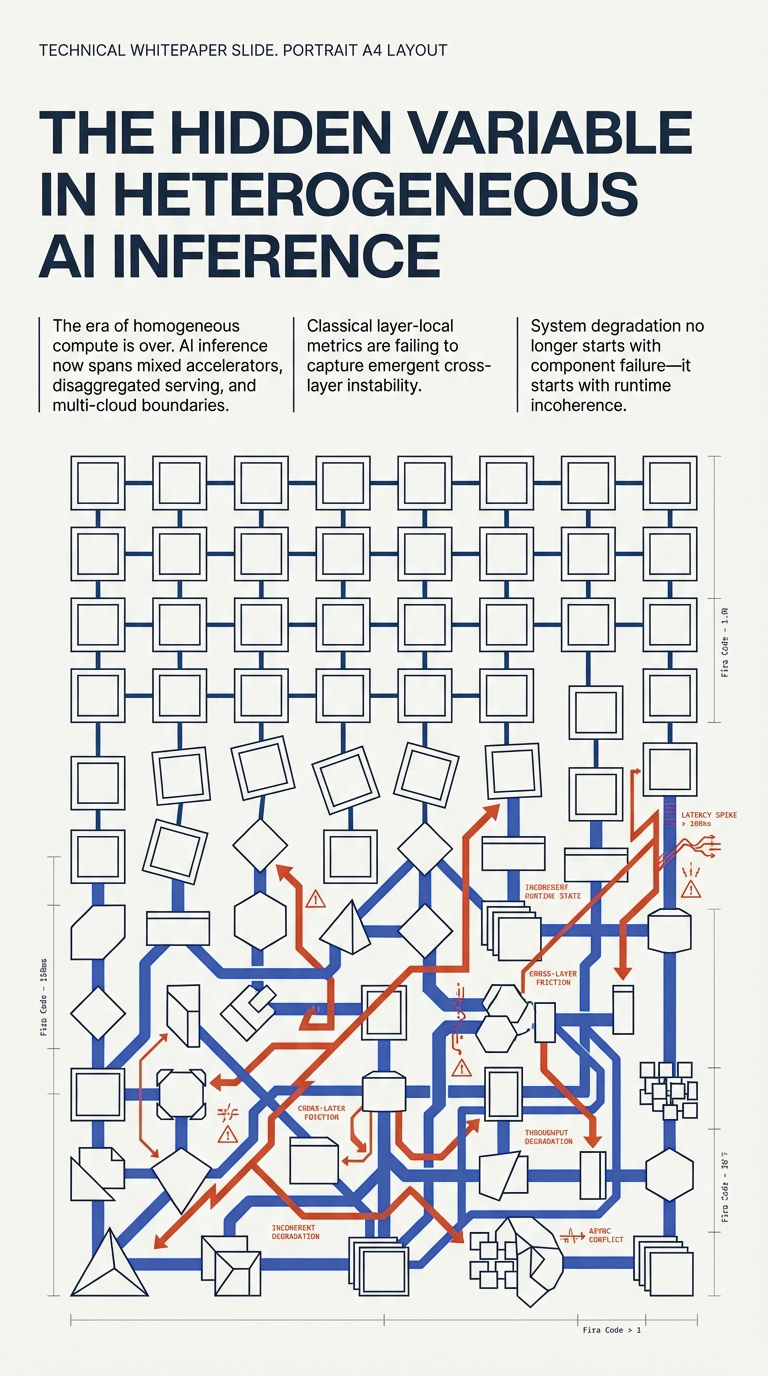
The Hidden Variable in Heterogeneous AI Inference

The era of homogeneous compute is over. Classical layer-local metrics do not capture emergent cross-layer dynamics. System-level behavior starts with runtime incoherence.

1. From Homogeneous Fleets to Heterogeneous Inference Fabrics

Earlier AI infrastructure regimes were frequently organized around relatively homogeneous accelerator fleets, bounded network assumptions, and comparatively stable runtime conditions. Under those conditions, performance reasoning could often proceed through localized constraints: device saturation, memory pressure, or interconnect bottlenecks within a mostly uniform execution fabric.

That assumption is becoming progressively less adequate. Contemporary inference systems are increasingly assembled from mixed accelerator classes, heterogeneous memory paths, disaggregated serving stages, virtualized execution layers, and placement patterns that extend across cloud, region, and provider boundaries.
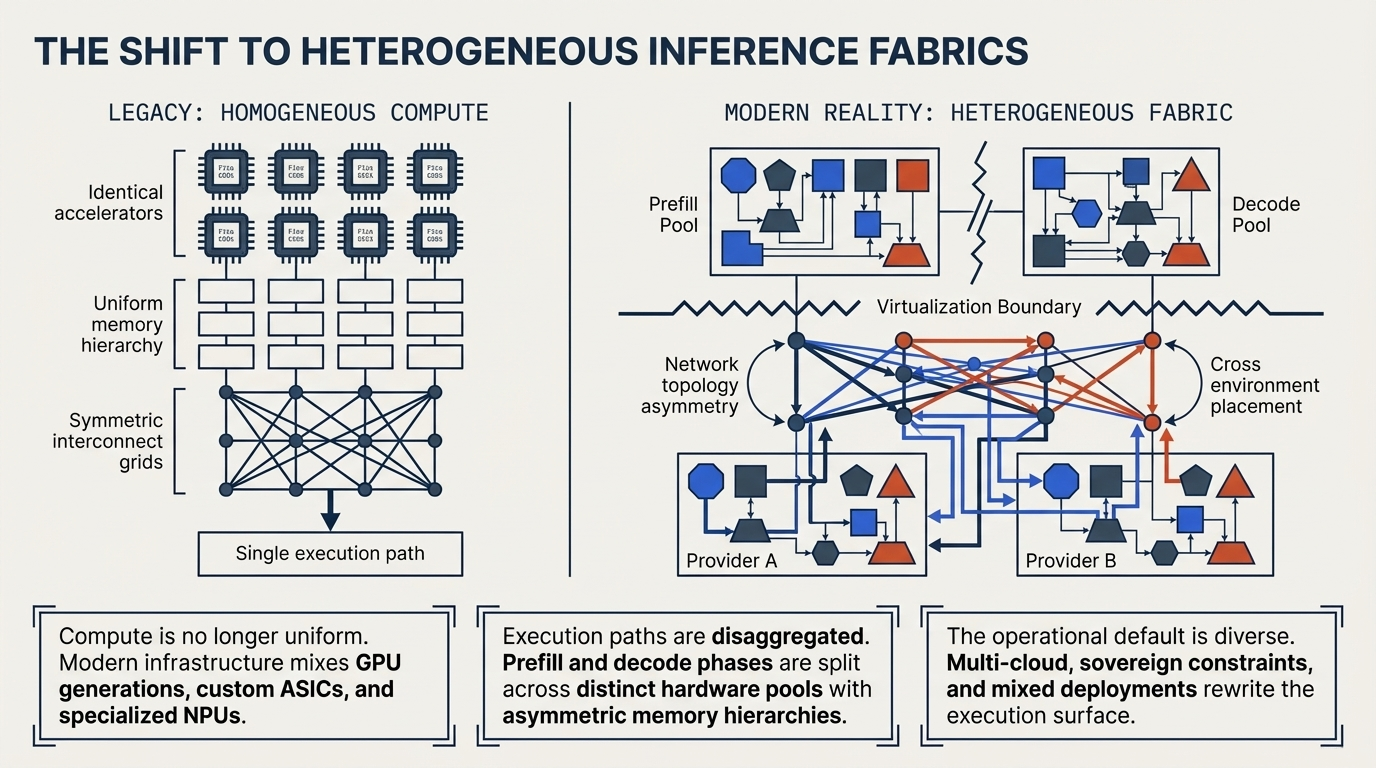
The Shift to Heterogeneous Inference Fabrics

Figure 1: From legacy homogeneous compute to modern heterogeneous inference fabrics. Compute is no longer uniform. Execution paths are disaggregated. Multi-cloud and sovereign constraints rewrite the execution surface.

The drivers are structural rather than incidental. Economic pressure encourages workload placement across different accelerator tiers. Supply constraints make mixed-generation procurement increasingly common. Prefill and decode phases may be separated across distinct resources. Hybrid deployment patterns distribute workloads across edge, regional, and centralized cloud environments.
Heterogeneity is not a temporary deviation from an otherwise homogeneous norm. In many large-scale deployments it is becoming the operational default—especially where multi-cloud strategy, sovereign control requirements, or differentiated service classes prevent architectural uniformity.

2. The Measurement Gap: When Metrics Provide Incomplete Visibility

GPU utilization, average latency, aggregate throughput in tokens per second, and benchmark-level task performance all describe important operational dimensions. Their limitation lies not in their validity, but in their observational scope. They primarily measure within-layer performance, whereas in heterogeneous inference, the most consequential dynamics often arise across layers.

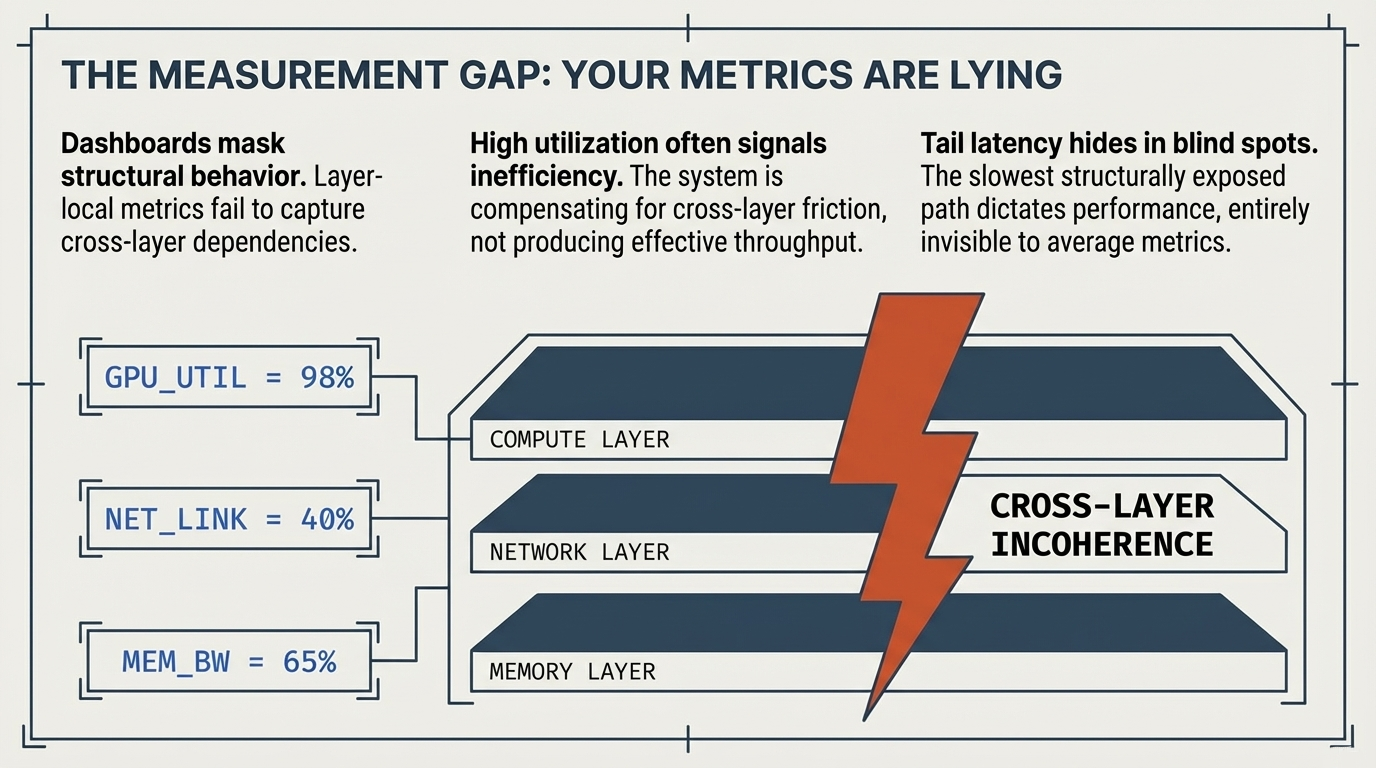
The Measurement Gap: Your Metrics Are Lying

Figure 2: The measurement gap. Layer-local metrics can appear healthy while the cross-layer coordination surface has already degraded. The slowest structurally exposed path dictates performance.

A heterogeneous system may report high utilization at the device level while a substantial fraction of its nominal resource pool remains operationally inaccessible for productive work. Synchronization overhead, transfer friction, resource fragmentation, or topology-constrained placement can reduce the fraction of capacity that can actually be coordinated into coherent serving behavior.

Average latency presents a similar pattern. In heterogeneous inference, the decisive performance constraint is frequently determined not by the average execution path but by the longest structurally exposed path. Tail latency accumulates through the slowest or least coherent interaction segment—whether induced by cross-accelerator transfer, topology-dependent decode placement, or queueing asymmetry across mixed hardware pools.

An additional structural perspective can help clarify this gap. The Efficiency Paradox analysis addresses the same divergence between nominal and effective capacity from the training and inference side. Here, the focus shifts specifically to the compositional diversity of the heterogeneous execution fabric itself.

3. Where Runtime Incoherence Originates: Four Structural Domains

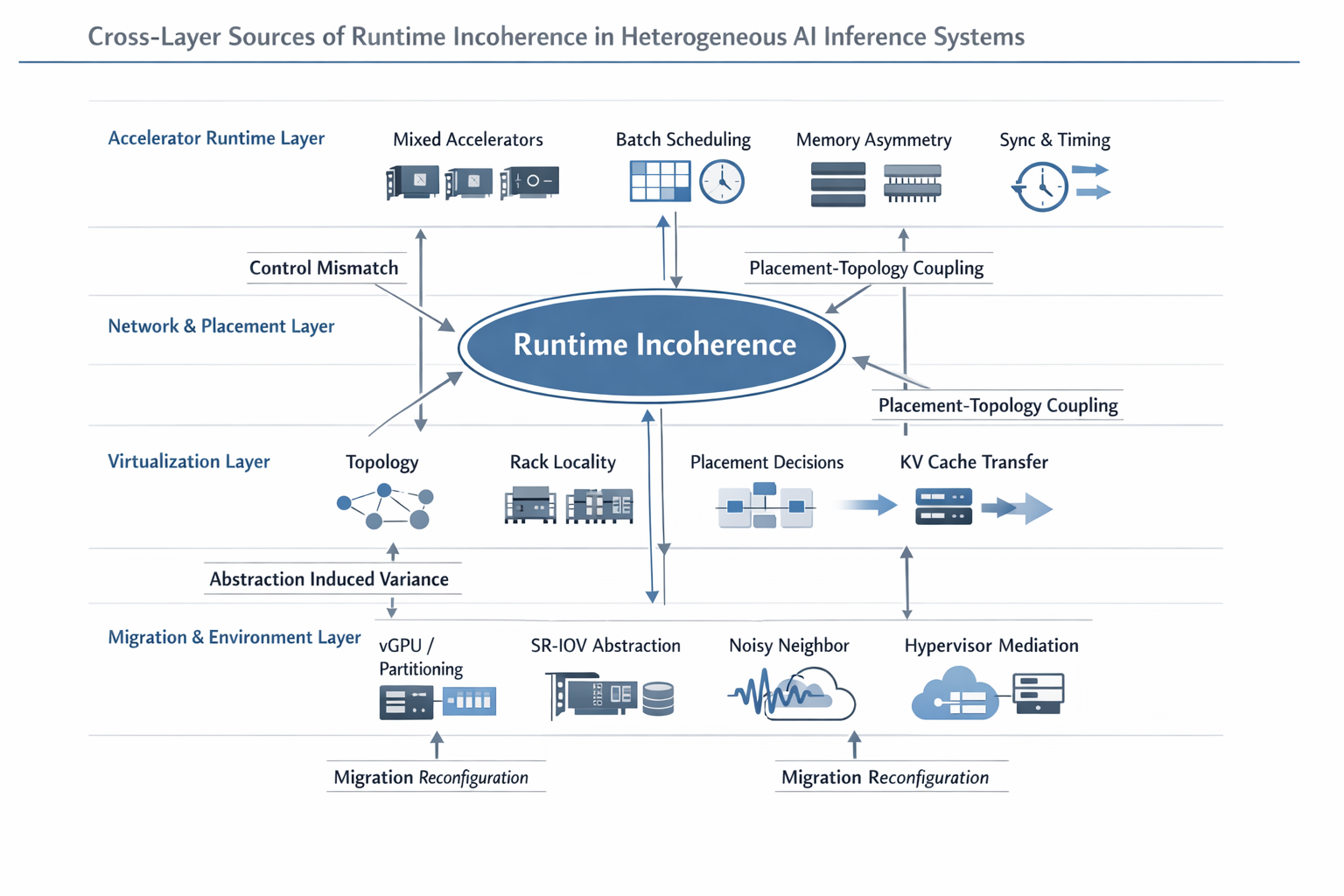
In heterogeneous inference, instability frequently originates at the interfaces between components that remain locally functional but become mutually misaligned when composed into a shared runtime. A structural view helps localize where this incoherence enters the system. Four source domains emerge from the analysis, each mapped to a corresponding SORT-AI diagnostic application.

Cross-layer sources of runtime incoherence in heterogeneous AI inference systems

Figure 3: Cross-layer sources of runtime incoherence. Instability originates at coupling boundaries between layers—not within any single layer taken in isolation.

Domain 1: Accelerator Heterogeneity & Control Mismatch

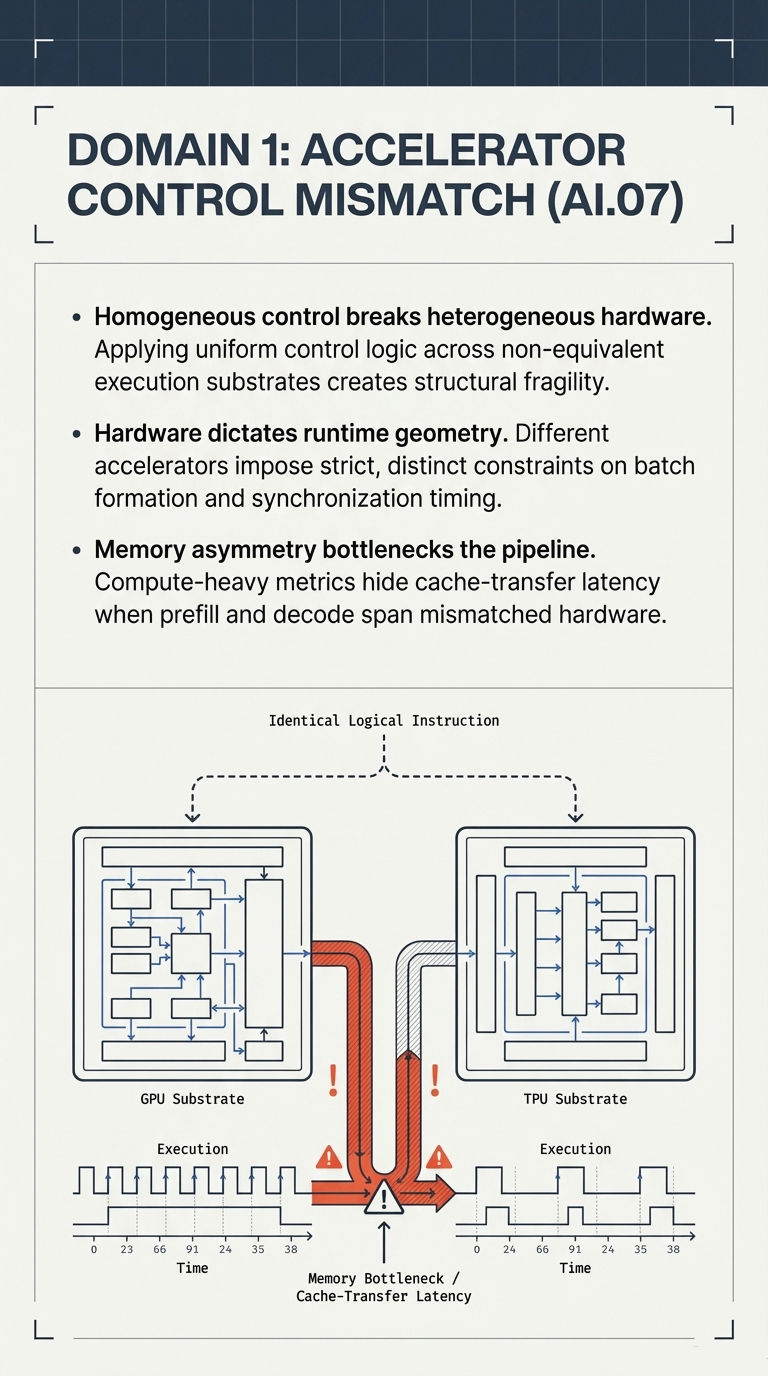
Different accelerator types encode different timing characteristics, memory-access behavior, batch-formation constraints, and synchronization costs. Runtime systems designed for homogeneous fleets can become structurally fragile when the same control assumptions are projected across non-equivalent execution substrates. The source of incoherence is the mismatch between the control model and the substrate on which that model is applied.

Domain 1: Accelerator Control Mismatch (AI.07)

Figure 4: Applying uniform control logic across non-equivalent execution substrates creates structural fragility. Memory asymmetry between prefill and decode paths produces cache-transfer latency invisible to compute-heavy metrics.

This is the diagnostic territory of ai.07 Accelerator Runtime Control—structural compatibility analysis between accelerator types, runtime incoherence detection across heterogeneous execution paths, memory hierarchy mismatch diagnostics, and communication protocol assessment for inter-accelerator data movement.

Domain 2: Network & Placement Coupling

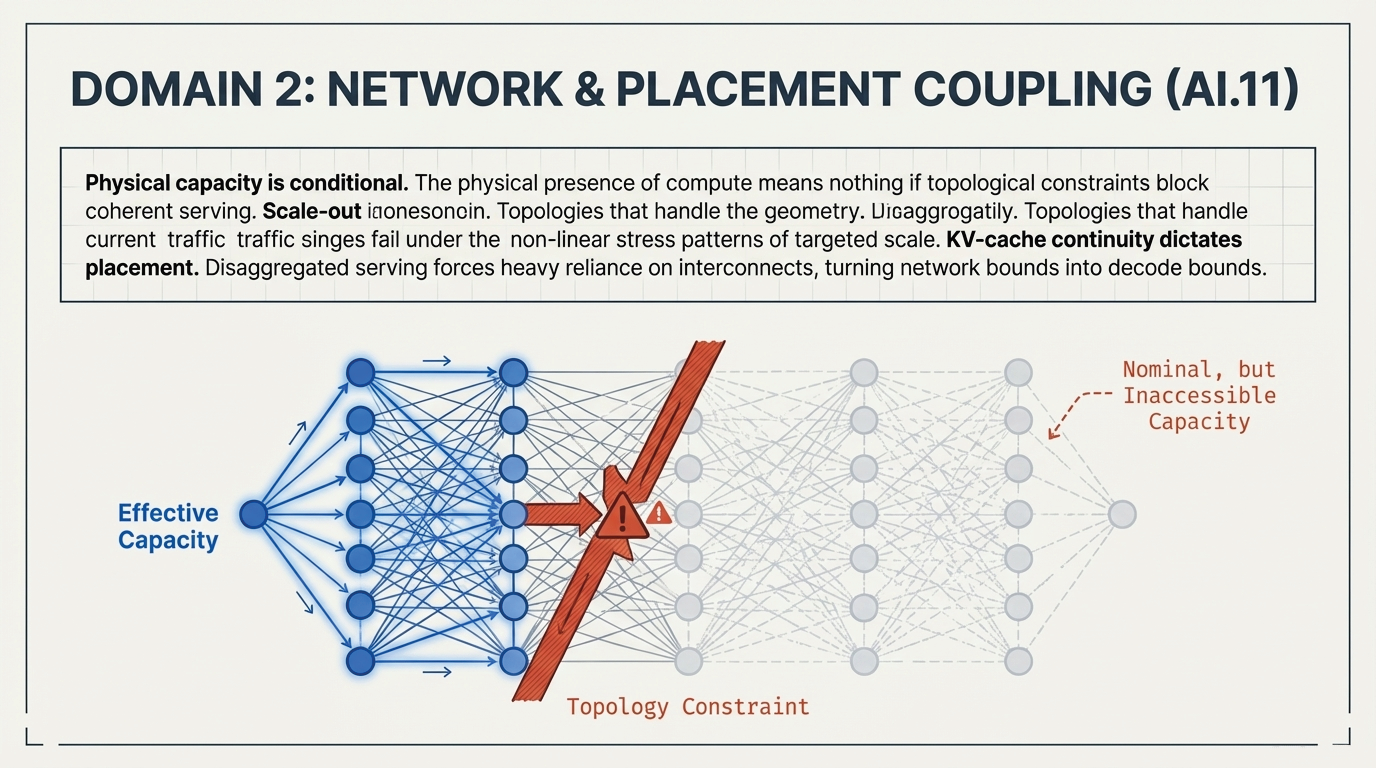
Capacity is not defined solely by the physical presence of accelerators. It is also defined by whether those resources can be arranged into execution paths whose communication properties remain coherent under load. A placement decision that is locally rational in compute terms can become globally destabilizing when it implies communication distance or stage asymmetry that the serving system cannot absorb.

Domain 2: Network and Placement Coupling (AI.11)

Figure 5: Physical capacity is conditional. Topology constraints can render provisioned resources inaccessible for coherent serving. Disaggregated architectures turn network bounds into decode bounds.

ai.11 Structural Network Scalability Risk Modeling addresses this domain, supported by ai.01 Interconnect Stability Control (Core-3) for physical interconnect coupling analysis.

Domain 3: Virtualization-Induced Distortion

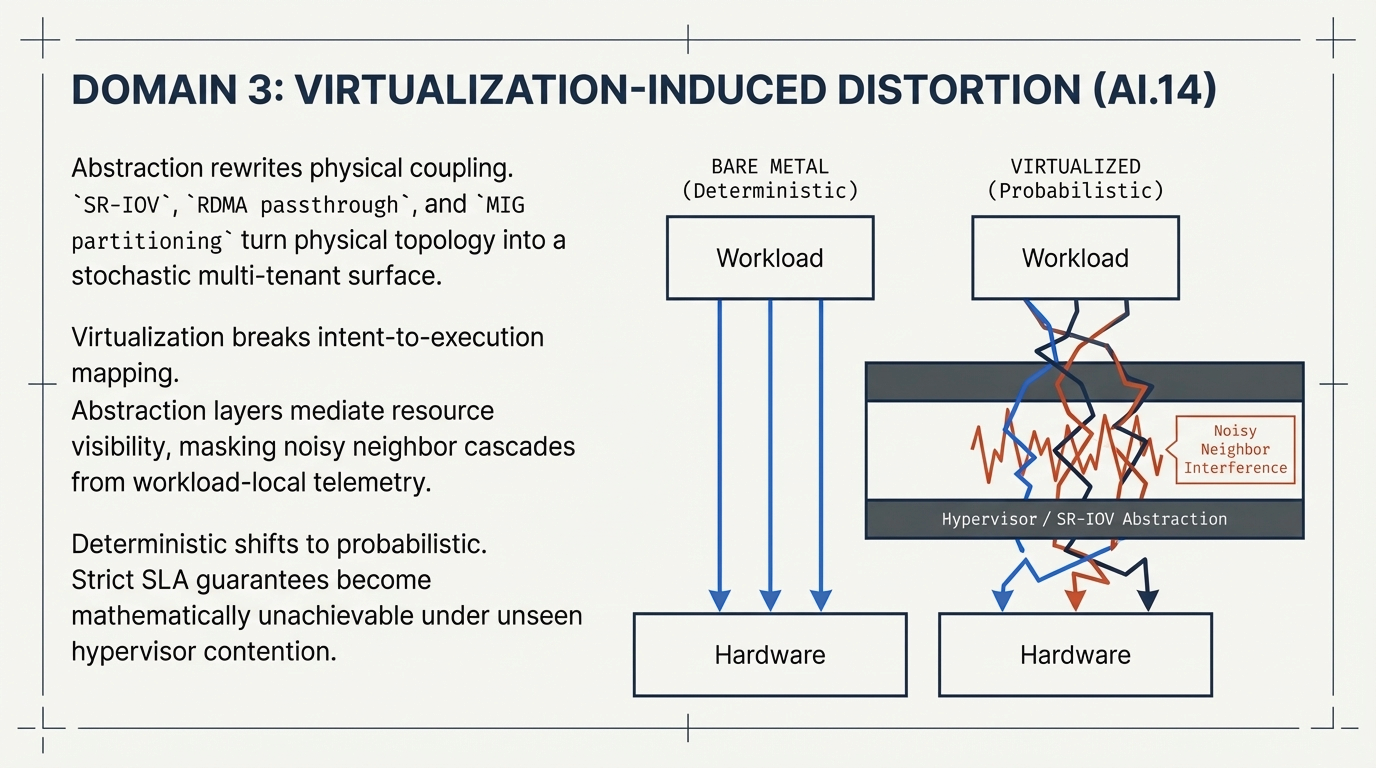
Virtualization changes the coupling topology between workloads and physical resources. GPU partitioning, SR-IOV, RDMA passthrough, and hypervisor-mediated scheduling introduce execution boundaries that differ materially from bare-metal environments. The source of incoherence is the introduction of mediation points through which control, timing, and resource visibility are structurally transformed.

Domain 3: Virtualization-Induced Distortion (AI.14)

Figure 6: Virtualization breaks the intent-to-execution mapping. Abstraction layers mediate resource visibility, masking noisy-neighbor cascades from workload-local telemetry. Deterministic behavior shifts to probabilistic.

This is characterized by ai.14 Virtualization Overhead Stability Analysis—decomposition of virtualization effects into deterministic overhead and stochastic noise, noisy-neighbor impact quantification, and performance guarantee feasibility analysis under multi-tenant conditions.

Domain 4: Migration-Induced Reconfiguration

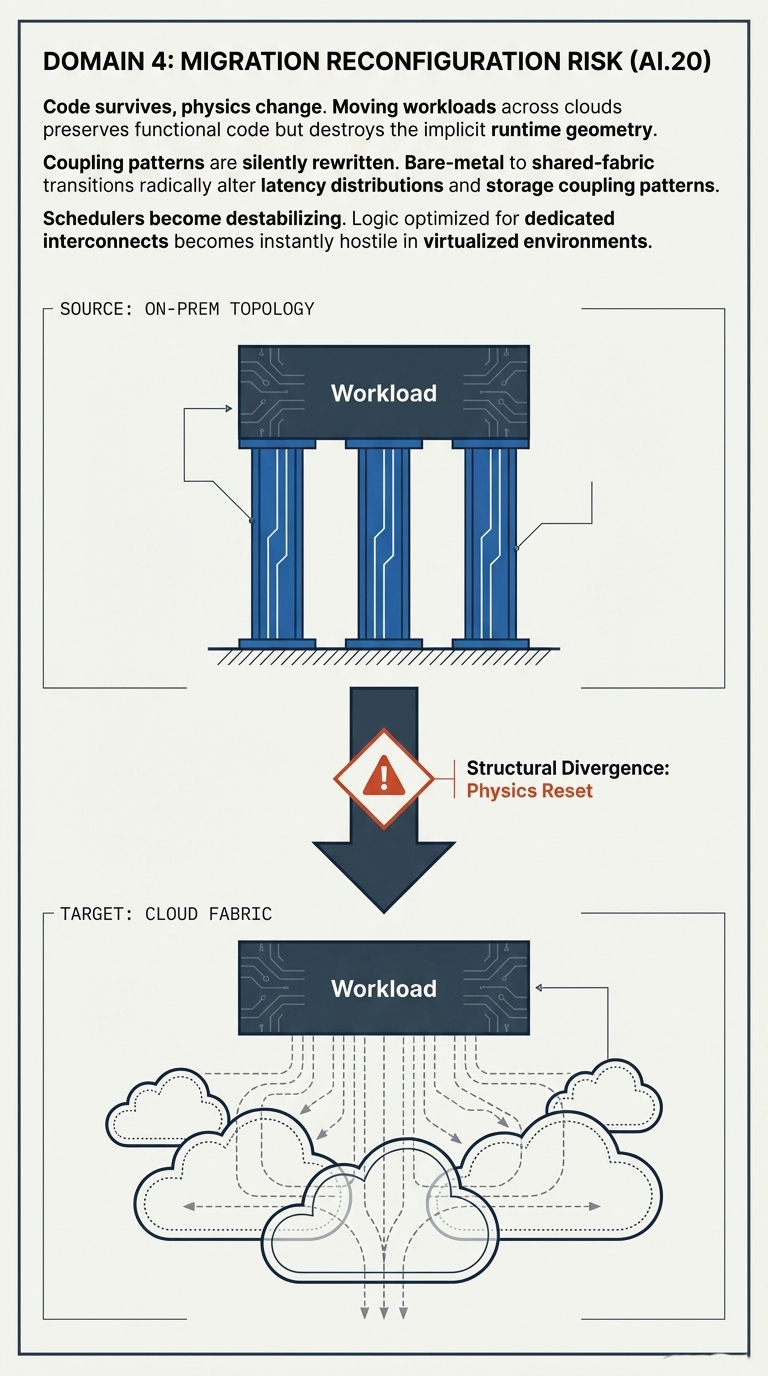
When workloads move between infrastructure contexts, functional interfaces may remain stable while coupling relations between scheduler, runtime, placement logic, and communication fabric change substantially. The instability originates in the preservation of functionality under changed infrastructural relations—the code survives, but the physics change.

Domain 4: Migration Reconfiguration Risk (AI.20)

Figure 7: Migration preserves code but rewrites runtime geometry. Bare-metal to shared-fabric transitions alter latency distributions and storage coupling. Schedulers optimized for dedicated interconnects become destabilizing in virtualized environments.

This is the domain of ai.20 Structural Cloud Migration Risk Assessment—structural coupling comparison between source and target environments, migration risk quantification, phased migration sequencing, and post-migration stability validation.

4. The Structural Taxonomy: Five Instability Modes

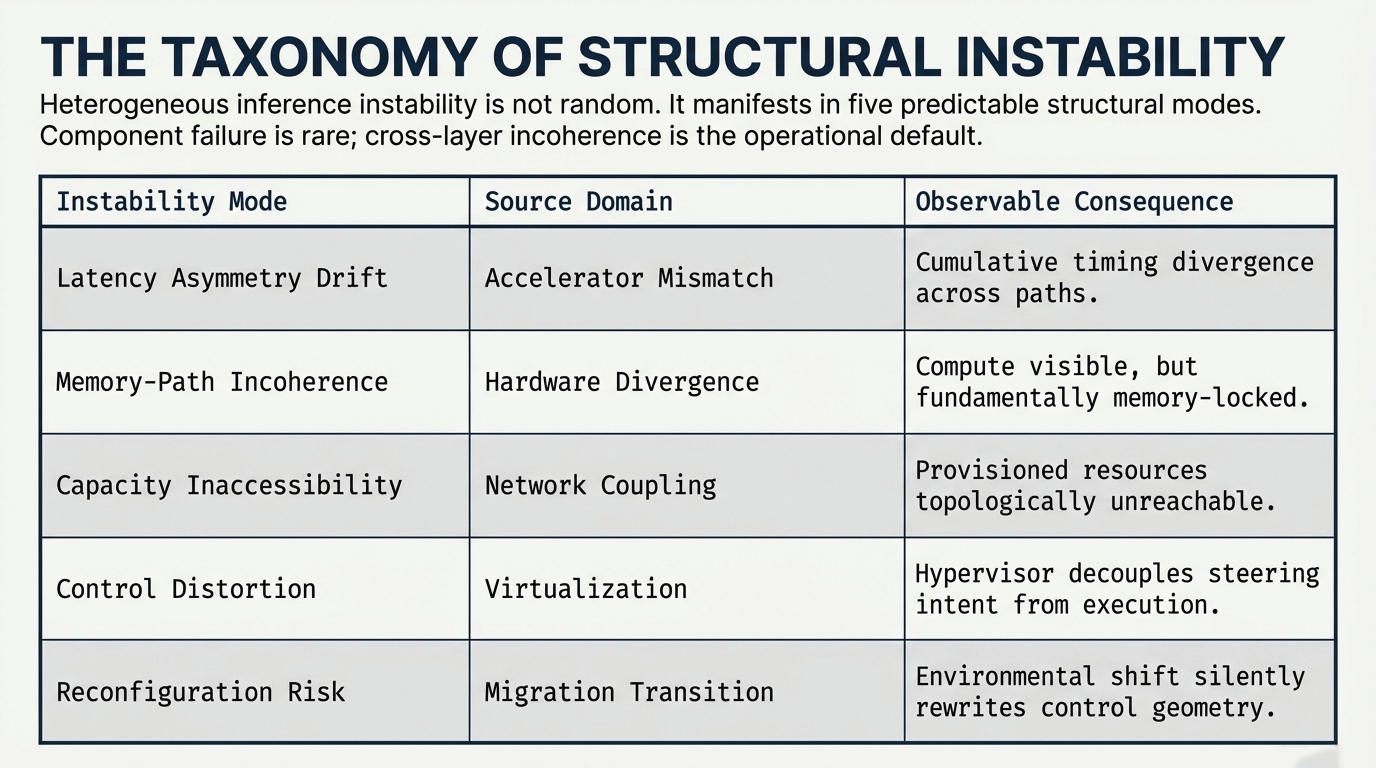
Once the source domains are identified, the question becomes how to classify the resulting instability once it becomes visible at system level. The taxonomy identifies five recurrent modes through which cross-layer incoherence is expressed—even when constituent components remain locally functional.

The Taxonomy of Structural Instability

Figure 8: The five modes of heterogeneous inference instability. Each describes a distinct structural mechanism. Component failure is rare; cross-layer incoherence is the operational default.

Mode 1  →  ai.07

Latency-Asymmetry Drift

Locally efficient execution across heterogeneous hardware paths produces cumulative timing divergence. No single control action need be incorrect. Repeated execution across non-equivalent latency domains gradually shifts the serving system away from the symmetry assumptions on which coordinated behavior depends.

Mode 2  →  ai.07

Memory-Path Incoherence

Reported compute availability diverges from actual serving capacity because execution is constrained by heterogeneous memory structure, bandwidth, or access latency. Especially consequential in LLM inference, where decode-stage behavior and KV-cache continuity depend heavily on memory bandwidth rather than arithmetic throughput alone.

Mode 3  →  ai.11 + ai.01

Interconnect-Induced Capacity Inaccessibility

Provisioned resources remain only partially usable because the communication topology cannot support the execution geometry required for coherent serving. Throughput fails to scale proportionally with added hardware—not because devices are absent, but because the interconnect cannot operationalize them at system level.

Mode 4  →  ai.14

Virtualization-Induced Control Distortion

Abstraction layers alter the relation between control intent, realized execution, and observed system state. The same steering signal can produce different runtime effects than under direct physical execution. Scheduling and placement choices become harder to interpret under mediated resource visibility.

Mode 5  →  ai.20

Migration-Induced Runtime Reconfiguration Risk

A workload remains functionally portable across environments while its performance distributions, control behavior, or stability profile change because the underlying control geometry has been reconfigured. Even modest changes in timing distributions can produce disproportionate growth in SLA violation rates.

5. Runtime Coherence: The First-Order Variable

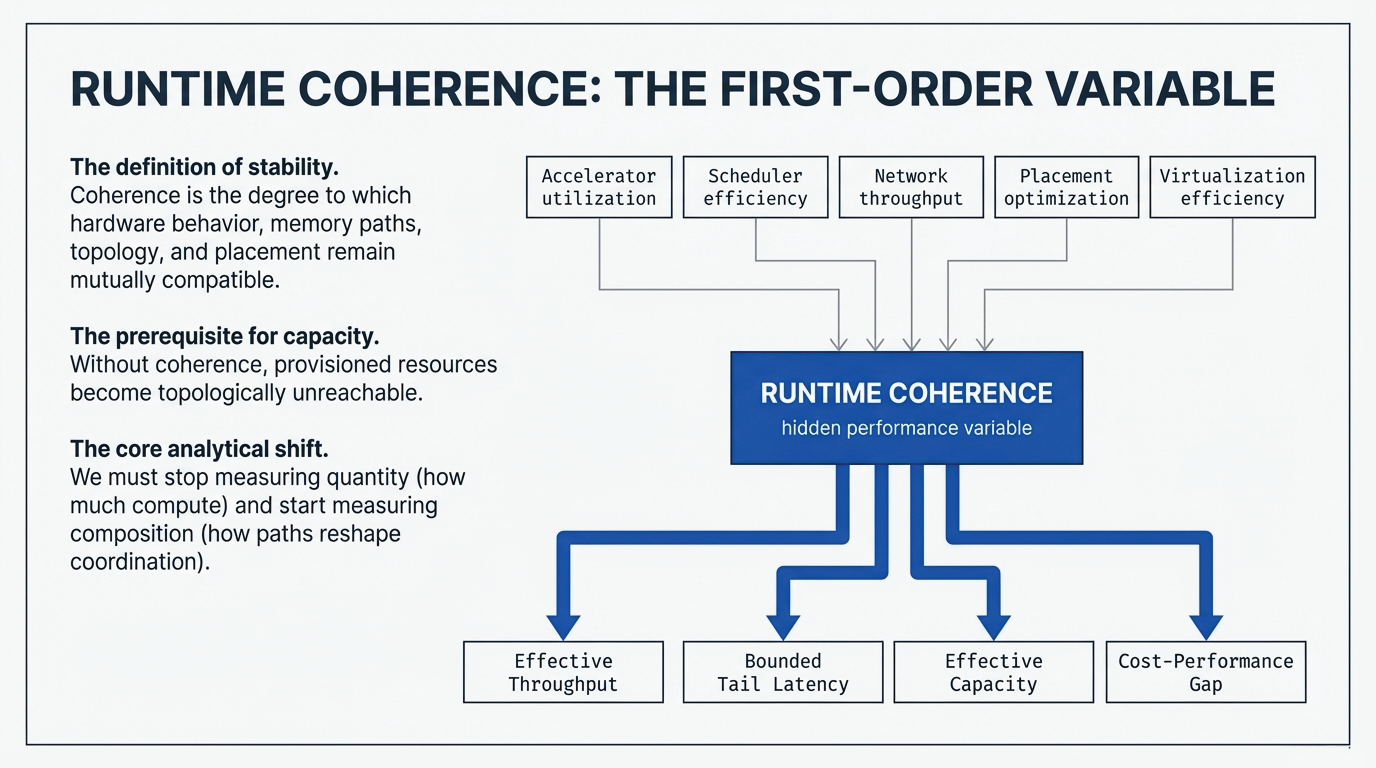
These five instability modes are not independent operational irregularities. They are expressions of a deeper systems condition. Runtime coherence functions as a hidden performance variable in heterogeneous large-scale inference. It is hidden not because it is immeasurable, but because it is not directly represented by the conventional metrics through which AI infrastructure is usually evaluated.

Runtime Coherence: The First-Order Variable

Figure 9: Runtime coherence as the first-order variable. Local optimization signals are mediated by cross-layer coherence before they determine effective throughput, tail latency, effective capacity, and cost-performance gap.

A coherent runtime is not one in which all layers are identical or perfectly synchronized. It is one in which cross-layer interactions preserve enough consistency that local optimization remains globally intelligible. An incoherent runtime is defined by a condition in which individually rational actions, healthy local metrics, and nominal resource availability no longer compose into stable system behavior.

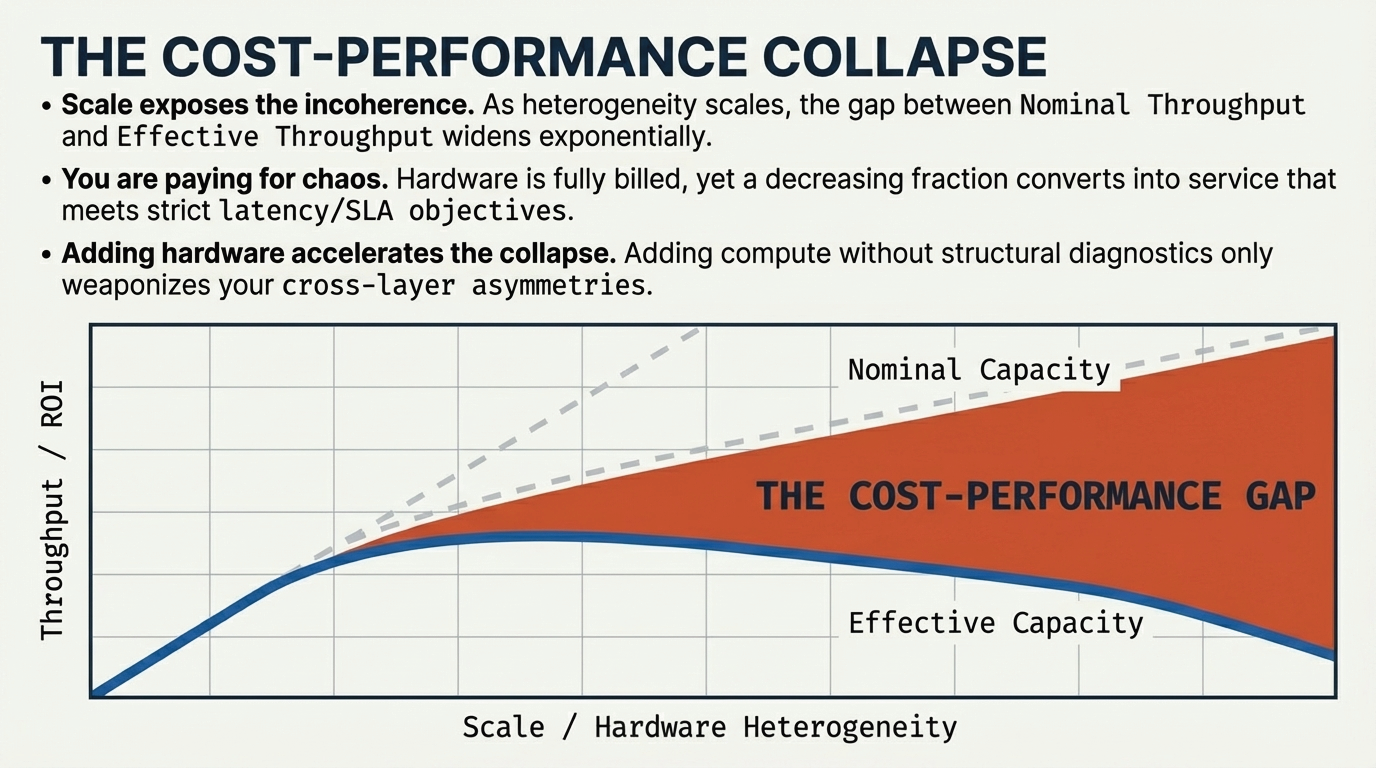
This distinction has direct economic consequences. Provisioned capacity refers to the resources nominally available. Effective capacity refers to the fraction that can actually be coordinated into productive serving behavior. When runtime coherence deteriorates, effective capacity declines even if provisioned capacity remains unchanged.

The Cost-Performance Gap

Figure 10: The cost-performance gap. As heterogeneity and scale increase, the divergence between nominal capacity and effective capacity widens. Resources are present, active, and fully billed—yet a decreasing fraction can be converted into service that meets operational objectives.

This extends the concept of ai.04 Runtime Control Coherence (Core-3) from logical coupling across scheduling and policy layers to the full cross-layer coordination surface of heterogeneous inference—including accelerator behavior, memory-path structure, network topology, virtualization boundaries, and migration-sensitive environmental reconfiguration.

6. Why Local Optimization Can Reduce Global Stability

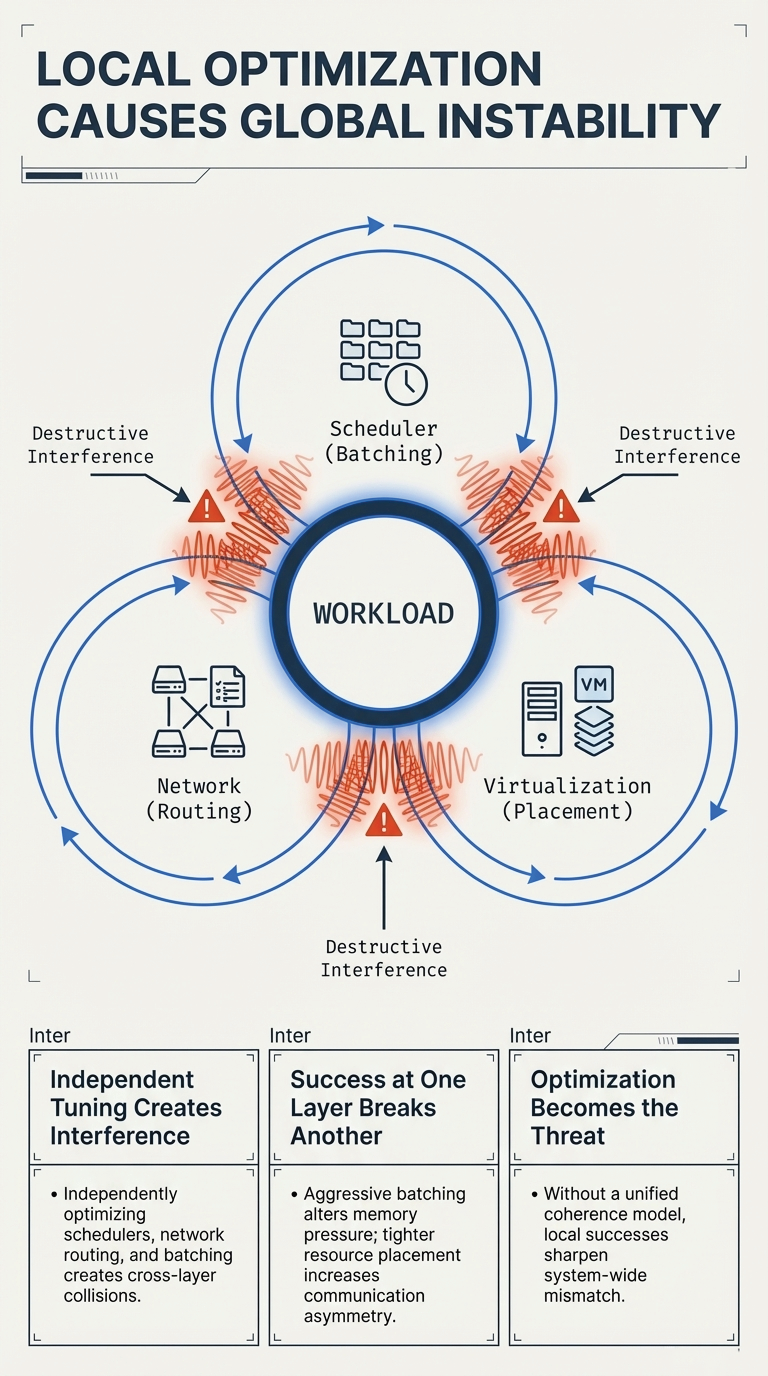
A recurring pattern in heterogeneous inference: accelerator utilization may be improved through more aggressive batching, scheduler efficiency through tighter packing, network throughput through path optimization—while the composite runtime nonetheless becomes less stable. The reason is that these optimizations act on partially shared system state without necessarily preserving cross-layer consistency.

Local Optimization Causes Global Instability

Figure 11: Independent tuning creates destructive interference. Success at one layer can break another. Without a unified coherence model, local successes sharpen system-wide mismatch.

Heterogeneity increases the severity of this effect because it multiplies the dimensions along which interaction can become inconsistent. Each additional accelerator class, virtualization layer, network regime, or provider boundary introduces conditional behavior that local optimization does not resolve by itself.

The implication is structurally interesting: investment in structural observability, cross-layer diagnosis, and topology-aware analysis may produce greater marginal benefit than isolated investment in additional compute capacity. Not because raw capacity has become unimportant, but because the economic meaning of capacity increasingly depends on whether provisioned resources remain effectively usable within a coherent runtime.

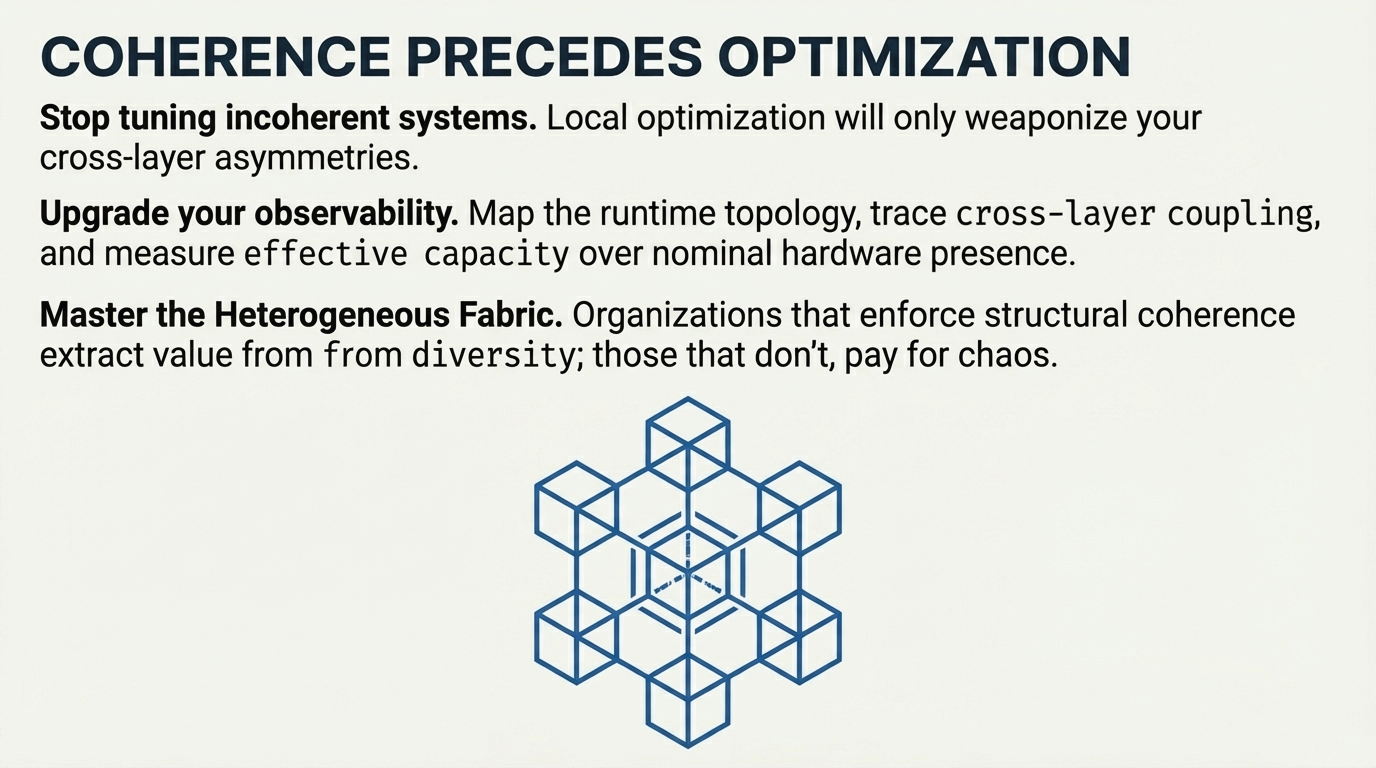
Coherence Precedes Optimization

Figure 12: The operational sequence. Coherence precedes optimization. Map the runtime topology, trace cross-layer coupling, and measure effective capacity over nominal hardware presence.

The sequence becomes: coherence first, optimization second. Organizations that make cross-layer coordination explicit extract value from infrastructure diversity. Those that do not, pay for capacity they cannot operationalize.

7. Diagnostic Mapping: SORT-AI Applications

Each instability mode maps to a corresponding diagnostic domain within the SORT-AI framework. The mapping identifies where each form of incoherence can be analyzed structurally rather than addressed through layer-local troubleshooting alone.

Supporting diagnostic roles are played by ai.04 Runtime Control Coherence (Core-3) for the cross-loop interference dimension and ai.27 Inference Pipeline Coherence as an end-to-end integrating perspective.

8. Implications for AI Factories and Multi-Cloud Inference

The emergence of AI factory architectures amplifies the coordination pattern identified here. As inference becomes a first-class infrastructure workload alongside training, operators are increasingly required to manage mixed accelerator fleets, differentiated serving tiers, and multiple execution pathways within the same datacenter or federated deployment environment.

Disaggregated inference architecture illustrates the point clearly. The separation of prefill and decode across different resource pools can improve specialization and utilization, but it also introduces a persistent dependency on KV-cache transfer, placement locality, and stage-to-stage communication coherence. Heterogeneity is both mitigated and reproduced by architectural design.

The same structural pattern extends to multi-cloud and sovereign-cloud deployment conditions. When workloads span provider boundaries, heterogeneity is compounded by differences in virtualization regimes, accelerator availability profiles, storage paths, control-plane behavior, and network performance distributions.

Different infrastructure classes—CUDA-based cloud environments, TPUs, inference-oriented accelerator families, custom ASIC deployments—should not be viewed only as alternative hardware options with different price-performance points. They instantiate distinct coupling topologies with different runtime assumptions. Movement between them, or composition across them, constitutes a structural reconfiguration of the execution fabric.

The Defining Question

The relevant question is no longer which resource is faster or cheaper in isolation. It is whether the composite infrastructure remains coordinated enough for nominal hardware diversity to be transformed into stable and economically meaningful serving behavior.

Core Research Papers

The SORT-AI applications forming the diagnostic foundation for structural analysis of heterogeneous inference coherence.

AI.01 • CLUSTER A • CORE-3

Interconnect Stability Control

Structural stability diagnostics for interconnect-induced performance dynamics—the physical layer conditioning whether provisioned compute remains topologically reachable.

View Application Brief →View Manuscript →
AI.04 • CLUSTER C • CORE-3

Runtime Control Coherence

Diagnosing incoherence between scheduler, orchestrator, runtime, and policy enforcement layers—the logical coordination surface conditioning whether local optimization remains globally constructive.

View Application Brief →View Manuscript →
AI.13 • CLUSTER D • CORE-3

Agentic System Stability

Stability control for agent workflows with retry loops, self-verification, and tool calling—where heterogeneous inference instability interacts with agentic orchestration patterns.

View Application Brief →View Manuscript →

Interested in Structural Diagnostics for Heterogeneous Inference?

We provide architecture risk briefings and structural diagnostics for hyperscale AI deployments. Zero-access, zero-data methodology for pre-implementation reasoning and cross-layer coherence analysis.

Get in Contact Engagement Scope