// SYSTEMS ANALYSIS • RUNTIME ARCHITECTURE

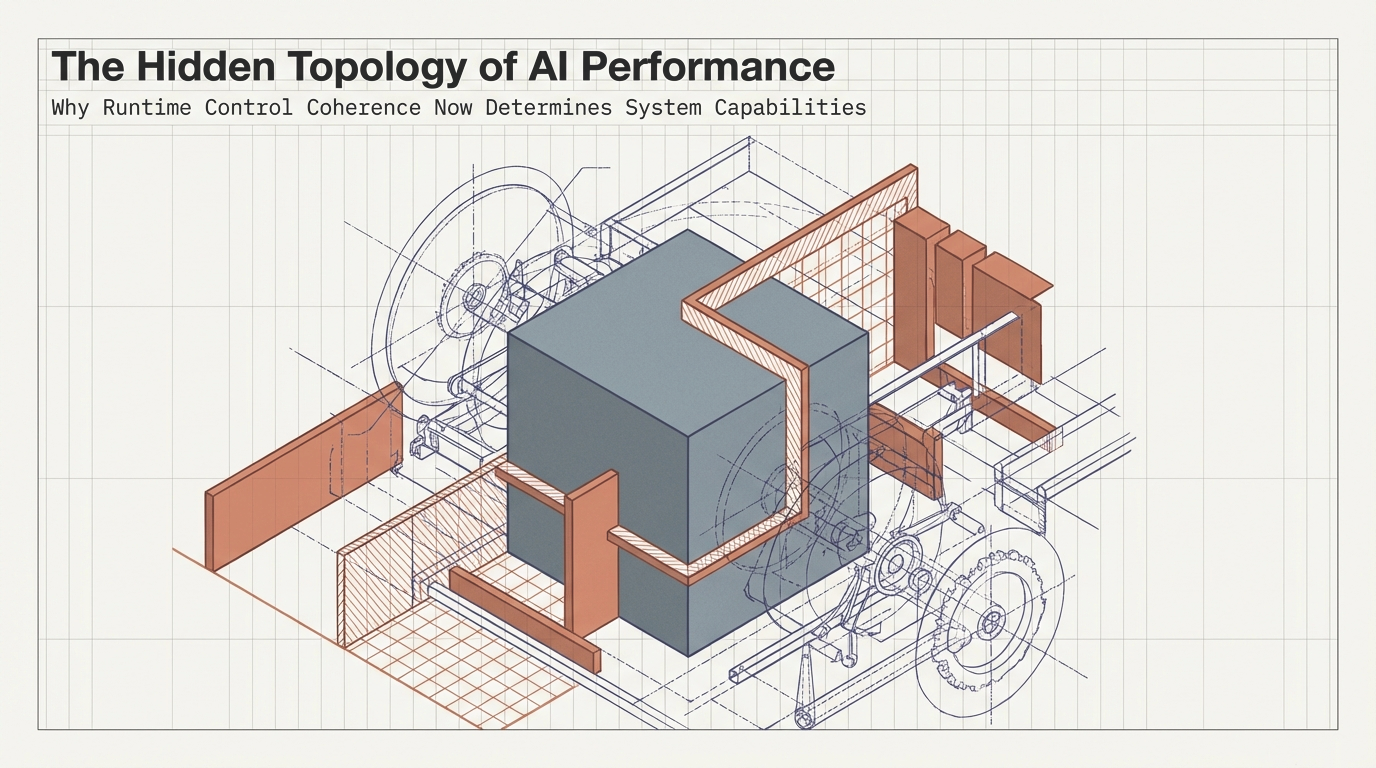
The Hidden Topology of AI Performance: Why Runtime Control Coherence Now Determines System Capabilities

Modern AI performance is increasingly determined not by the model itself but by the orchestration mechanisms coordinating inference at runtime. As optimization loops interact across routing, batching, autoscaling, and cost control, the runtime control layer becomes the hidden variable that shapes system behavior independently of model weights.

Download Presentation Companion: Cost-Reliability Paradox View Core Papers
The Hidden Topology of AI Performance – Why Runtime Control Coherence Now Determines System Capabilities

The Hidden Topology of AI Performance: runtime control coherence as the defining variable of modern AI system capabilities.

1. The Hidden Performance Variable

Modern AI systems are typically evaluated through the lens of model capability. Benchmarks measure reasoning ability. Leaderboards compare architectures. Research papers focus on parameter counts, training data, and evaluation scores.

Yet in large-scale deployments, something different has quietly become true: many of the most significant performance improvements no longer come from better models. They come from the runtime control layer—and in many systems, this layer remains the least visible part of the architecture.
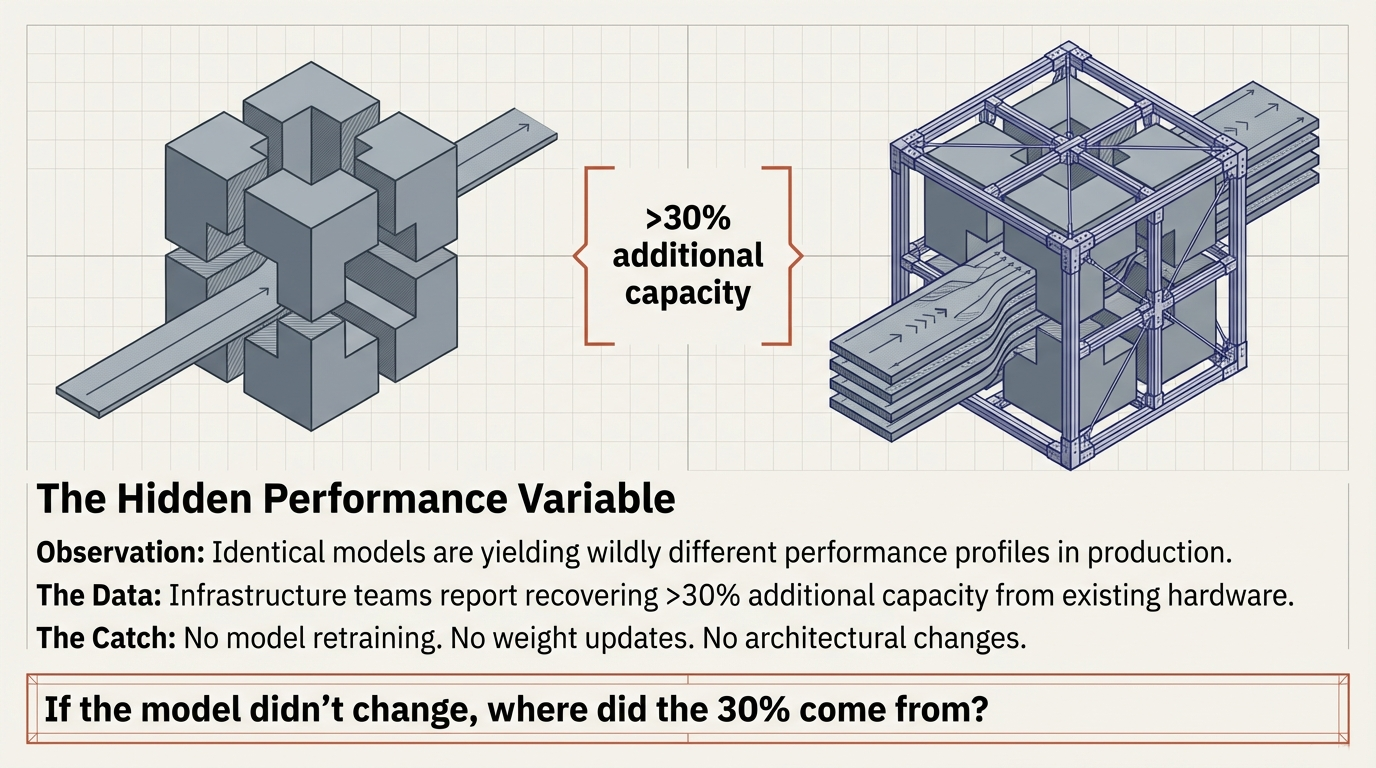
The Hidden Performance Variable – Identical models yielding wildly different performance profiles; infrastructure teams recovering more than 30 percent additional capacity without model changes

Figure 1: The hidden performance variable—identical models yield different performance profiles in production. Infrastructure alignment alone has recovered more than 30% additional capacity.

Infrastructure teams across the industry have reported significant throughput gains after refining runtime scheduling and inference orchestration. In some cases, infrastructure alignment alone has recovered more than 30 percent additional capacity from existing hardware. No model retraining was required. No architectural changes to the neural network were necessary. The improvement emerged entirely from better coordination of the runtime control layer.
"If the model didn't change, where did the 30% come from? The answer lies in the orchestration geometry—the structural coherence of the system surrounding the model."

2. The Quiet Shift: Where Performance Comes From

For most of the history of machine learning, system performance was primarily determined by the model itself. Bigger models produced better results. More training data increased accuracy. Improved architectures delivered measurable gains. But modern AI deployments operate very differently.

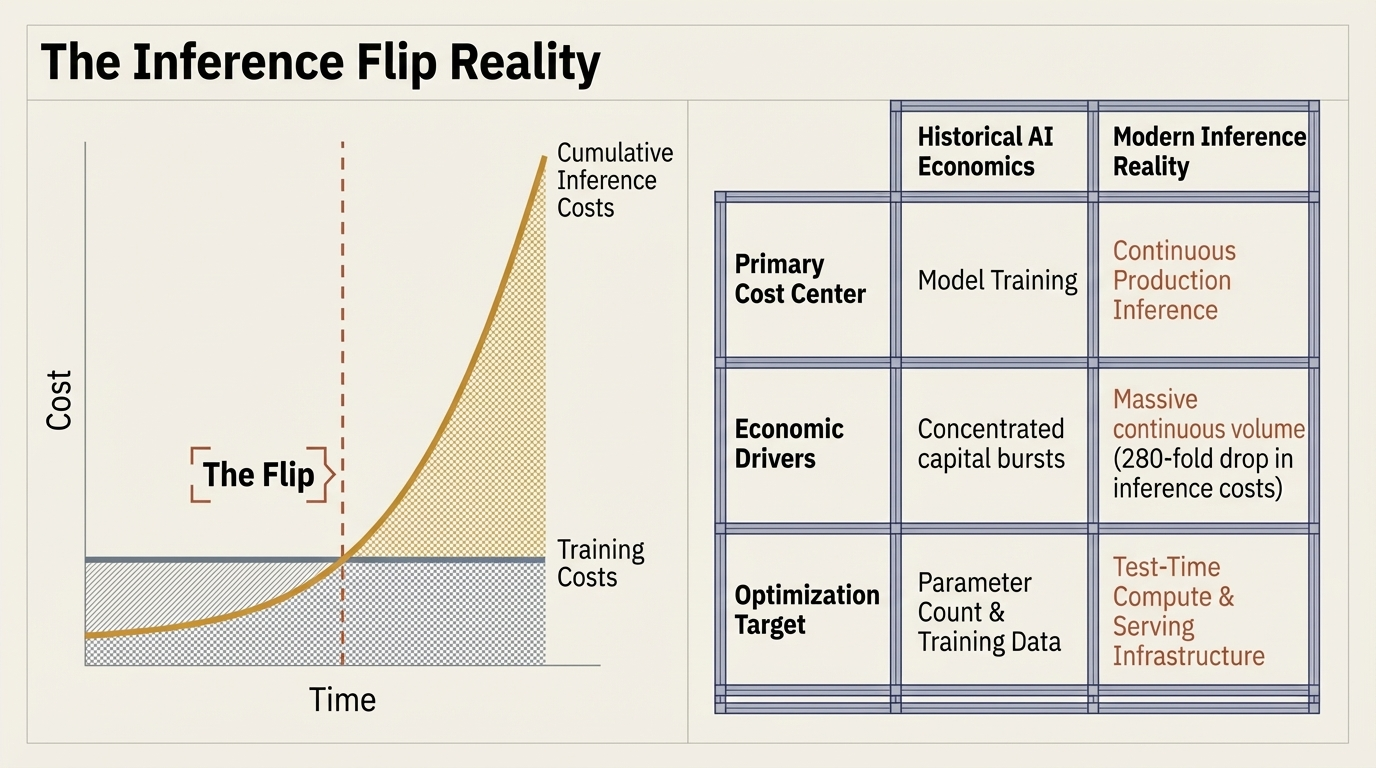
The economics of AI have undergone a fundamental transition. Inference expenditure now completely dominates the lifecycle economics of deployed models. The primary cost center has shifted from model training to continuous production inference, with a 280-fold drop in inference costs driving massive continuous volume. The optimization target is no longer parameter count and training data—it is test-time compute and serving infrastructure.

The Inference Flip Reality – Cumulative inference costs surpassing training costs, with optimization target shifting to test-time compute and serving infrastructure

Figure 2: The Inference Flip—cumulative inference costs now dominate AI economics, shifting the optimization frontier from model training to serving infrastructure.

Large language models now run inside complex production infrastructures involving distributed inference clusters, routing layers, speculative decoding pipelines, autoscaling systems, and cost-optimization controllers. The model is only one component of a much larger system. The resulting behavior is shaped not only by the model's capabilities but by the orchestration mechanisms coordinating inference at runtime.

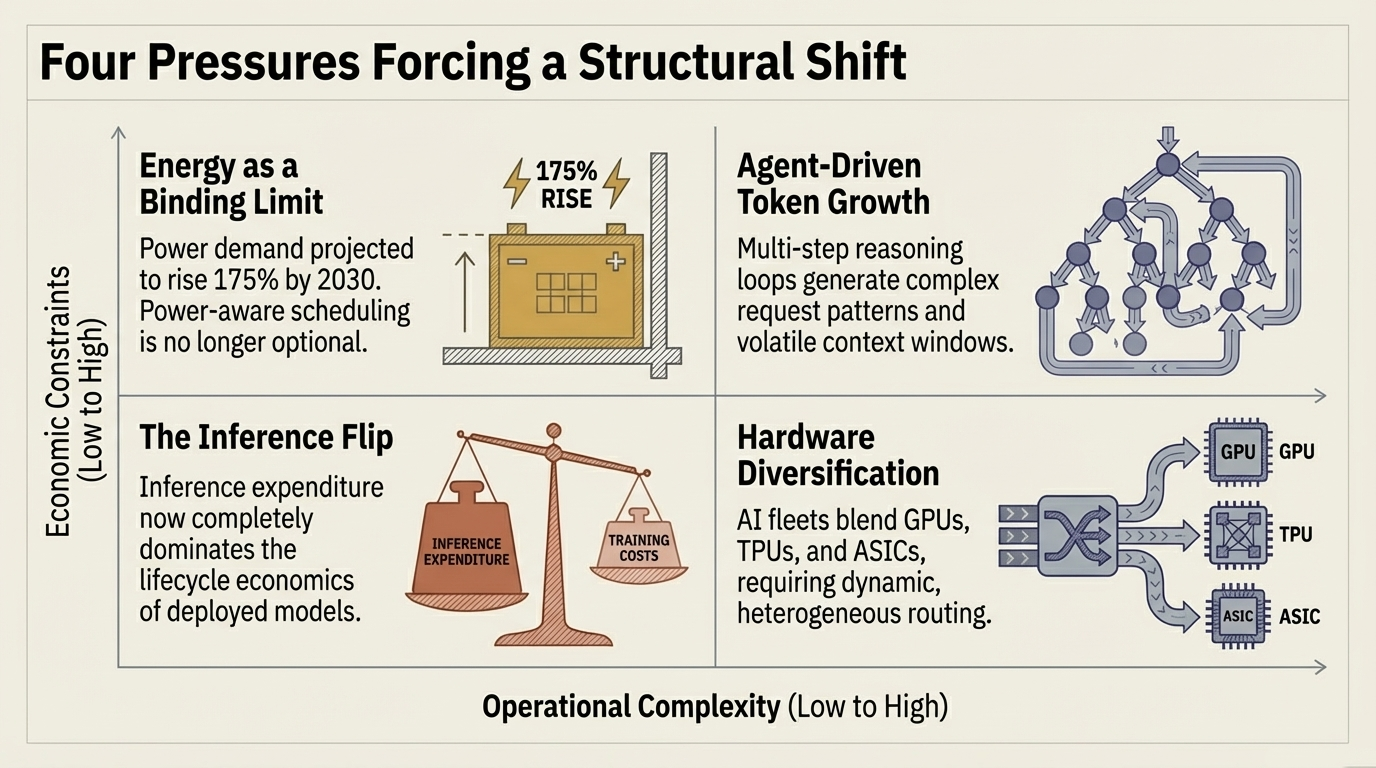
Four Pressures Forcing a Structural Shift – Energy as binding limit, agent-driven token growth, the inference flip, and hardware diversification

Figure 3: Four pressures forcing a structural shift—energy constraints, agent-driven token growth, the inference flip, and hardware diversification reshape the operating environment.

These four pressures—energy as a binding limit with power demand projected to rise 175% by 2030, agent-driven token growth generating 20× to 30× more tokens than conventional interactions, the inference flip itself, and hardware diversification across GPUs, TPUs, and ASICs—together force a structural rethinking of where system performance actually originates.

3. The Three-Layer Architecture of Modern AI Systems

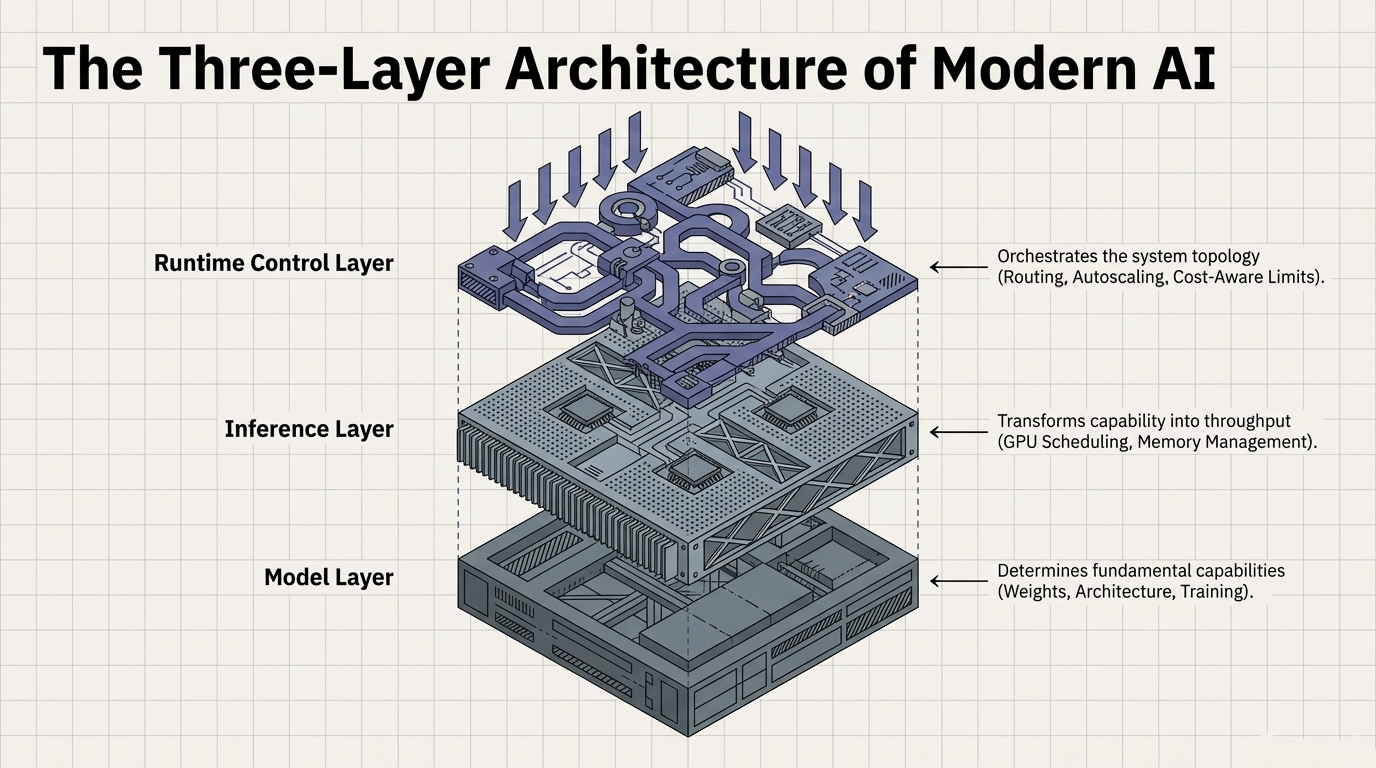
A useful way to understand this shift is to view modern AI infrastructure as a three-layer architecture. The model layer contains the neural network itself: training data, parameter counts, architecture choices, and fine-tuning strategies. This layer determines the fundamental capabilities of the system.

The inference layer executes model calls. This includes GPU scheduling, batching strategies, memory management, speculative decoding pipelines, and token generation infrastructure. Here the system transforms model capability into operational throughput.

Above both sits the runtime control layer. This layer orchestrates the system as a whole. It decides which model receives a request, how requests are batched, when capacity is scaled, how routing policies adapt to load, and how cost targets influence inference decisions.

The Three-Layer Architecture of Modern AI – Runtime Control Layer orchestrating system topology above the Inference Layer and Model Layer

Figure 4: The three-layer architecture—runtime control layer (routing, autoscaling, cost-aware limits) sits above the inference layer (GPU scheduling, memory management) and model layer (weights, architecture, training).

In large-scale deployments, the runtime control layer increasingly determines how efficiently the entire stack operates. This is the structural domain of ai.04 Runtime Control Coherence—diagnosing incoherence between scheduler, runtime, and model control loops—and ai.27 Inference Pipeline Control Coherence, which extends the analysis to batching, caching, and serving control loops.

4. When Optimization Loops Interact

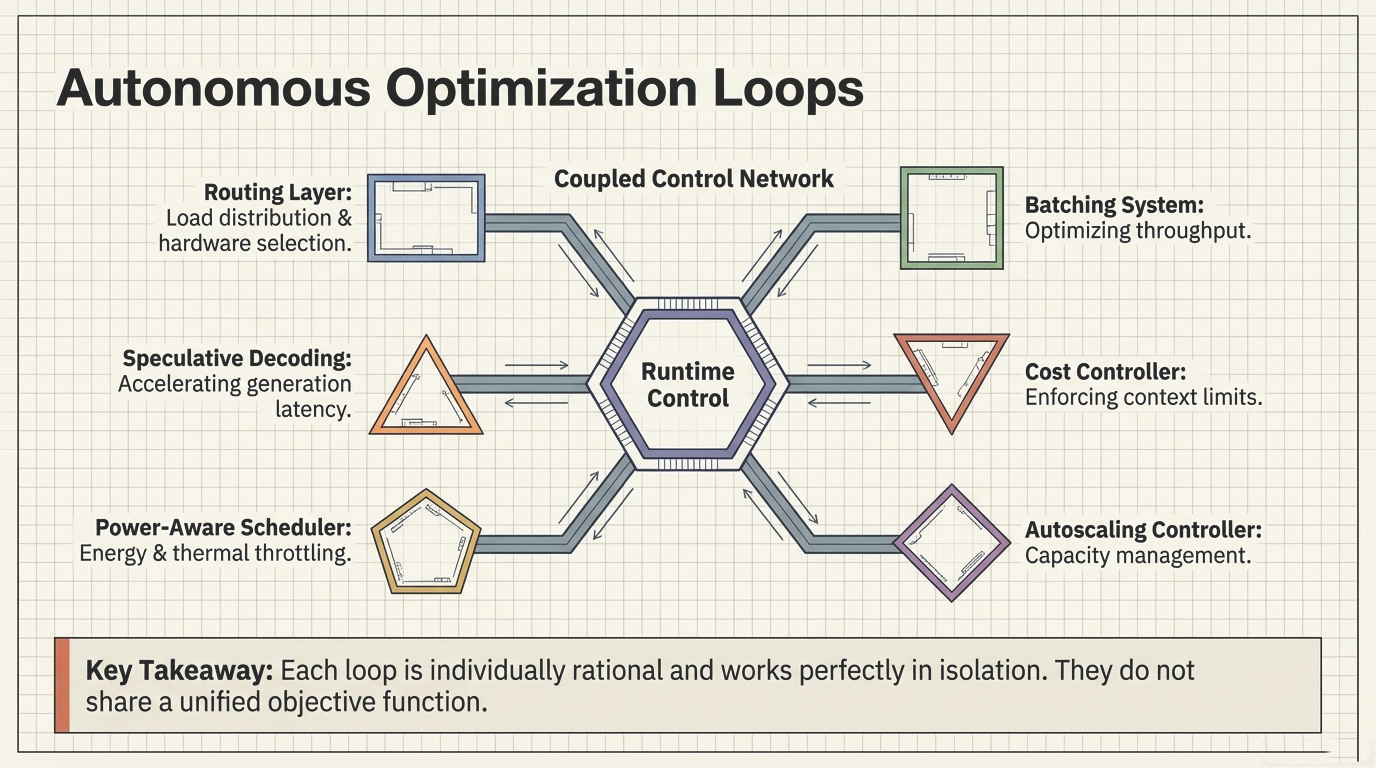
The runtime control layer contains a variety of mechanisms that rarely appear in model-centric discussions of AI performance: request routing policies, batching controllers, speculative decoding managers, autoscaling policies, cost-aware scheduling, safety and moderation gates, and latency optimization strategies. Each of these mechanisms typically operates as a local optimization loop.

A routing layer might optimize for latency. A batching scheduler might optimize for GPU utilization. An autoscaling controller might optimize for infrastructure cost. Individually, each component works exactly as intended. Yet collectively they form a dynamic control system that governs the entire inference environment.

Autonomous Optimization Loops – Routing, batching, speculative decoding, cost control, power-aware scheduling, and autoscaling forming a coupled control network

Figure 5: Autonomous optimization loops—each loop is individually rational and works in isolation, but they do not share a unified objective function.

In hyperscale inference environments, many simultaneous control loops operate concurrently: routing policies adapting to traffic, batching systems adjusting to request volume, cost controllers optimizing token generation, autoscaling mechanisms expanding and contracting capacity, and speculative decoding pipelines attempting to accelerate generation. None of these loops are incorrect. But when many optimization loops interact simultaneously, the system begins to behave like a coupled control network.

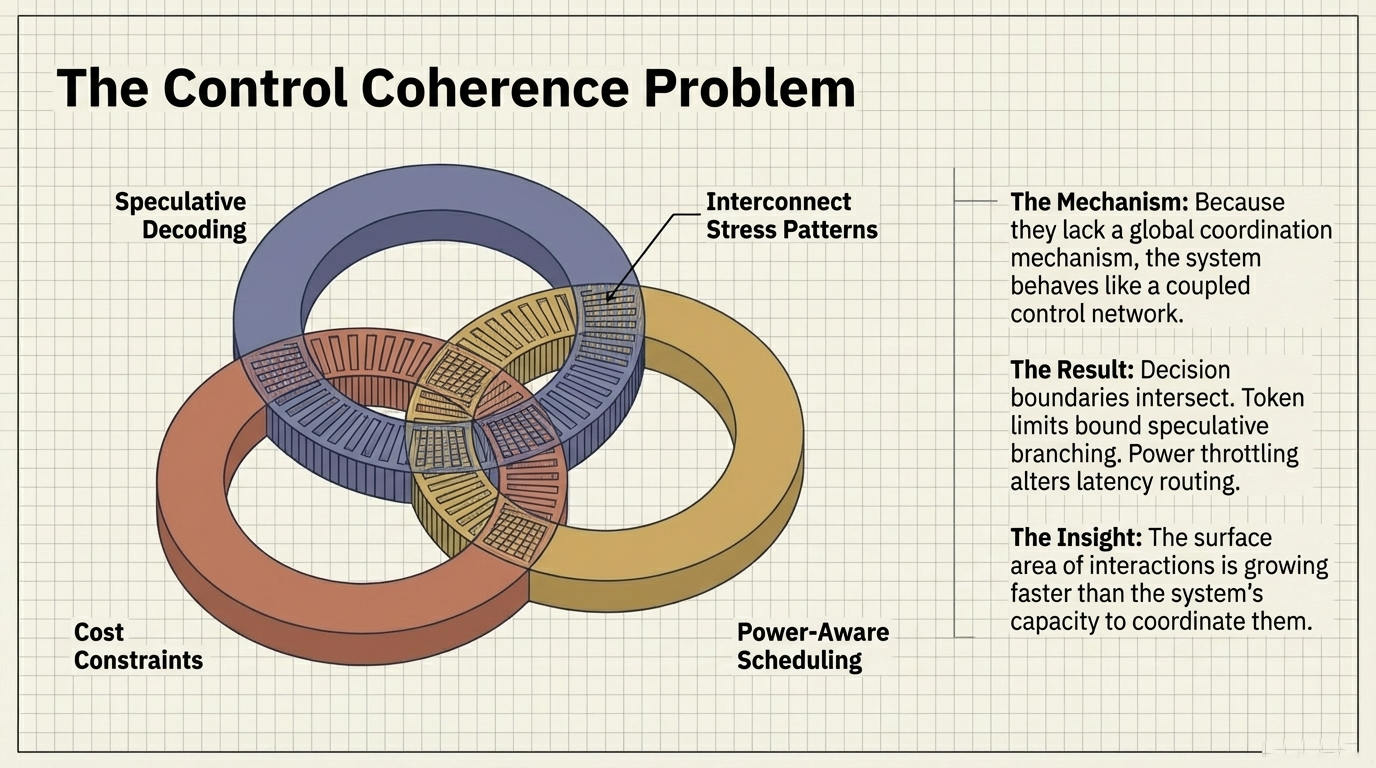
The Control Coherence Problem – Overlapping decision boundaries between speculative decoding, interconnect stress, cost constraints, and power-aware scheduling

Figure 6: The control coherence problem—the surface area of interactions grows faster than the system's capacity to coordinate them.

Because these loops lack a global coordination mechanism, the system behaves like a coupled control network. Decision boundaries intersect: token limits bound speculative branching, power throttling alters latency routing. The surface area of interactions grows faster than the system's capacity to coordinate them. This is precisely the structural domain of ai.04 Runtime Control Coherence and ai.09 Control-Flow Instability Mapping.

Structural Question

How many independent optimization loops operate simultaneously in your inference infrastructure? Do they share a coordination mechanism—or do they interact only through their side effects?

5. The Control Coherence Tipping Point

When runtime control mechanisms are well aligned, systems often experience dramatic performance improvements. These improvements may appear to originate from model changes. In practice, they frequently originate from infrastructure orchestration.

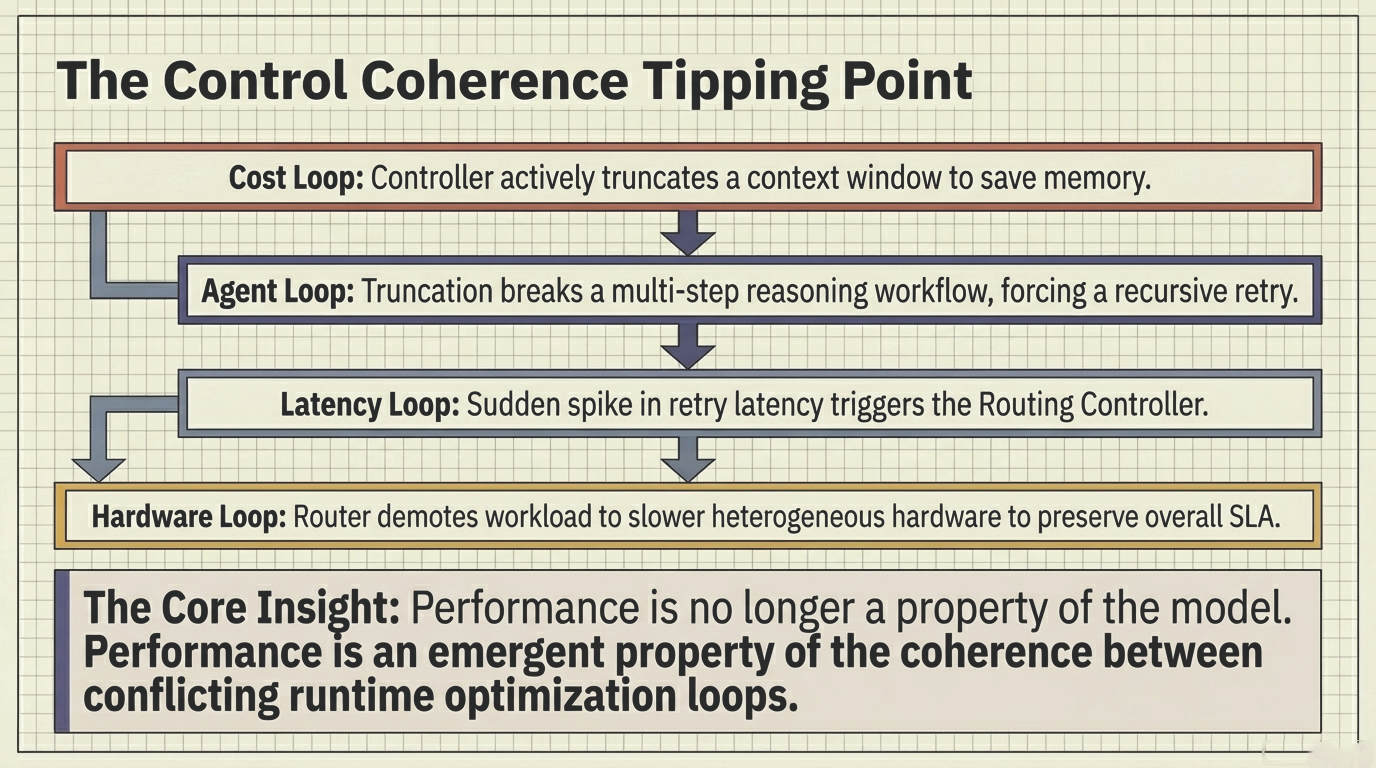
The cascade mechanism illustrates this clearly. A cost controller actively truncates a context window to save memory. That truncation breaks a multi-step reasoning workflow, forcing a recursive retry. The sudden spike in retry latency triggers the routing controller. The router demotes the workload to slower heterogeneous hardware to preserve overall SLA. The net result: a cost optimization decision has cascaded through four distinct control loops, each behaving rationally in isolation.

The Control Coherence Tipping Point – Cost loop, agent loop, latency loop, and hardware loop cascading through four control layers

Figure 7: The control coherence tipping point—performance is no longer a property of the model; it is an emergent property of the coherence between conflicting runtime optimization loops.

This phenomenon reflects a broader shift in AI systems. As models mature, infrastructure coordination becomes an increasingly powerful lever for improving system performance. The performance of the system now depends on the coherence of these loops—not on any single loop's optimality.

Cascade Pattern

Cost → Agent → Latency → Hardware

Context truncation saves memory but breaks agent reasoning. Agent retries spike latency. Latency triggers routing demotion. Each step is individually rational. The combined effect degrades system capability without any model change.

6. Why Traditional Observability Rarely Detects It

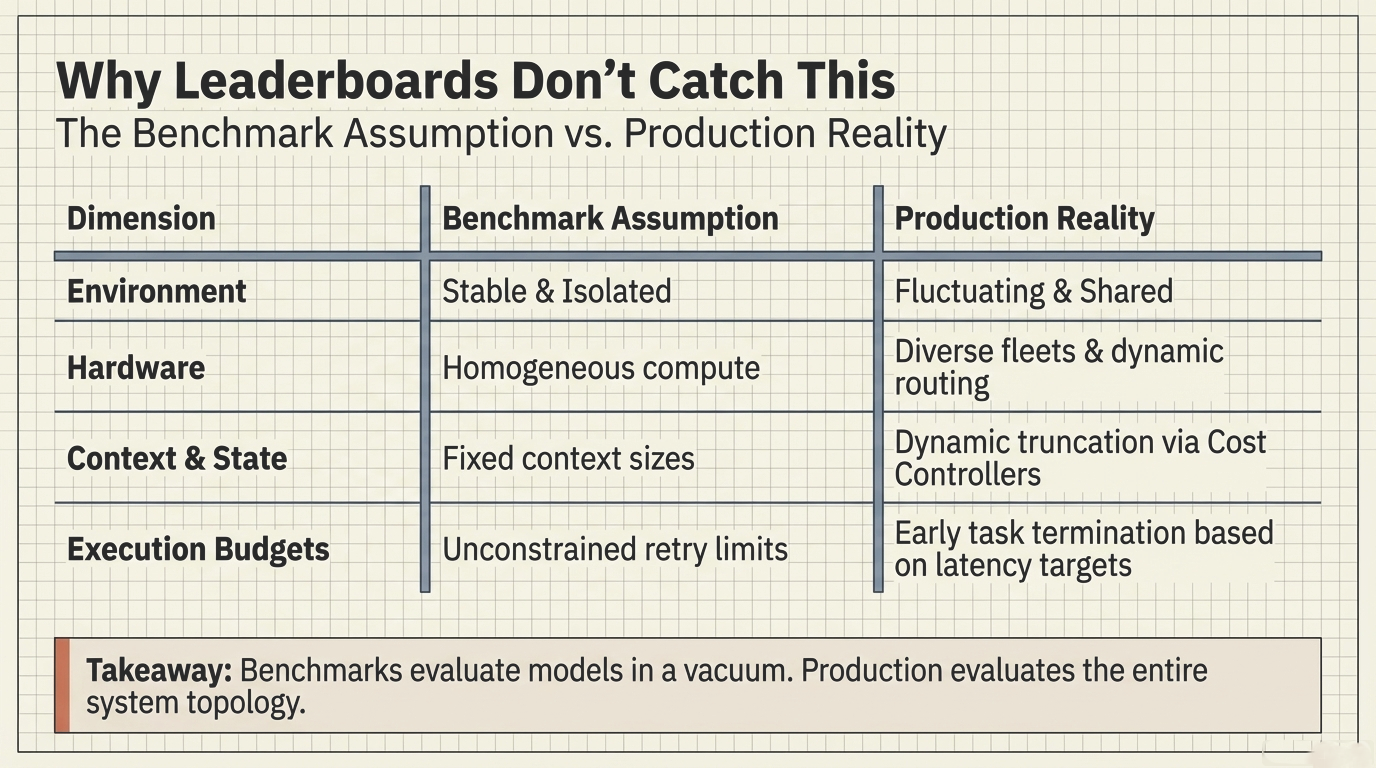
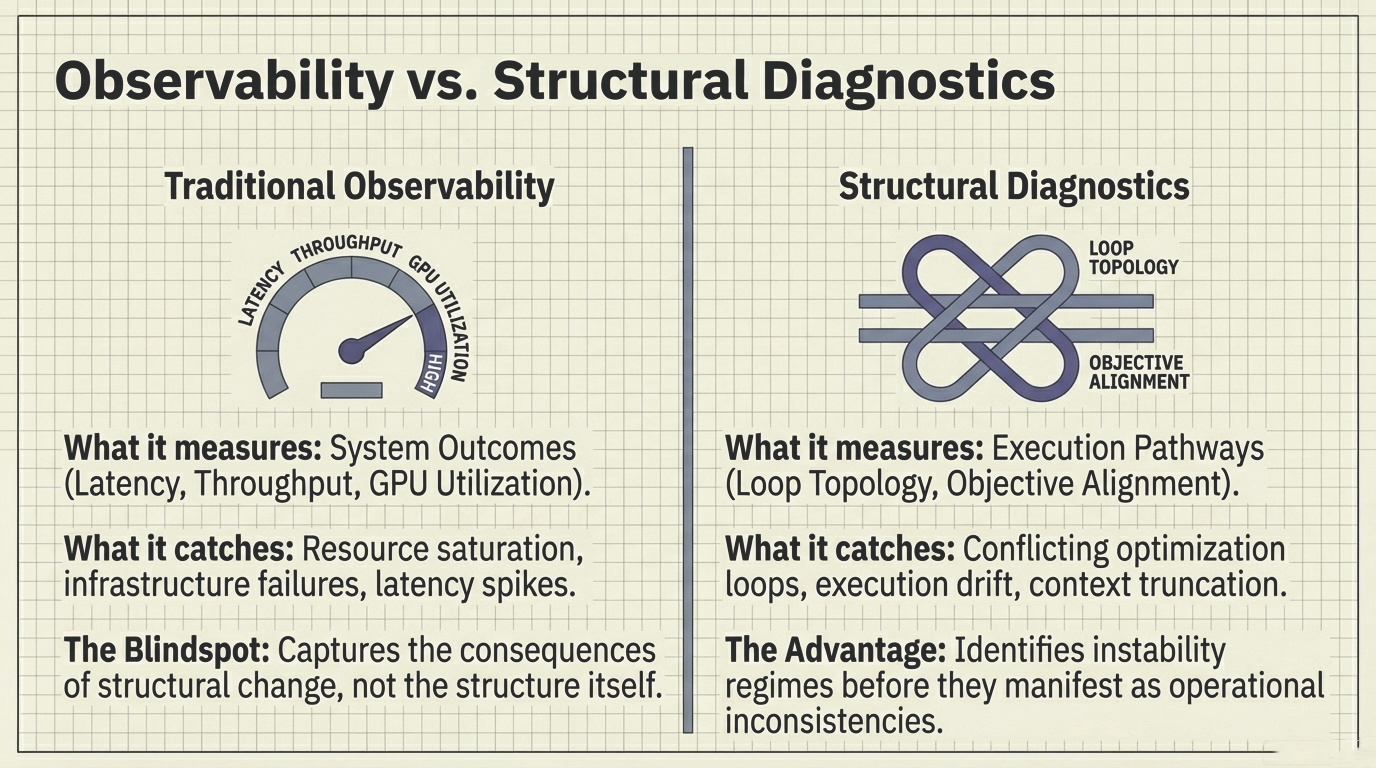
One reason the runtime control layer remains under-discussed is that it is difficult to observe directly. Most monitoring systems track outcome metrics: latency, throughput, GPU utilization, token generation rates, system uptime. These metrics describe outcomes. They rarely describe the control geometry producing those outcomes.

Why Leaderboards Don't Catch This – Benchmark assumptions versus production reality across environment, hardware, context, and execution budgets

Figure 8: Why leaderboards don't catch this—benchmarks evaluate models in a vacuum; production evaluates the entire system topology.

Evaluation benchmarks operate in stable environments where structural constraints are absent. Production environments introduce adaptive scheduling, hardware routing, and cost-aware truncation. The model that was evaluated and the system that is deployed are therefore not structurally identical—the observability gap analyzed through ai.47 Evaluation Context Projection Instability and ai.02 Structural Drift Diagnostics.

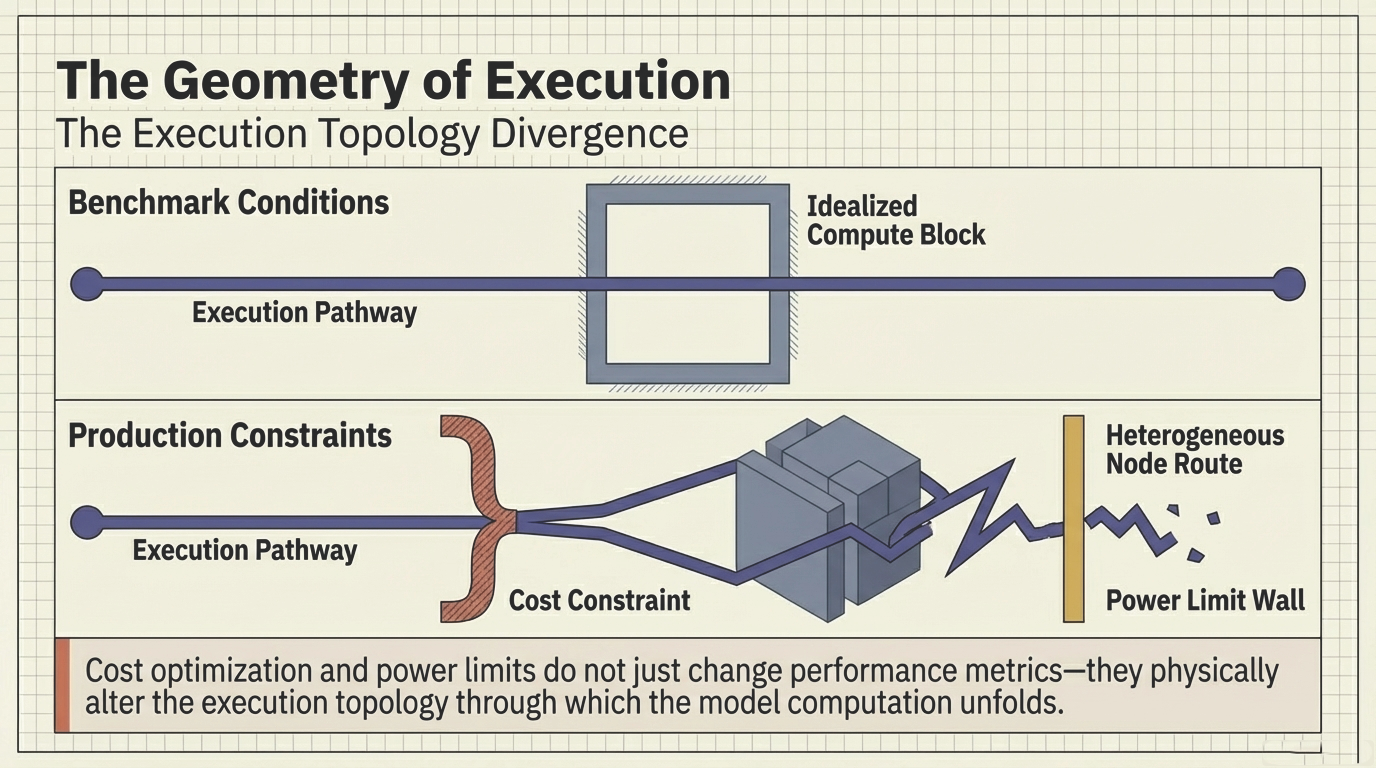
The Geometry of Execution – Benchmark conditions with idealized compute versus production constraints with cost, heterogeneous routing, and power limits

Figure 9: The geometry of execution—cost optimization and power limits physically alter the execution topology through which model computation unfolds.

The runtime control layer operates primarily through interactions between multiple optimization loops. These interactions often leave no single observable signal. Instead, they appear indirectly through changes in system behavior. A small routing adjustment may alter batching patterns. Batching changes may influence speculative decoding success rates. Autoscaling policies may alter GPU memory pressure.

Observability vs. Structural Diagnostics – Traditional observability measuring system outcomes versus structural diagnostics measuring execution pathways

Figure 10: Observability vs. structural diagnostics—traditional monitoring captures consequences of structural change, not the structure itself. Structural diagnostics identify instability regimes before they manifest as operational inconsistencies.

Structural Question

Your monitoring shows latency is stable, throughput is high, and GPU utilization is nominal. But has the execution topology through which your model computes changed in the last three months?

7. Agent Systems Amplify the Effect

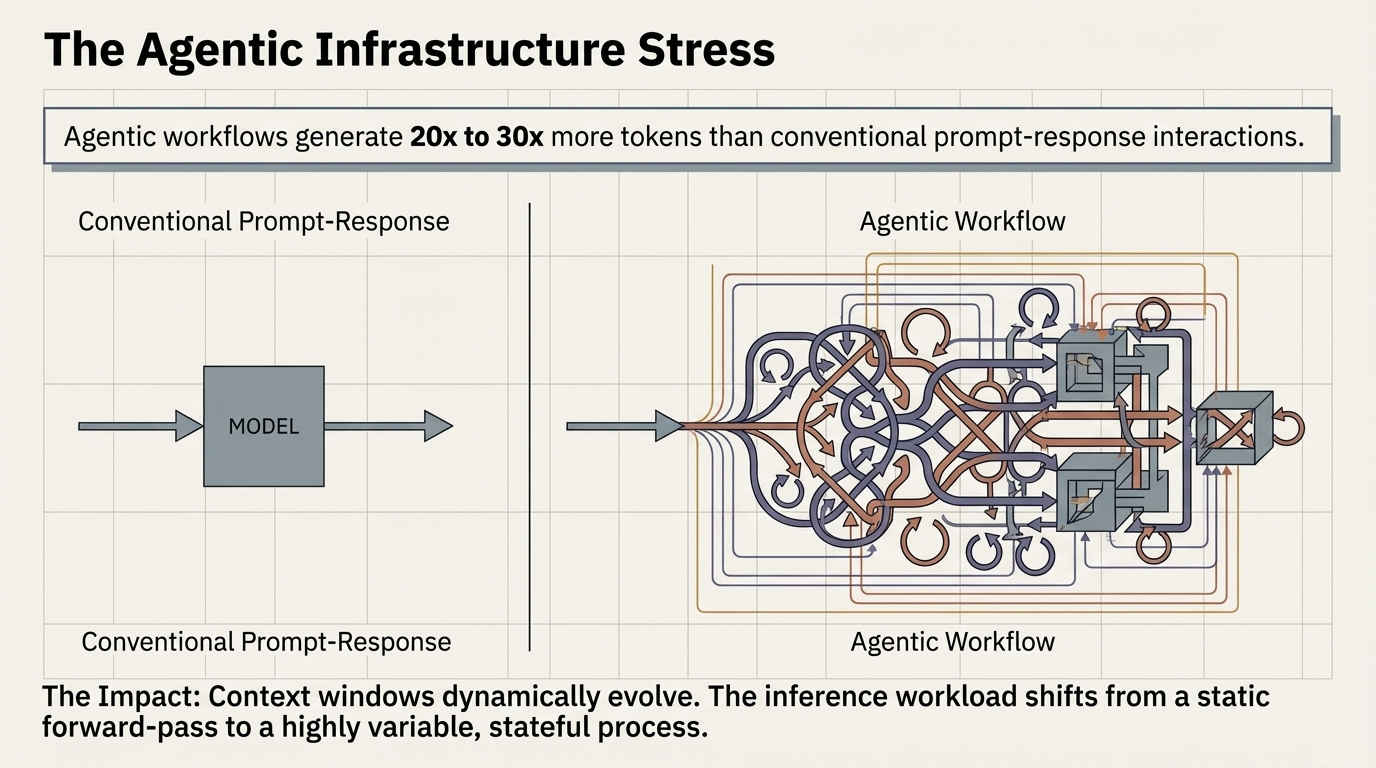
The importance of runtime control coherence becomes even more visible in emerging agent-based AI workflows. Agentic workflows generate 20× to 30× more tokens than conventional prompt-response interactions. Context windows dynamically evolve. The inference workload shifts from a static forward-pass to a highly variable, stateful process.

The Agentic Infrastructure Stress – Conventional prompt-response versus agentic workflow complexity with 20x to 30x more tokens

Figure 11: The agentic infrastructure stress—agentic workflows generate 20× to 30× more tokens, shifting inference from static forward-pass to highly variable, stateful processes.

Agent systems execute multi-step reasoning processes involving planning, tool use, iterative refinement, retry strategies, and branching exploration. These workflows generate complex request patterns. Requests may expand or contract depending on intermediate results. In such environments, the runtime control layer becomes the primary determinant of system efficiency.

Small orchestration changes can dramatically influence the behavior of the entire workflow. An estimated 40% of agentic AI projects fail before production due to unmanaged execution constraints—not model capability gaps. This is the domain of ai.13 Agentic System Stability, which provides stability control for agent workflows with retry loops, self-verification, and tool calling patterns.

Agentic Reliability Risk

Cost-Pressure Degradation in Multi-Step Workflows

Cost-pressure explicitly degrades multi-step agent workflows. Planning horizons shorten. Retry budgets tighten. Context buffers shrink. The agent remains operational, but its reasoning depth is structurally reduced—producing the impression of a “less capable” model without any model change.

8. Strategic Implications for Hyperscalers

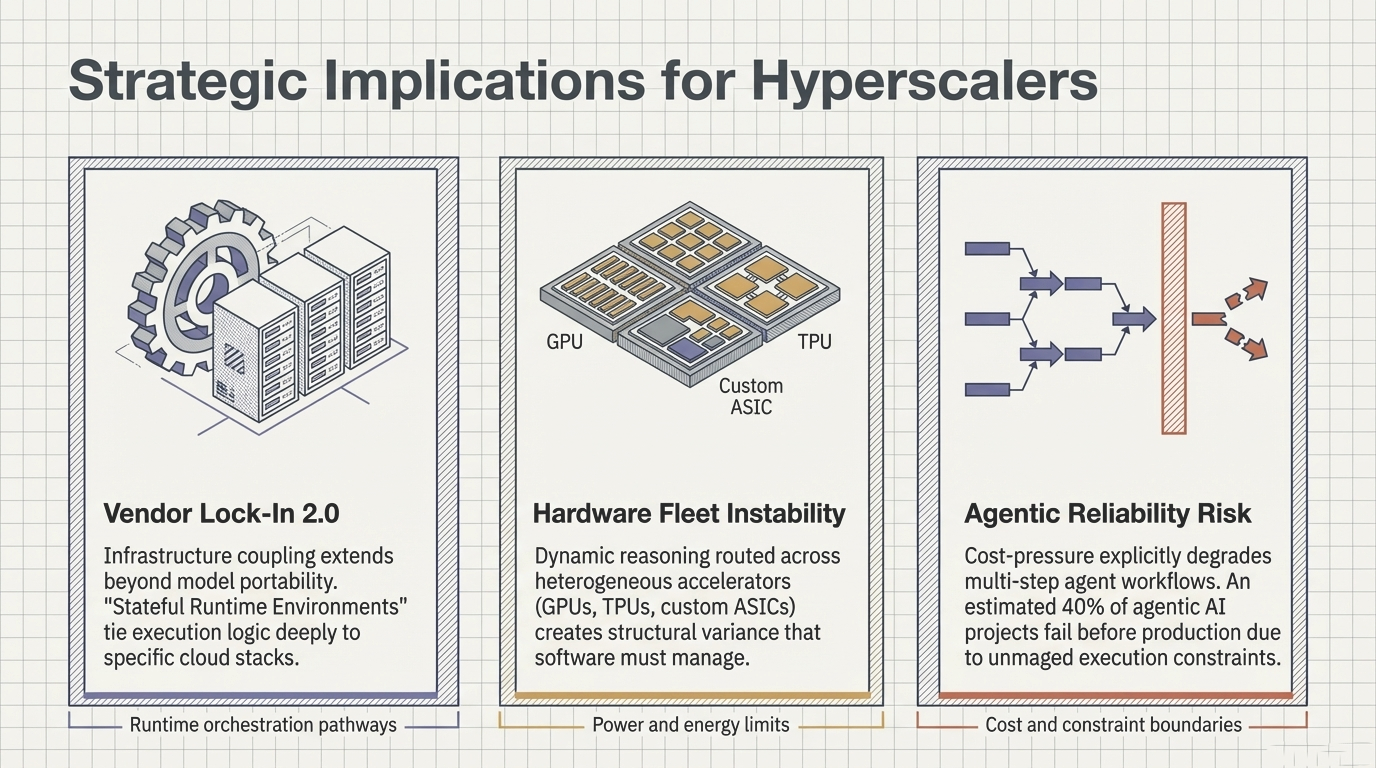
This evolution carries three strategic implications for organizations operating large-scale AI infrastructure.

Strategic Implications for Hyperscalers – Vendor Lock-In 2.0, Hardware Fleet Instability, and Agentic Reliability Risk

Figure 12: Strategic implications—vendor lock-in extends to runtime orchestration pathways, hardware diversification creates structural variance, and cost pressure degrades agentic workflows.

Implication 1

Vendor Lock-In 2.0

Infrastructure coupling now extends beyond model portability. Stateful runtime environments tie execution logic deeply to specific cloud stacks. Switching providers means re-engineering the runtime control layer, not just migrating model weights—analyzed through ai.07 Accelerator Runtime Control.

Implication 2

Hardware Fleet Instability

Dynamic reasoning routed across heterogeneous accelerators (GPUs, TPUs, custom ASICs) creates structural variance that software must manage. This is not a scheduling problem—it is an ai.01 Interconnect Stability Control problem, where cross-accelerator routing introduces behavioral variance under varying load regimes.

Implication 3

Agentic Reliability Risk

Cost-pressure explicitly degrades multi-step agent workflows. An estimated 40% of agentic AI projects fail before production due to unmanaged execution constraints. ai.13 Agentic System Stability provides the diagnostic framework for identifying where control geometry changes undermine agent reasoning depth.

9. Diagnosing Runtime Geometry

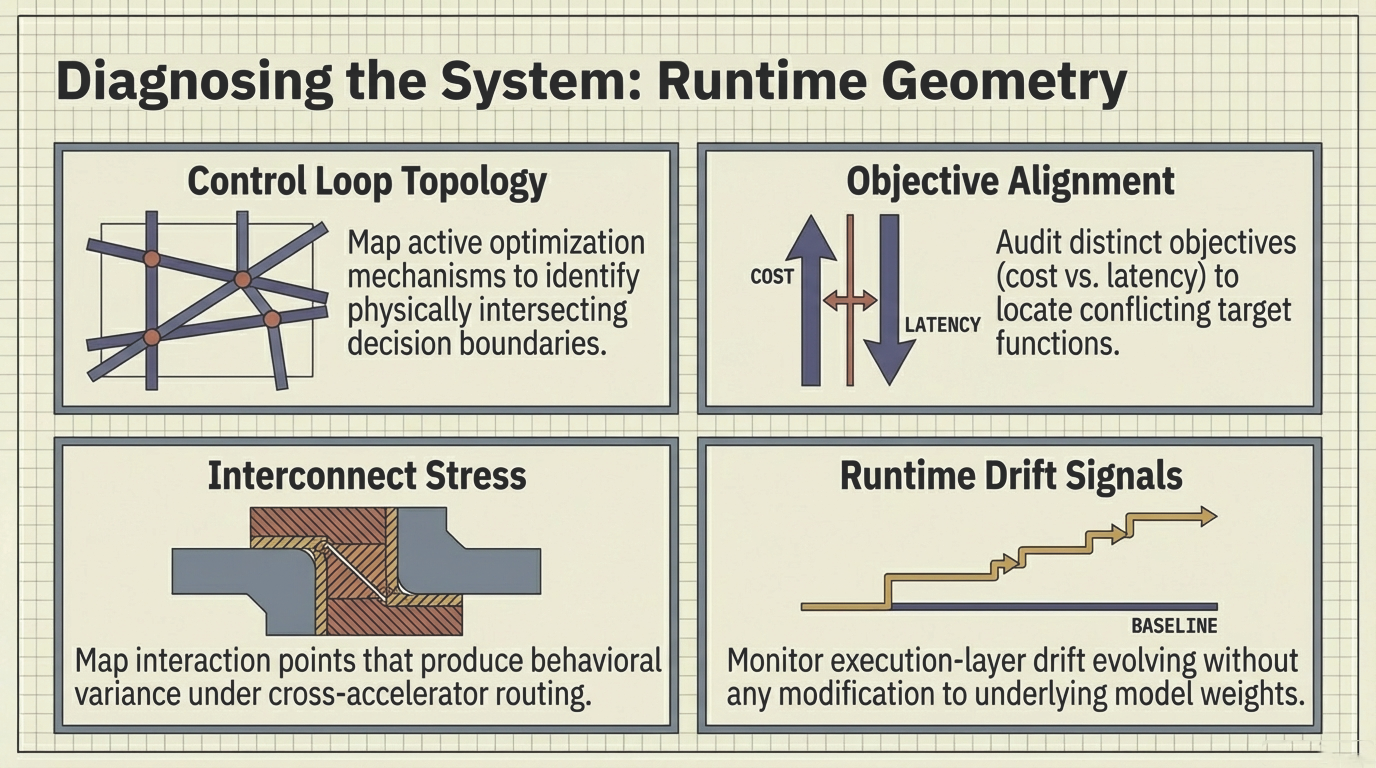
Understanding the runtime control layer requires a different diagnostic approach than traditional observability. Four structural dimensions define the diagnostic surface for runtime geometry analysis.

Diagnosing the System: Runtime Geometry – Control loop topology, objective alignment, interconnect stress, and runtime drift signals

Figure 13: Diagnosing runtime geometry—four structural dimensions: control loop topology, objective alignment, interconnect stress, and runtime drift signals.

  • Control Loop Topology – Map active optimization mechanisms to identify physically intersecting decision boundaries. Analyzed through ai.04 Runtime Control Coherence.
  • Objective Alignment – Audit distinct objectives (cost vs. latency) to locate conflicting target functions across concurrent controllers.
  • Interconnect Stress – Map interaction points that produce behavioral variance under cross-accelerator routing. Diagnosed through ai.01 Interconnect Stability Control.
  • Runtime Drift Signals – Monitor execution-layer drift evolving without any modification to underlying model weights. Detected through ai.02 Structural Drift Diagnostics.

10. The Frontier Is System Topology

This evolution suggests a broader architectural shift in large AI systems. For many years, progress in artificial intelligence was driven primarily by improvements in model capability. Today, the frontier increasingly lies in system architecture.

The interaction between models, inference infrastructure, and runtime orchestration now defines the performance envelope of large deployments. The runtime control layer is where these interactions converge. As AI systems scale further, improvements in control coherence, scheduling strategies, and infrastructure orchestration may deliver gains comparable to those achieved through model innovation itself.

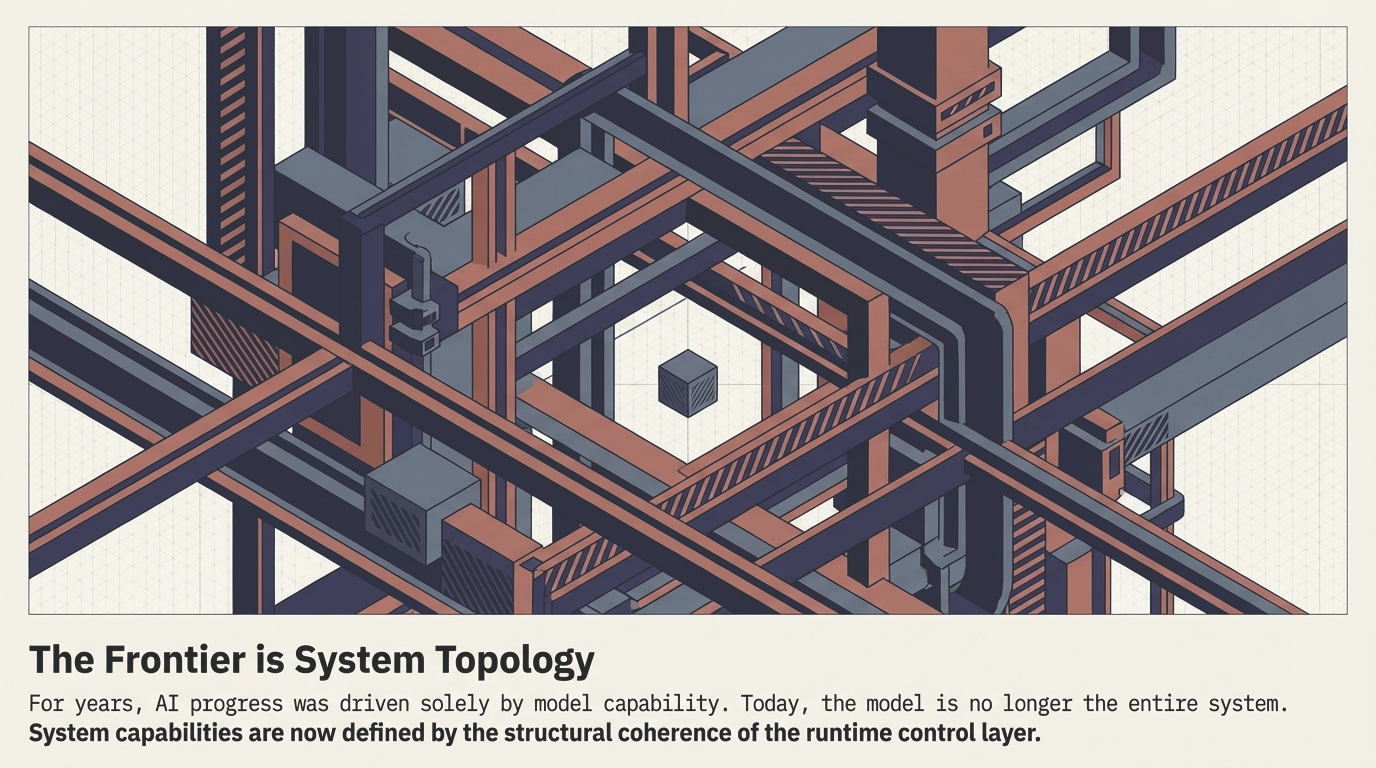
The Frontier is System Topology – System capabilities now defined by the structural coherence of the runtime control layer

Figure 14: The frontier is system topology—system capabilities are now defined by the structural coherence of the runtime control layer.
In large-scale deployments, performance is no longer determined solely by model capability. It increasingly emerges from the structure and coherence of the system surrounding the model. And much of that structure lives in the runtime control layer.
Core Research Papers

The SORT-AI applications forming the diagnostic foundation for structural analysis of runtime control coherence and system topology in inference-dominated AI systems.

AI.04 • CLUSTER C • CORE-3

Runtime Control Coherence

Diagnose and reduce incoherence between scheduler, runtime, and model control loops—the primary diagnostic for identifying how optimization loop interactions reshape system behavior.

View Application Brief → View Manuscript →
AI.01 • CLUSTER A • CORE-3

Interconnect Stability Control

Structural stability diagnostics for interconnect-induced performance collapse in distributed AI and HPC systems—diagnosing behavioral variance under cross-accelerator routing.

View Application Brief → View Manuscript →
AI.13 • CLUSTER C • CORE-3

Agentic System Stability

Stability control for agent workflows with retry loops, self-verification, and tool calling—diagnosing why agents are disproportionately affected by control geometry changes.

View Application Brief → View Manuscript →
AI.02 • CLUSTER A

Structural Drift Diagnostics

Detect structural drift across training and inference pipelines beyond metrics and telemetry—identifying execution topology changes that escape standard observability.

View Application Brief →
AI.07 • CLUSTER A

Accelerator Runtime Control

Structure-compatible control for heterogeneous hardware execution across GPU, TPU, NPU, and ASIC fleets—the vendor lock-in and fleet instability diagnostic.

View Application Brief →
AI.27 • CLUSTER C

Inference Pipeline Control Coherence

Structural coherence analysis of inference pipelines including batching, caching, and serving control loops—extending runtime coherence into the inference execution layer.

View Application Brief →

Interested in Applying SORT-AI to Your Inference Architecture?

We provide architecture risk briefings and structural diagnostics for inference-dominated AI deployments. Zero-access, zero-data methodology for pre-implementation reasoning and economic risk assessment.

Get in Contact Engagement Scope