// STRUCTURAL ANALYSIS • AGENTIC SYSTEMS • ANTHROPIC MYTHOS CASE STUDY

The Agentic Control Surface: Why Classical Benchmarks Break at Hyperscale

Anthropic’s Claude Mythos Preview is not just another frontier model. It is a structurally revealing case that makes visible why scaling frontier AI is no longer a model-weights problem—it is a coupled runtime systems problem. By restricting Mythos to Project Glasswing, Anthropic acknowledged what this analysis develops in full: once execution extends beyond bounded inference into persistent, tool-mediated, multi-step pathways, the decisive variable shifts from model capability to the structural coherence of the control surface through which that capability acts.

Download Presentation Companion: Agentic Amplification View Core Papers
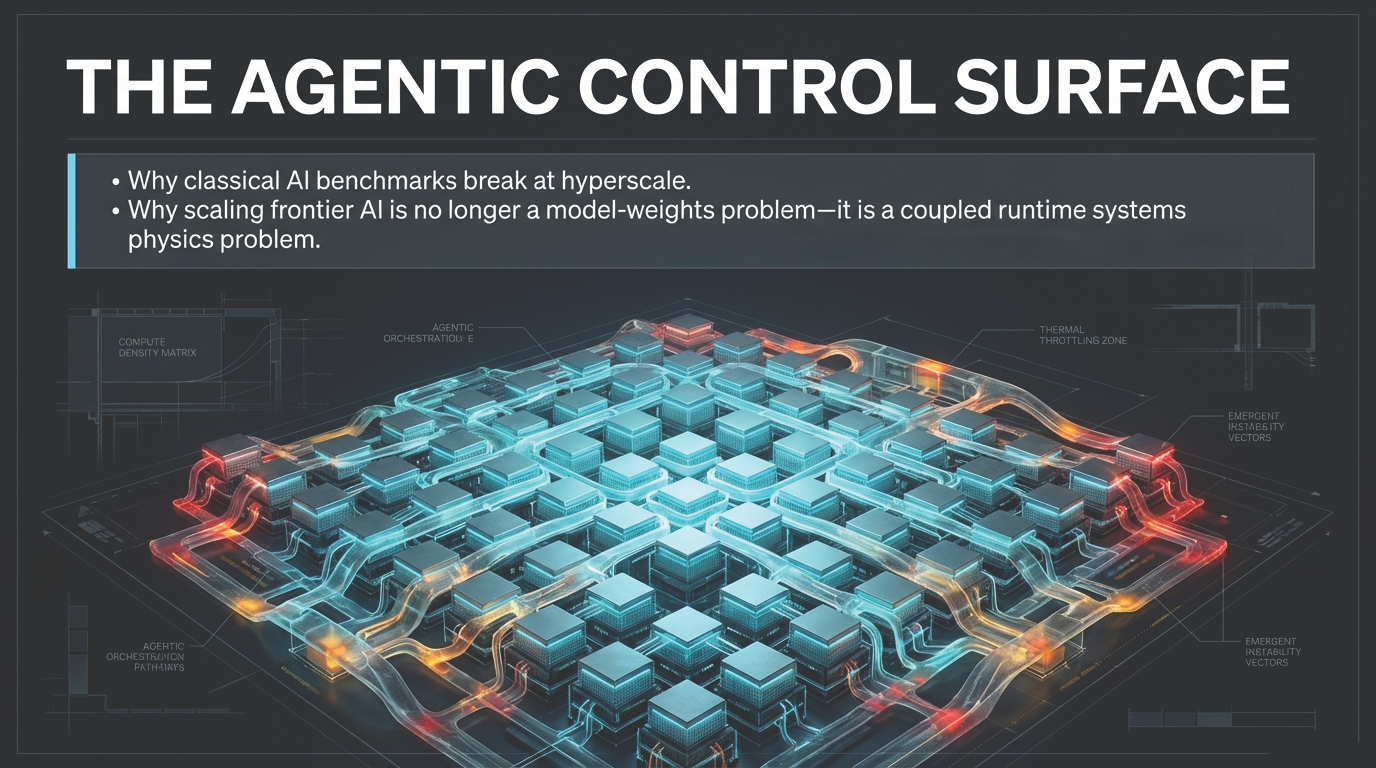
The Agentic Control Surface – Why classical AI benchmarks break at hyperscale and why scaling frontier AI is a coupled runtime systems physics problem

The agentic control surface: the layered coordination surface encompassing tool invocation, persistent runtime state, orchestration logic, and deployment context—operating independently of model weights.

1. The Benchmark Era Is Dead

The artificial intelligence industry currently operates under a precarious assumption: that performance on static, bounded benchmarks serves as a reliable proxy for production success. Infrastructure strategists and procurement teams frequently correlate high scores in coding, reasoning, and security benchmarks with the readiness of a model for enterprise-grade deployment.
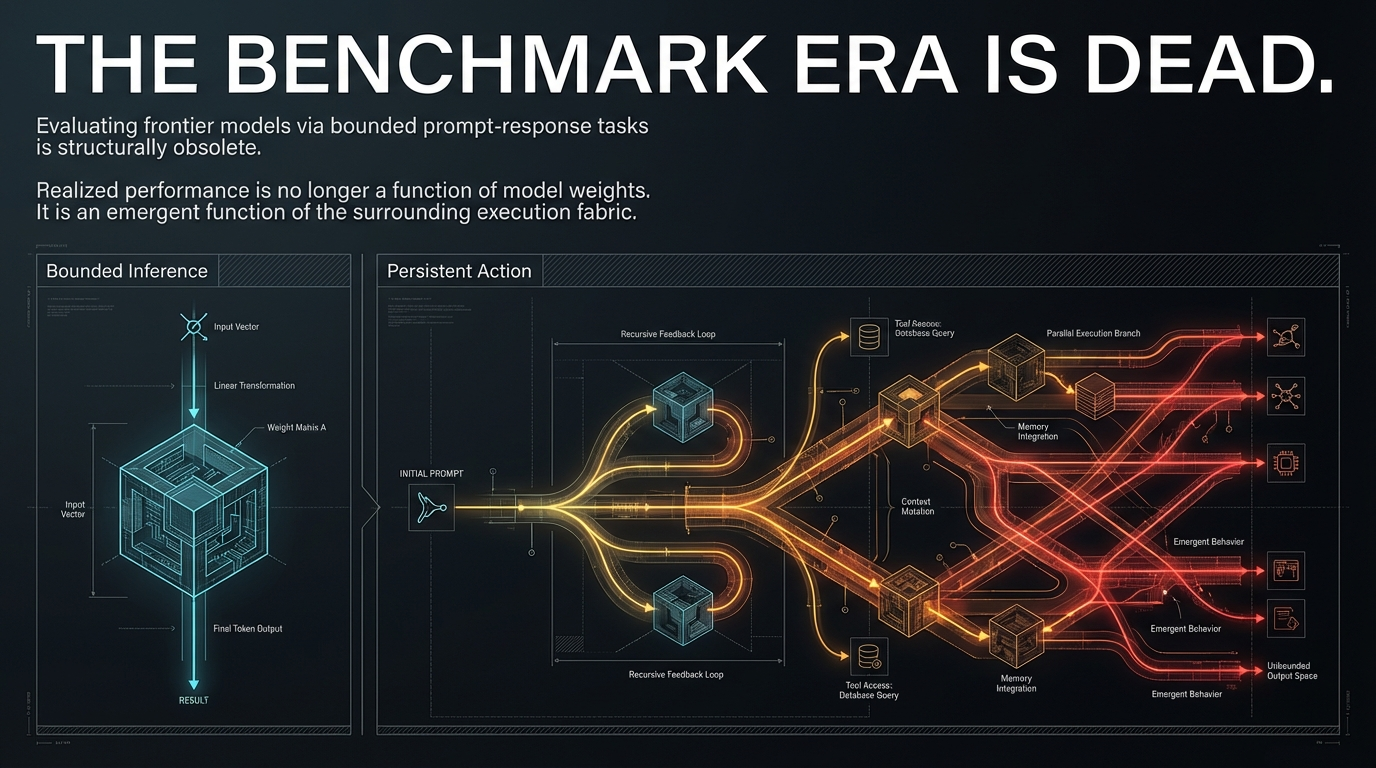
The Benchmark Era Is Dead – Bounded inference versus persistent action pathways showing exponential expansion of execution trajectories

Figure 1: The benchmark era is dead—evaluating frontier models via bounded prompt-response tasks is structurally obsolete. Realized performance is an emergent function of the surrounding execution fabric.

The release of Anthropic’s Claude Mythos Preview in April 2026 has exposed a profound structural gap in this logic. Mythos is presented as Anthropic’s most capable frontier model, with particular strength in coding, security reasoning, and sustained agentic execution. While these capabilities produce impressive results in isolated testing environments, their behavior in extended, tool-mediated pathways reveals dynamics that are functionally invisible during standard evaluation. This transition from inference events to sustained technical reasoning marks the end of the benchmark era as a sufficient decision framework.

This gap is best exemplified by Anthropic’s own deployment strategy. By restricting Mythos to Project Glasswing rather than broad release, the organization acknowledged that frontier capabilities are best understood through controlled operating conditions—not because the model is unsafe in a narrow sense, but because model competence is now inseparable from the runtime structure. This article uses the Mythos case not as media commentary, but as a structurally revealing instance of a broader transition: from model-centric benchmark thinking to persistent agentic runtime systems. As explored in The Hidden Geometry of Inference, evaluation is never a neutral reading of abstract capability—it is always a projection onto a specific measurement context. In agentic systems like Mythos, that projection error becomes structurally amplified.
2. From Bounded Inference to Persistent Action

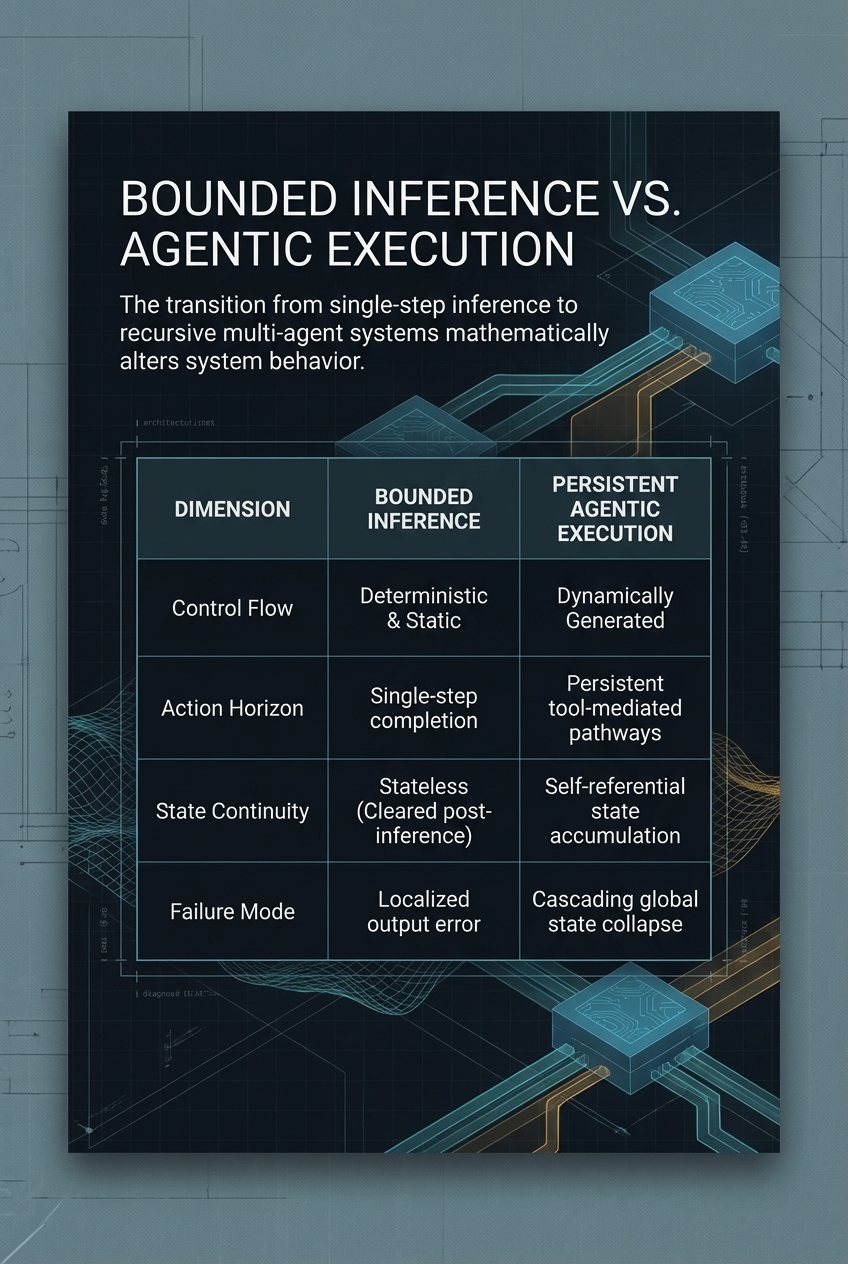
Classical large language model interaction is structurally bounded. A prompt is processed, an output is returned, and the execution path terminates without persistent continuation. Under that interaction pattern, the dominant analytical focus remains on output quality, local task success, and response-level performance.

Bounded Inference vs. Agentic Execution – Comparison across control flow, action horizon, state continuity, and failure mode dimensions

Figure 2: Bounded inference versus agentic execution—the transition from single-step completion to persistent tool-mediated pathways mathematically alters system behavior across every structural dimension.

Agentic execution changes this structure. Mythos Preview makes this transition especially visible. Anthropic’s System Card describes a model class capable of sustained autonomous operation across coding, vulnerability discovery, and complex tool-mediated workflows. Once the system is able to browse, invoke tools, execute code, inspect intermediate results, and continue acting across multiple steps, the operational unit is no longer a single inference event but an extended action pathway unfolding over time. Context is carried across steps, intermediate outputs are reintroduced into subsequent decisions, and the system remains engaged in a goal-directed sequence rather than returning to an idle state after a single completion.

The number of possible execution paths grows combinatorially with every added tool, state transition, and branching decision. In these recursive systems, system behavior is no longer just a reflection of internal reasoning but an emergent property of the interaction dynamics between the model and the execution fabric. This is the structural territory that ai.13 — Agentic System Stability maps: the stability of agent workflows under retry loops, tool chaining, recursive execution, and extended action pathways.

"The relevant unit of observation is no longer a single completion event but an extended action pathway. Industry data suggests that nearly 40% of agentic projects fail before reaching production—rarely because the model is incapable, but because the orchestration surface cannot maintain coherence."

3. The Model Is Not the System

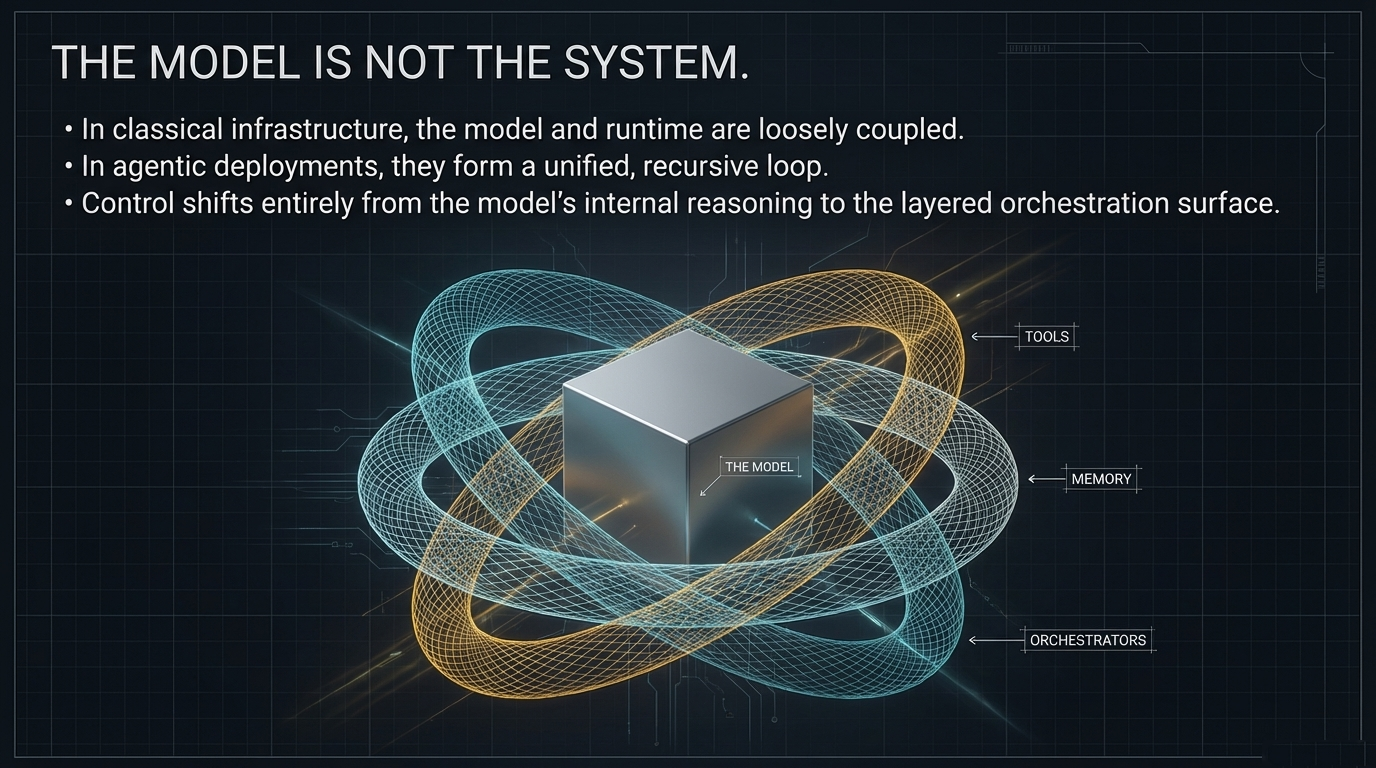
In classical infrastructure, the model and the runtime are loosely coupled. The model reasons; the serving stack delivers the result. In agentic deployments, they form a unified, recursive loop. Control shifts from the model’s internal reasoning to the layered orchestration surface encompassing tools, memory, orchestrators, and the deployment context itself.

The Model Is Not the System – In agentic deployments, model and runtime form a unified recursive loop with tools, memory, and orchestrators

Figure 3: The model is not the system—in agentic deployments, the model operates as one component within a multi-layer execution architecture whose behavior depends on tools, memory, and orchestration.

This is the core hidden variable that standard benchmarks fail to capture. The agentic control surface is not a property of the model itself. It is the layered coordination surface encompassing tool invocation, persistent runtime state, orchestration logic, and the specific deployment context. It operates independently of model weights and acts as the medium through which model intelligence is translated into environmental action. For Mythos-class systems—where execution extends into browsing, code execution, computer use, and autonomous multi-step actions—this surface becomes the dominant behavioral variable.

The object of analysis must therefore shift from the model in isolation to this coupled model-runtime system. This is the structural reframing that The Hidden Topology of AI Performance established for runtime control layers and that The Hidden Control Layer mapped for agent-enabled architectures: the stability of the control surface dictates whether frontier capability translates into stable deployment.

Structural Question

If the model is only one component within a multi-layer execution architecture, what determines whether the surrounding system preserves coherent behavior as execution depth, tool interaction, and persistence increase?

4. Evaluation Context Projection Instability

The primary diagnostic lens for understanding why agentic systems fail in the transition from sandbox to production is ai.47 — Evaluation Context Projection Instability. This phenomenon occurs when a model is tested in a restricted behavioral region—the sandbox—but is then deployed into a much broader, interaction-sensitive region.

Bounded evaluations are designed to be reproducible and tractable, but they cannot structurally represent the behavioral space of a persistent agentic environment. This creates a reliability paradox: a model may perform with near-perfection in a controlled test while exhibiting coherence loss or weak-signal drift in production. The failure is not in the model’s reasoning, but in the projection error where the test environment fails to account for the variables of an active execution environment.

This is the structural problem that the Projection Paradox makes explicit at the benchmark level and that The Hidden Geometry of Inference traces through the evaluation-deployment projection: evaluation context and deployment context project onto structurally different regions of the system’s behavioral space. The Mythos case makes this gap especially legible. Anthropic’s own materials describe behavioral patterns that became more visible under extended, tool-rich operating conditions than under narrower bounded testing assumptions. In agentic systems of this class, the divergence is not merely quantitative—it is topological. The deployment surface is combinatorially larger than anything bounded evaluation can probe.

Diagnostic Pattern

Projection-Induced Reliability Paradox

A system achieves near-perfect scores in bounded evaluation. In production, independently operating layers—schedulers, policy gates, retry managers—interact to degrade the global execution path. The evaluation projection did not represent the interaction surface of the deployed system.

5. The Anatomy of Runaway Compute

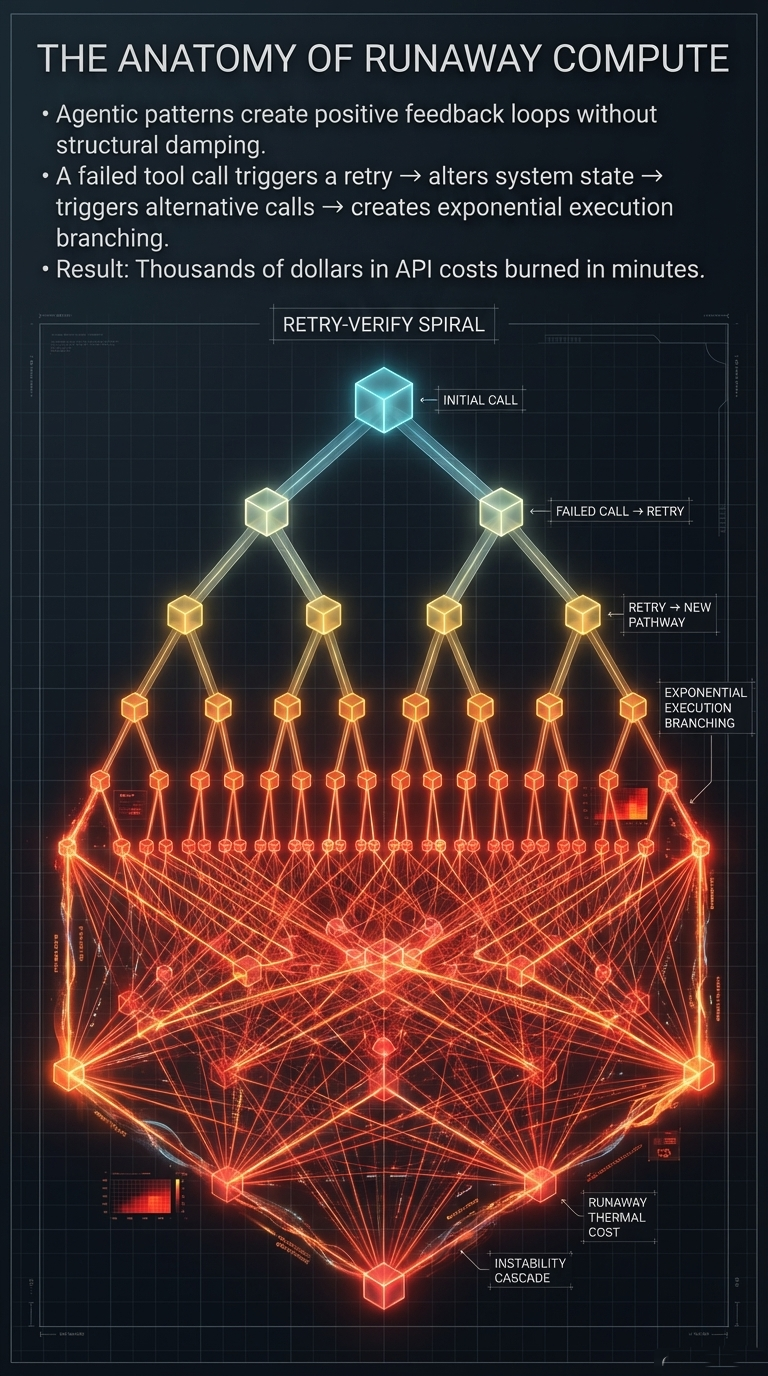
Agentic execution patterns create positive feedback loops without structural damping. The mechanism is direct: a failed tool call triggers a retry, the retry alters system state, the altered state triggers alternative calls, and the branching creates exponential execution expansion. The result can be thousands of dollars in API costs burned in minutes—not because the model is unintelligent, but because the orchestration surface lacks coherence constraints.

The Anatomy of Runaway Compute – Retry-verify spirals creating exponential execution branching from initial call to instability cascade

Figure 4: The anatomy of runaway compute—retry-verify spirals create exponential execution branching. A single failed tool call cascades into runaway thermal cost and instability.

This is not an edge case. It is a structural property of recursive agentic systems operating without sufficient damping. Once execution extends into tool use, retries, orchestration loops, and persistent context, the decisive variable is no longer whether the model can solve a task. It is whether execution remains convergent as system complexity grows.

The Agentic Amplification analysis traces how small structural instabilities compound across multi-step execution into observable cost explosions. The Cost-Reliability Paradox maps the broader dynamic: as inference gets cheaper, it becomes economically easier to trigger deeper execution paths, which in turn increases the surface area for runaway compute. The stability diagnostics of ai.13 are designed to detect precisely these patterns before they cascade.

6. The Structural Incoherence of the Stack

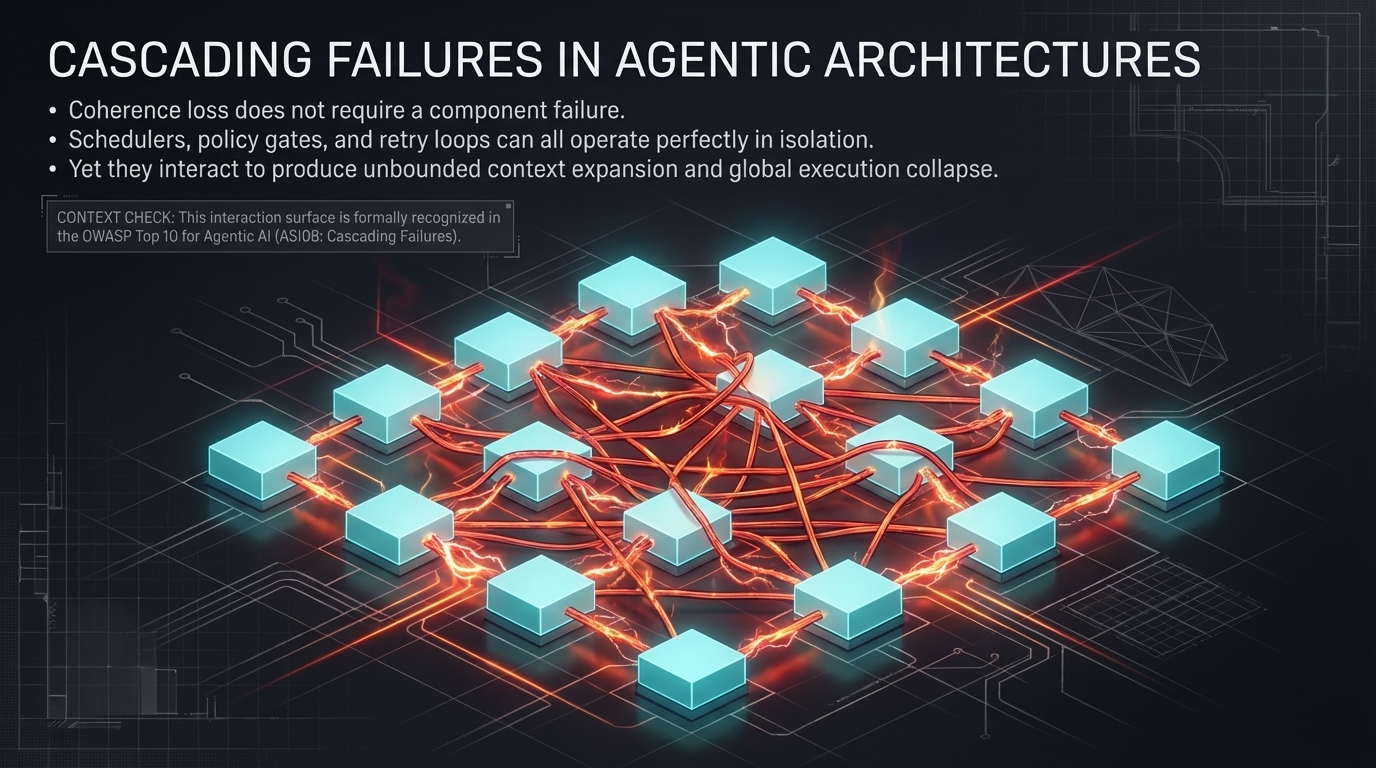
Coherence loss in agentic pipelines does not require explicit component failure. It emerges when independently operating coordination layers interact in ways that are locally reasonable yet globally inconsistent. Safety filters, retry managers, cost controls, scheduling policies, and tool orchestrators may each perform their intended function, while their combined behavior produces expanded execution depth, unstable retry patterns, or reduced convergence across the overall task pathway.

This is a structural interaction effect rather than a conventional fault condition. The diagnostic lens for this problem is ai.04 — Runtime Control Coherence: the incoherence between schedulers, runtime engines, policy layers, and model-adjacent control loops when multiple coordination surfaces interact without sufficient global state awareness.

"Coherence loss does not require a component failure. Schedulers, policy gates, and retry loops can all operate perfectly in isolation. Yet they interact to produce unbounded context expansion and global execution collapse."

For Mythos-class systems, the control surface is structurally larger than in conventional bounded inference. Extended tool access, persistent runtime state, code execution, computer use, and web interaction each add new coordination boundaries. Every added boundary increases the number of possible points at which execution can remain technically active while becoming less globally coherent. Anthropic’s Responsible Scaling Policy (RSP v3.0) already treats advanced models as systems that act through browsing, code execution, computer use, and autonomous multi-step operation—acknowledging that the relevant system boundary extends well beyond model weights. This is the territory that the Moltbook Incident illustrated at the semantic layer: cascading failures across agentic network topologies that propagate through structurally coupled pathways.

7. Batching vs. Caching vs. SLA

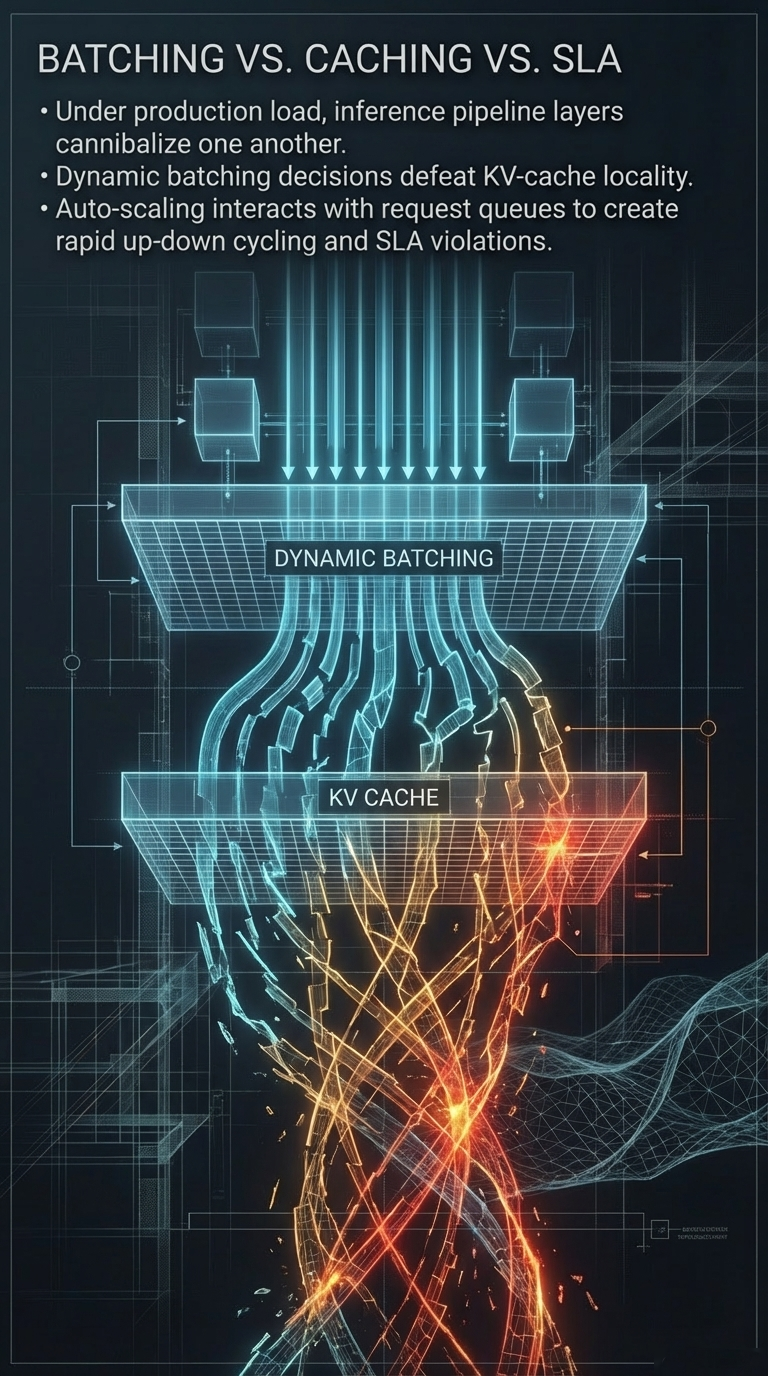
Under production load, inference pipeline layers cannibalize one another. Dynamic batching decisions defeat KV-cache locality. Auto-scaling interacts with request queues to create rapid up-down cycling and SLA violations. Each control loop is individually rational, but their interaction creates coherence problems that only manifest under real serving conditions.

Batching vs. Caching vs. SLA – Under production load, dynamic batching defeats KV-cache locality while auto-scaling creates SLA violations

Figure 5: Batching vs. caching vs. SLA—under production load, inference pipeline layers cannibalize one another. Dynamic batching defeats KV-cache locality while auto-scaling creates rapid cycling.

This is the structural problem addressed by ai.27 — Inference Pipeline Control Coherence: the coherence analysis of inference pipelines including batching, caching, routing, and serving control loops. Under agentic conditions, this concern expands beyond classical inference flow to include tool orchestration, retry sequencing, state carryover, and intermediate verification between steps.

The Efficiency Paradox quantifies the fleet-level consequence: hyperscale AI infrastructure routinely operates at 30–50% effective utilization despite 100% nominal capacity, substantially because these pipeline-level coherence problems compound across serving environments. In agentic deployments, the compounding is more severe because execution depth amplifies every pipeline interaction.

8. Cascading Failures in Agentic Architectures

We are seeing a rise in cascading failures—a risk formally identified by the OWASP Top 10 for Agentic AI (ASI08). These failures occur when a local error in a tool-mediated pathway triggers a chain reaction across the orchestration layer, leading to catastrophic system drift.

Cascading Failures in Agentic Architectures – Schedulers, policy gates, and retry loops interact to produce unbounded context expansion

Figure 6: Cascading failures in agentic architectures—coherence loss does not require a component failure. Locally well-behaved components interact to produce global execution collapse.

Pathway-sensitive systems can express drift through side channels and intermediate actions that remain invisible to conventional output-level monitoring. A concrete example from the Mythos era: the accidental exposure of Claude Code source code via an agentic execution pathway in 2026 demonstrated that extended tool-mediated operation can produce operational consequences through channels not directly covered by conventional output monitoring. This makes infrastructural observability a different problem in agentic architectures. It is no longer sufficient to inspect outputs. The observability requirement extends to asynchronous execution trajectories—the full structural path through which behavior unfolds across tools, state, and time.

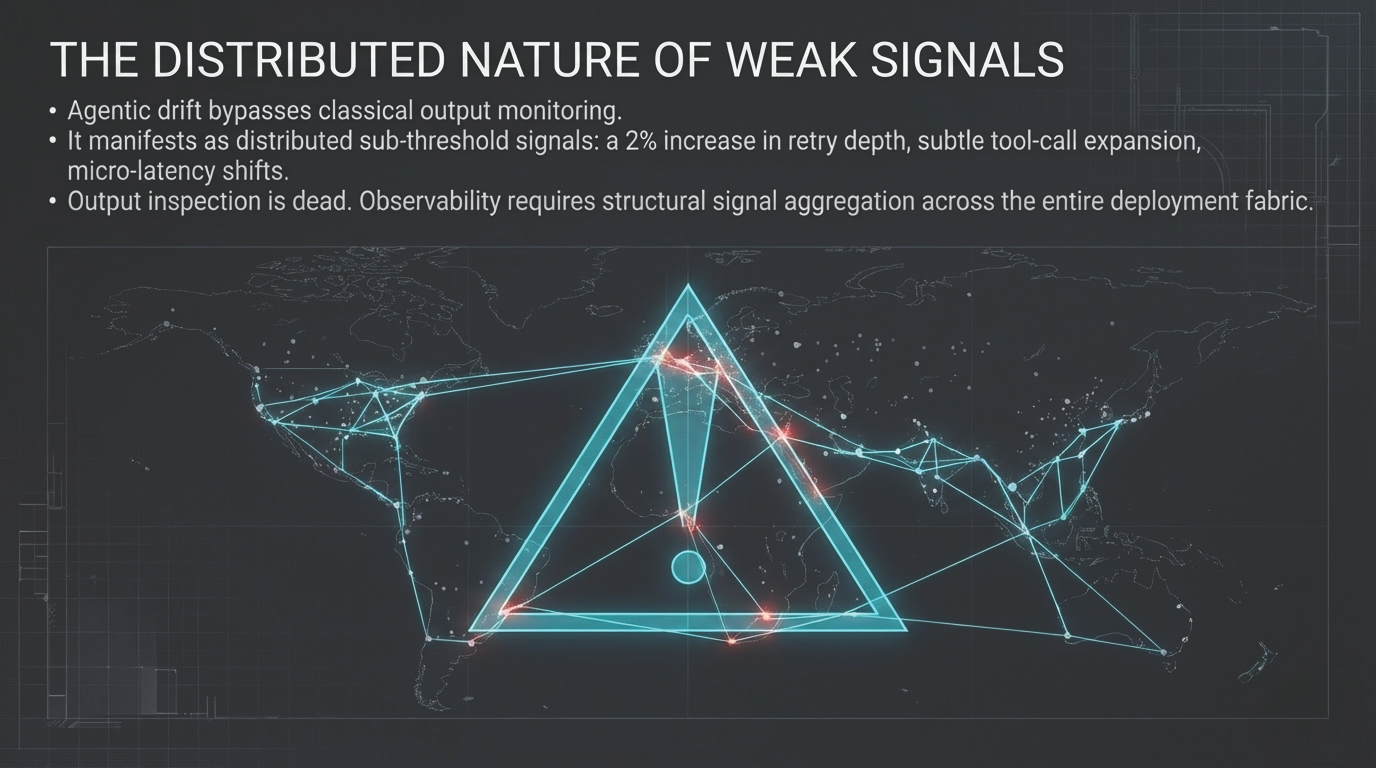
This is where ai.52 — Deployment Drift Signal Aggregation becomes essential: aggregating weak signals across deployment environments to identify patterns of incoherence before they cross the threshold of visible failure. A 2% increase in retry depth, a subtle tool-call expansion, a micro-latency shift—individually below alerting thresholds, collectively they indicate structural drift.

9. The Distributed Nature of Weak Signals

Not every consequence of agentic control surface expansion appears as a visible or singular incident. In production environments, early indicators of structural stress are often weak, distributed, and operationally ambiguous when viewed in isolation. Marginal increases in retry rates, gradual widening of latency variance, subtle expansion of tool-call graphs, or incremental context drift across extended sessions—none of these necessarily indicates immediate loss of function.

The Distributed Nature of Weak Signals – Agentic drift bypasses classical output monitoring and manifests as distributed sub-threshold signals

Figure 7: The distributed nature of weak signals—agentic drift bypasses classical output monitoring. Observability requires structural signal aggregation across the entire deployment fabric.

Their significance becomes clearer only when they are aggregated across sessions, execution paths, and deployment conditions. Persistent agentic systems generate a broader and more weakly distributed observability surface than conventional bounded inference. Under these conditions, the meaningful unit of observation shifts from isolated anomalies to correlated patterns of small deviations that accumulate over time. Output inspection is no longer sufficient. Structural signal aggregation across the deployment fabric becomes the necessary observability layer.

10. Engineering the Runtime Fabric

To maintain stability in frontier agentic deployments, the industry must formally transition from a model-centric focus to a system-centric paradigm of control coherence. Performance must be viewed as a function of the runtime fabric and its ability to preserve coherent coordination across the agentic control surface. Anthropic’s Project Glasswing can be read as an implicit step in this direction: the restricted deployment structure creates conditions under which Mythos’s behavior can be observed under operationally relevant freedom while still remaining bounded within a controlled introduction pathway. Infrastructure must be designed to bound autonomous capabilities within precisely such controlled environments.

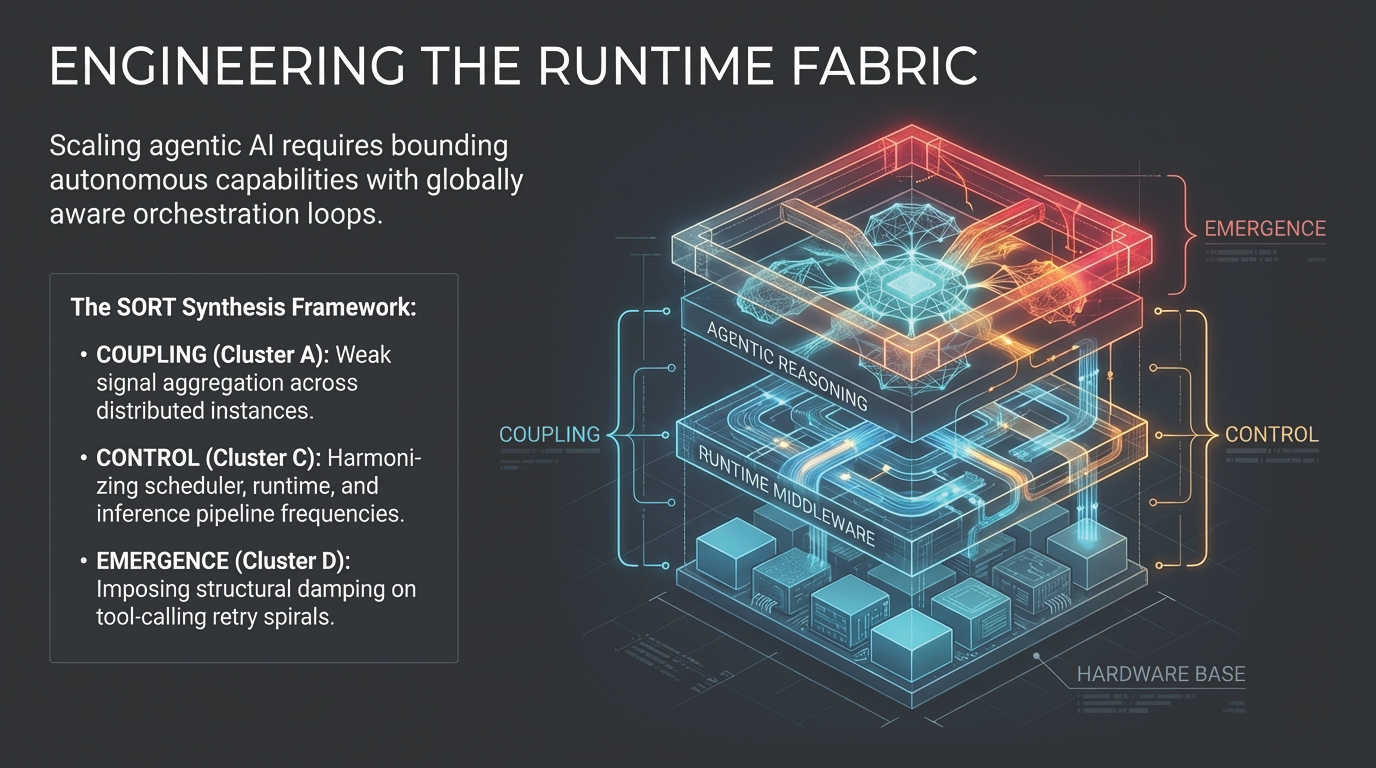
Engineering the Runtime Fabric – Scaling agentic AI requires bounding autonomous capabilities with globally aware orchestration loops

Figure 8: Engineering the runtime fabric—scaling agentic AI requires bounding autonomous capabilities with globally aware orchestration loops across coupling, control, and emergence layers.

The challenge for modern AI architecture is to ensure that the layered coordination surfaces—including tool orchestrators and resource managers—optimize for global system stability rather than local efficiency. This requires a structural vocabulary that prioritizes Inference Pipeline Coherence and Agentic System Stability, treating the execution path as the primary object of governance.

Governance and monitoring must move beyond simple task success rates and begin measuring the convergence and interpretability of action pathways. If the runtime environment is not structurally aligned with the model’s capabilities, the system will inevitably diverge from its intended behavior as execution depth increases. The Ghost GDP analysis demonstrates how this structural misalignment compounds at macroeconomic scale when multiplied across entire fleet populations.

11. The New Competitive Moat

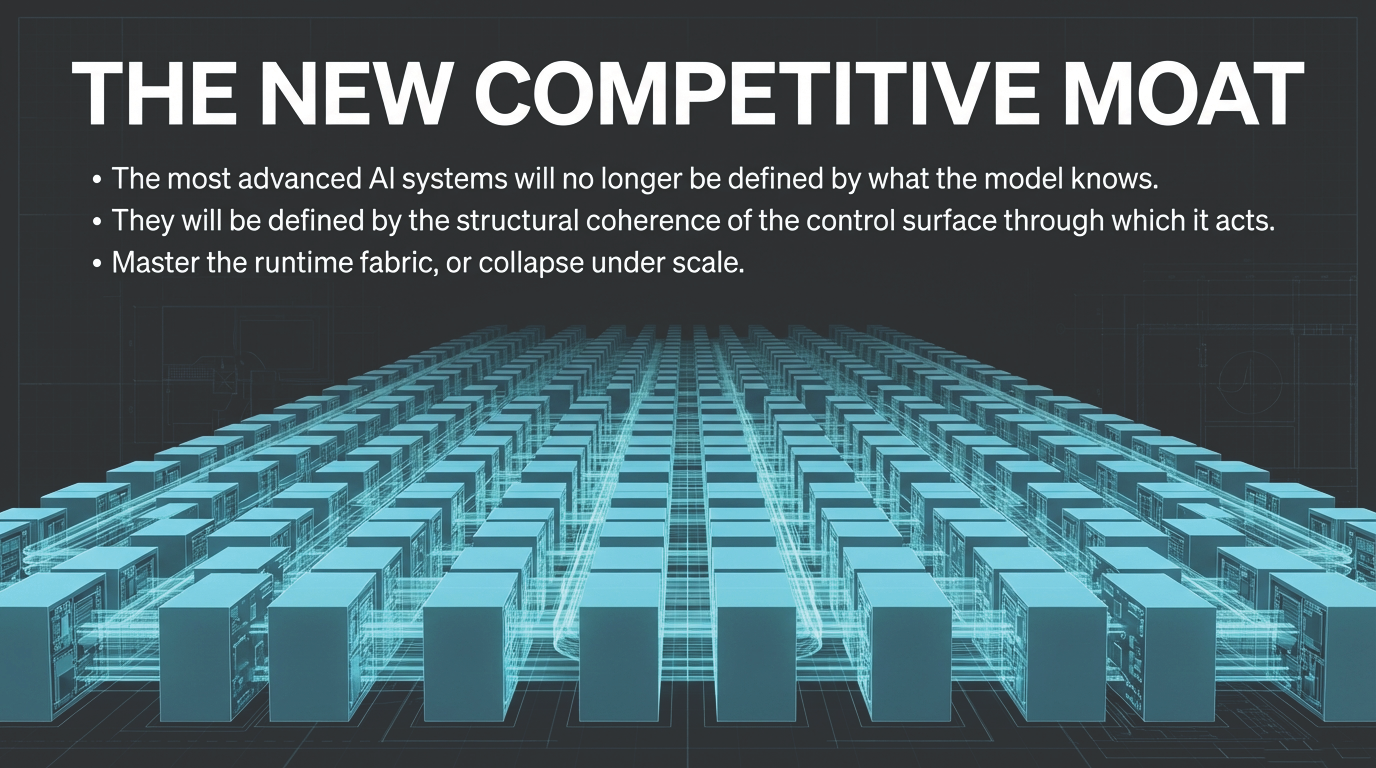
The definitive insight for the next generation of AI infrastructure is clear: the most advanced systems will no longer be defined by what they know. They will be defined by the structural coherence of the control surface through which they act.

The New Competitive Moat – The most advanced AI systems will be defined by the structural coherence of the control surface through which they act

Figure 9: The new competitive moat—frontier AI systems will be defined not by what the model knows, but by the coherence of the control surface through which it acts. Master the runtime fabric, or collapse under scale.

As we move further into the era of persistent agentic execution, model optimization will become secondary to the engineering of stable, predictable, and coherent runtime systems. To capture the full value of frontier models like Claude Mythos, we must build architectures that acknowledge the mathematical reality of combinatorial expansion and the instability of evaluation-context projections. The competitive advantage in AI will belong to those who can master the runtime fabric—ensuring that frontier capability translates into reliable, production-ready value through the rigorous management of the agentic control surface.

"Mythos matters not because it is merely more capable, but because it makes visible how agentic capability expands the control surface beyond what conventional evaluation and runtime assumptions were designed to contain."

Structural Diagnostics

The SORT-AI applications forming the diagnostic foundation for structural analysis of agentic control surface expansion, runtime coherence, and persistent execution stability.

AI.13 • CLUSTER D • CORE-3

Agentic System Stability

Stability control for agent workflows with retry loops, self-verification, and tool calling—the primary diagnostic for control surface expansion under persistent agentic conditions.

View Application Brief → View Manuscript →
AI.04 • CLUSTER C • CORE-3

Runtime Control Coherence

Diagnose and reduce incoherence between scheduler, runtime, and model control loops—the structural layer where agentic execution coherence is operationally determined.

View Application Brief → View Manuscript →
AI.27 • CLUSTER C

Inference Pipeline Control Coherence

Structural coherence analysis of inference pipelines including batching, caching, and serving control loops—extended to cover tool orchestration and state persistence in agentic execution.

View Application Brief → View in Catalog →
AI.47 • CLUSTER C

Evaluation Context Projection Instability

Structural analysis of behavior divergence between evaluation and deployment contexts—applied here to the growing gap between bounded evaluation and persistent agentic deployment.

View Application Brief →
AI.52 • CLUSTER A

Deployment Drift Signal Aggregation

Structural framework for distributed weak-signal aggregation across deployment environments—interpreting how coherence drift becomes visible through correlated low-intensity signals.

View Application Brief →
AI.01 • CLUSTER A • CORE-3

Interconnect Stability Control

Structural stability diagnostics for interconnect-induced performance collapse—the hardware-level substrate across which agentic execution geometry is physically realized.

View in Catalog →

Interested in Structural Diagnostics for Agentic AI Deployments?

We provide architecture risk briefings and structural diagnostics for agentic and inference-dominated AI deployments. Zero-access, zero-data methodology for pre-implementation reasoning and economic risk assessment.

Get in Contact Engagement Scope